Articles
Your Guide to Outsourced Data Entry Services
At its most basic, outsourcing data entry means you're hiring a specialized firm to handle your company's data-heavy tasks. Instead of your own team getting bogged down manually keying in information from invoices, receipts, or client forms, a dedicated external team does it all for you. This simple shift can save an enormous amount of time and money.
What Are Outsourced Data Entry Services Anyway?

Let's think of your business like a professional kitchen. Your top chefs—the sales, marketing, and strategy folks—are focused on creating incredible dishes that keep customers coming back. But what about all the prep work? The endless chopping, dicing, and organizing. That’s your data entry. It’s absolutely essential, but it pulls your best people away from the work that actually grows the business.
Outsourced data entry services are your dedicated prep cooks. They step in to handle all that tedious but vital work, making sure your star players have everything they need, right when they need it. Your team gets to focus squarely on innovation and customer-facing work, not administrative grind.
How It Works in Practice
It's pretty straightforward. Rather than paying a full-time employee to spend their day typing numbers from PDFs into a spreadsheet or updating your CRM, you partner with an outside provider. These firms are built for one thing: processing huge amounts of information with speed and accuracy.
For a lot of businesses, especially in the accounting and bookkeeping world, this isn't just about cutting costs anymore. It's a strategic move to get faster, more accurate, and just plain better at handling the mountains of data we all face.
This partnership immediately frees up your internal team to tackle more valuable projects. Your accountant, for example, can finally stop the manual data input and start doing the deep financial analysis that actually helps you make smarter decisions. It's no wonder the global market for these services is expected to hit $578.62 million by 2033—it's a clear sign of how businesses are evolving.
Who Benefits the Most?
Just about any business drowning in paperwork can see a big win here, but some roles feel the relief almost instantly. These services are a game-changer for:
- Bookkeepers and Accountants: They can offload the mind-numbing task of processing every single invoice, receipt, and bank statement. This frees them up for high-level financial advising and strategic planning.
- E-commerce Businesses: Think about managing massive product catalogs, processing thousands of daily orders, and keeping inventory levels perfect. Outsourcing turns a chaotic process into a smooth operation.
- Healthcare Providers: Patient records, medical billing, and insurance claims demand near-perfect accuracy. A specialized team can deliver that precision while making sure everything stays compliant.
At the end of the day, using outsourced data entry services is about turning a slow, error-prone internal chore into a fast, accurate, and scalable part of your business. It's how you stay competitive.
The Real-World Payoffs of Outsourcing Data Entry
Alright, so we've talked about what outsourced data entry is, but let's get to the good stuff: what it actually does for your business. For any owner, bookkeeper, or accountant, the results aren't just numbers on a spreadsheet; they translate directly into a healthier, more agile company.
We’re talking about three major wins: cutting down your operational costs, seriously boosting your team's efficiency, and freeing everyone up to focus on work that actually grows the business. Let's dig into what that looks like day-to-day.
Slash Your Operational Costs
For many businesses, the first thing that gets them interested in outsourcing is the potential for huge cost savings. It’s easy to see why. When you handle data entry in-house, you're not just paying a salary. You’re also on the hook for benefits, office space, computers, software, and the constant need for training.
By bringing in an outside partner, all those overheads just... disappear. Instead of a fixed salary on your payroll, you have a predictable, flexible fee for a specific service. That single move can completely change your budgeting game.
Slashing costs is a huge reason businesses turn to outsourced data entry services. It lets them cut expenses without ever sacrificing quality. In fact, research shows companies can reduce operational costs by as much as 60%. That’s a massive saving when you consider that in-house data clerks in the US can average $19.58 per hour—and that’s before you add benefits and other overheads. You can see a full breakdown in these outsourcing cost-saving statistics from Ardem.com.
Boost Efficiency and Accuracy
Here’s something to remember: outsourcing providers are specialists. This is what they do. Their entire business is built on processing mountains of information quickly and, most importantly, accurately. They have the best tech and trained operators who can chew through data at a pace an internal employee could never match.
This expertise pays off in two big ways:
- Faster Turnarounds: These teams are machines. Many work around the clock with fine-tuned workflows, turning piles of documents into clean data in hours, not days. Your books are always current.
- Pinpoint Accuracy: Good providers have strict quality checks, like double-entry systems and automated validation, to hit accuracy rates of 99% or higher.
One of the biggest wins here is dramatically improving data quality. Cleaner data means fewer expensive mistakes, smarter decisions, and financial reports you can actually trust.
Get Your Strategic Focus Back
This might just be the most valuable benefit of all. When your key finance people are drowning in paperwork, they aren't doing the high-level work you hired them for. They're not analyzing cash flow, forecasting budgets, or finding strategic ways to save money.
Think about what your finance team could accomplish if they weren't just chasing down receipts. They could be analyzing spending trends to find new savings or providing the insights you need to navigate the market. Outsourcing literally buys you back that critical, high-value time.
This is especially true for businesses already using automation tools like Booksmate. An AI tool is fantastic at grabbing and processing 90% of your digital invoices, but what happens to the tricky stuff?
- That handwritten receipt from a team lunch
- A poorly scanned document that's hard to read
- A weirdly formatted invoice from a tiny supplier
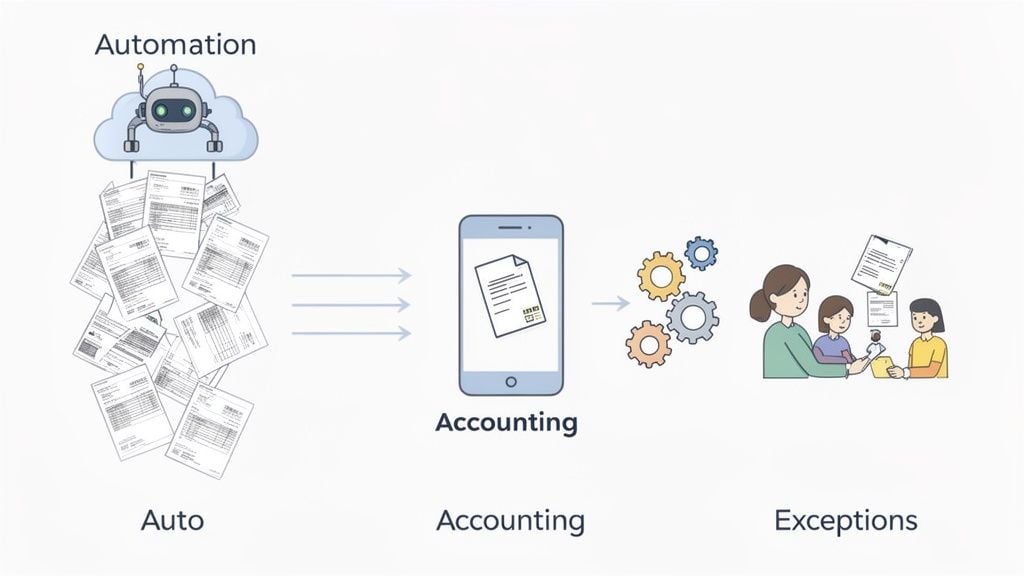
This is where an outsourced team becomes your secret weapon. They step in to handle all the exceptions that automation stumbles on, creating a truly seamless workflow. You get the incredible speed of AI paired with the sharp eye of a human expert. It's the best of both worlds, ensuring every last bit of financial data is captured perfectly without bogging down your team.
So, you’ve decided you need a hand with data entry. That's a huge step. Now comes the real question: what kind of help do you actually need?
Choosing the right data entry model is like picking the right tool for a job. You wouldn't use a sledgehammer to hang a picture frame, and the same logic applies here. It all comes down to finding the sweet spot between cost, control, how quickly you need to scale, and good old-fashioned communication.

You’ve got three main paths to choose from: keeping it all in-house, outsourcing to a dedicated human team, or letting smart AI automation take the wheel.
In-House vs Outsourced vs AI Automation
Let's be honest, each route has its own set of pros and cons. What works for a small startup won't fly for a massive enterprise, so let's break down what each option really means for your business.
Thinking through these options can feel a bit overwhelming, but a simple table can help lay it all out clearly.
In-House vs Outsourced vs AI Automation
Factor
In-House Team
Outsourced Services
AI Automation (e.g., Booksmate)
Cost
Highest (salaries, benefits, overhead)
Variable (moderate to low)
Lowest (predictable subscription fee)
Scalability
Low (hiring is slow and costly)
High (easy to scale up or down)
Highest (instantly scalable)
Speed
Slowest (manual work, limited hours)
Fast (often 24/7 operations)
Fastest (near-instant processing)
Control
Full direct control over employees
High, managed via SLAs and contracts
Full control over software settings
Accuracy
Prone to human error, variable
High (with quality control)
Extremely High (for structured data)
Best For
Very small volumes or highly sensitive tasks
Fluctuating volumes, complex documents
High volumes of digital, standardized documents
As you can see, there's a clear trade-off with each choice. The "best" option is simply the one that fits your specific volume, budget, and growth plans.
If you're still on the fence about whether outsourcing is even the right move, this quick flowchart can help you decide.
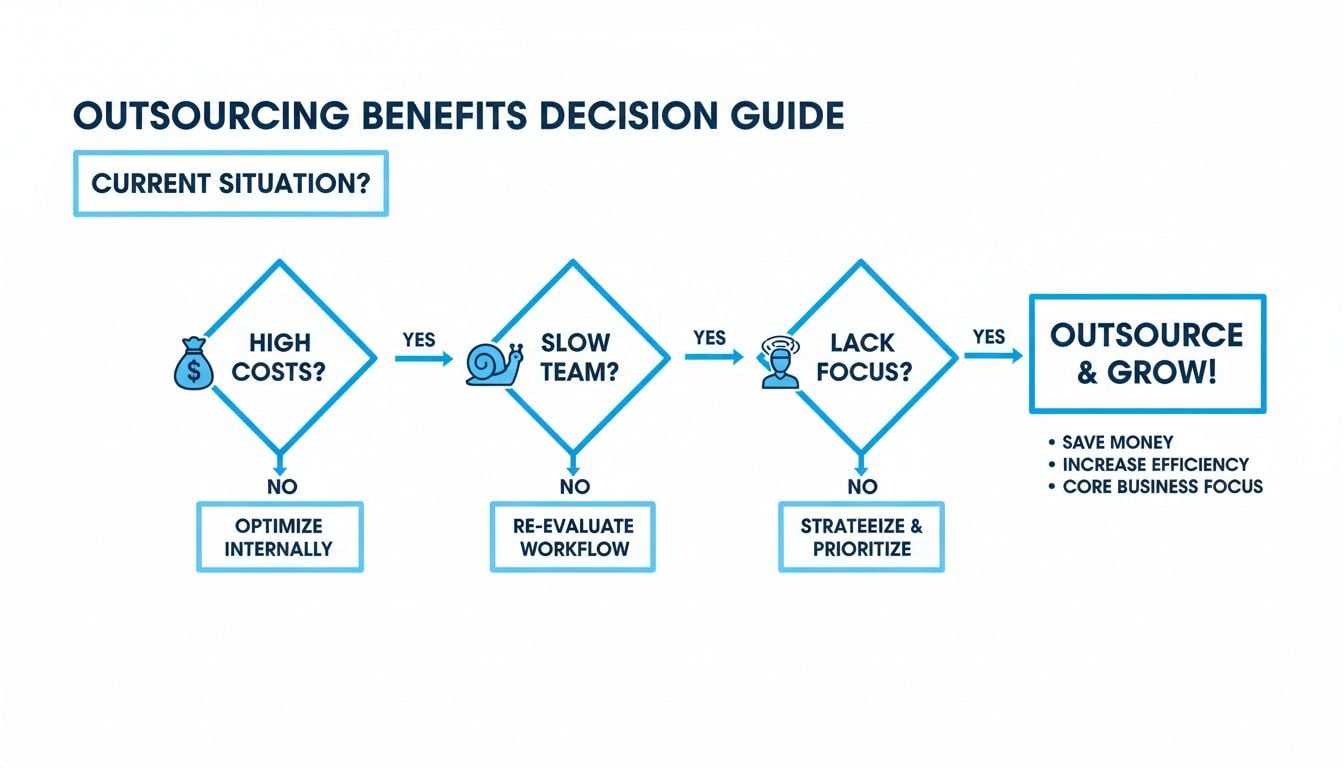
If you found yourself nodding along to the problems in that chart—high costs, a bogged-down team, or no time to focus on growth—then you're in the right place.
The global market for Data Entry Outsourcing Services is projected to hit a whopping $578.62 million by 2033, growing at a 6.18% clip each year. That's not just a random number; it shows a massive shift happening, especially in data-heavy fields like finance and e-commerce. For bookkeepers, it means specialists can pull data from portals like Stripe or Amazon with 99% accuracy, finally freeing them from that mind-numbing manual work.
The smartest strategy we see today often involves a hybrid approach. Use an AI tool like Booksmate for the heavy lifting on digital docs, then bring in an outsourced team to handle physical papers or the one-off tricky documents that need a human eye.
Onshore vs Offshore vs Hybrid Models
Okay, so let's say you're leaning toward outsourcing to a human team. Your next decision is a big one: where will this team be located? This choice has a direct impact on your budget, workflow, and even company culture.
Onshore Outsourcing (Local) This is when you hire a company right in your own country. The big win here is communication—no weird time zones or language mix-ups. The downside? It's almost always the most expensive option because you're paying local wages.
Offshore Outsourcing (International) This means you're partnering with a team in another country, often somewhere with much lower labor costs like the Philippines or India. The cost savings can be huge, sometimes 50-70% less than hiring locally. The trade-off is you'll have to manage time zone differences and be mindful of potential cultural nuances.
Hybrid Outsourcing (Blended) This model gives you the best of both worlds. You might have a project manager in your city who acts as your main point of contact, while they manage a team offshore. You get the convenience of local oversight with the cost savings of a global team.
For many North American businesses, hiring from nearby regions is becoming a go-to strategy. For example, you can Hire LatAm Virtual Assistants who bring a fantastic blend of top-tier talent, cultural alignment, and minimal time zone headaches. It’s a great way to get cost-effective help without feeling like your team is a world away.
How to Pick the Right Outsourcing Partner
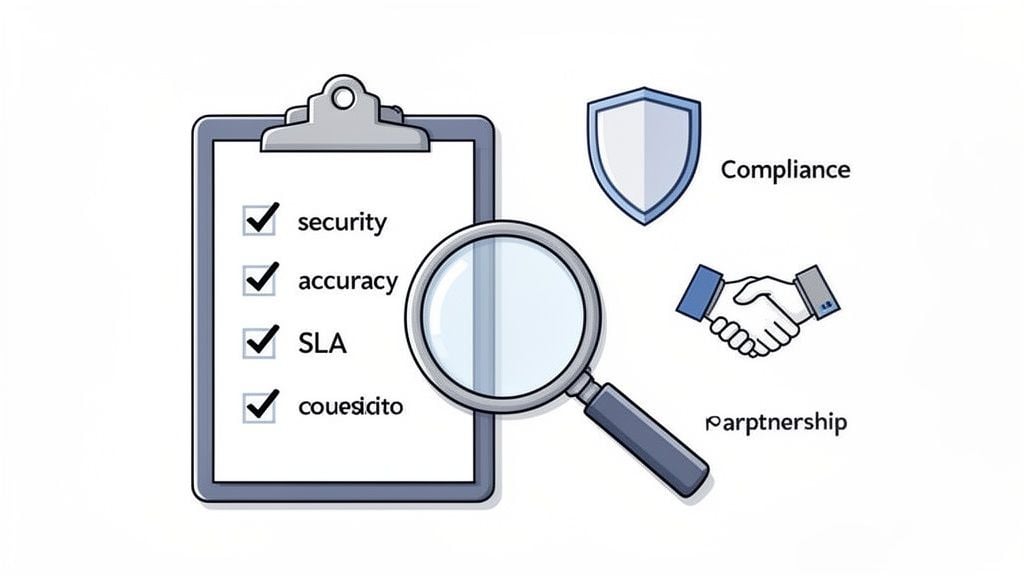
Choosing a partner for your outsourced data entry services feels a lot like hiring a key employee. You wouldn't hire someone without checking their references and making sure they're a good fit, right? The same logic applies here.
Jumping in without doing your homework is a recipe for disaster—think missed deadlines, surprise costs, and a mountain of bad data to fix.
To avoid those headaches, you need a solid vetting process. This isn't just about finding the cheapest quote; it's about finding the right partner. A great provider becomes a genuine extension of your team, delivering the reliable support that lets your business run like a well-oiled machine.
But before you can even think about evaluating vendors, the first step is actually an internal one. You have to get crystal clear on what you actually need.
Start by Defining Your Own Needs
First things first: sit down with your team and map out exactly what you want to hand off. This internal clarity is the yardstick you'll use to measure every potential provider. If you have a fuzzy idea of your own needs, it’s impossible to know if a vendor can meet them.
Here’s a quick checklist to get the ball rolling:
- Data Type: What kind of documents are we talking about? Are they neat, structured digital invoices? Messy handwritten receipts? Complex legal contracts? Or maybe thousands of customer sign-up forms?
- Data Volume: How much work is there, really? Try to estimate the number of documents you process per week or month. This is crucial for getting an accurate quote and making sure they can handle the workload.
- Turnaround Time: How fast do you need it done? Some businesses need a 24-hour turnaround for daily sales reports, while others are fine with weekly processing for expense receipts.
- Accuracy Level: What's your tolerance for mistakes? When it comes to financial data, you should be demanding 99.9% accuracy or better. For less critical tasks, a slightly lower rate might be okay.
Once you’ve nailed down these details, you're in a much stronger position to start your search and ask the right questions.
Critical Questions to Ask Potential Vendors
Alright, you've got your requirements list. Now it's time to start interviewing potential partners. The goal here is to get past the glossy sales pitch and understand how they actually work.
Here are the non-negotiable questions you should ask every single provider you're seriously considering:
- Can You Walk Me Through Your Security and Compliance Protocols? This is your most important question, period. Especially if you're handling sensitive financial or personal data. Ask if they are GDPR, HIPAA, or SOC 2 compliant and ask to see proof. Dig into their data encryption methods, physical security, and whether they run background checks on their staff.
- What Are Your Accuracy Guarantees and Quality Control Steps? Don't accept vague promises of "high quality." Ask them to describe their process. Do they use a double-entry system where two people key the same data? Do they use automated validation rules? Is there a final human review? A professional firm will have a clear, multi-layered process they’re proud to share.
- Do You Have Specific Experience in Our Industry? A partner who already knows the difference between a bill of lading and a purchase order in your industry is worth their weight in gold. Industry-specific experience with accounting, e-commerce, or healthcare means a shorter learning curve and fewer errors from day one.
- Can You Share Client References and Case Studies? Any provider worth their salt will be happy to connect you with a few current clients. There is no better way to get an honest review of their reliability and service quality than by talking to a real customer.
- How Do You Structure Your Service Level Agreements (SLAs)? The SLA is your rulebook for the entire partnership. It needs to clearly define everything—turnaround times, accuracy rates, and, crucially, what happens if they don't meet those standards.
A strong Service Level Agreement (SLA) is your best friend in an outsourcing partnership. It’s a formal contract that locks in expectations for performance, security, and quality, ensuring you and your provider are always on the same page. Never sign a contract without a detailed SLA.
By asking these tough, direct questions, you cut through the marketing fluff and get to the core of what a provider can truly deliver. This diligence is what separates a successful, long-term partnership from a costly mistake.
Integrating Outsourced Services with Your Workflow
Finding a great data entry provider is one thing. Actually weaving them into your daily operations is where the real work—and the real payoff—begins. When done right, they feel less like a vendor and more like an extension of your own team.
This is especially true when you're connecting them to the heart of your finances, like Xero or QuickBooks. A clunky setup can cause more headaches than it solves. The goal is to create a seamless flow of information from your business to your partner, and then cleanly back into your accounting system.
This isn't about just firing off emails with a bunch of PDF attachments. A truly professional outsourced data entry services provider will have a structured, secure process for getting information back and forth.
Building Secure Data Pathways
Let's be honest: your financial data is incredibly sensitive. Protecting it isn't just a best practice; it's a requirement. Good integration doesn't mean giving a third party full admin rights to your accounting software. It's about creating secure, controlled pipelines for data to travel through.
Most experienced providers will use a few common, battle-tested methods:
- Secure Cloud Folders: Think Google Drive, Dropbox, or a dedicated portal your provider sets up. You get specific user permissions, making it simple to upload documents and track who has access to what.
- Dedicated Email Inboxes: This is a simple but powerful trick. You can set up an email like [email protected] and have all your vendors send their bills there directly. Your outsourced team can then access that inbox to collect everything in one place.
- API Connections: If you’re dealing with a high volume of documents, a direct API connection is the gold standard. It creates a secure, automated bridge between your systems and your provider’s platform for hands-free data transfer.
The smartest setups I've seen blend automation with a human touch. For instance, an AI tool like Booksmate can automatically grab 90% of your digital invoices from web portals and email inboxes. Your outsourced team is then freed up to focus only on the tricky stuff—the handwritten receipts, the weirdly formatted supplier invoices, and other exceptions that trip up software.
This hybrid model gives you the best of both worlds. You get the sheer speed of automation for the routine work and the critical thinking of a human expert for everything else. It ensures nothing gets missed.
Connecting with Xero and QuickBooks
Getting the data into your accounting software is where the magic really happens. A good outsourced team won't just dump a raw spreadsheet on you and call it a day. They’ll deliver the data perfectly formatted and ready to go.
A solid workflow usually looks like this:
- Document Collection: You (or your vendors) send all your receipts, bills, and invoices to the agreed-upon secure location.
- Data Extraction: The outsourced team gets to work, pulling out all the key details—vendor, date, amount, line items, you name it.
- Formatted Delivery: They hand back a clean, organized file (like a CSV) that’s already mapped to the import template for your specific accounting software.
This completely changes your bookkeeping process. Instead of your bookkeeper spending hours manually typing in data from 50 different invoices, they just have to click "import" and do a quick review. A tedious, soul-crushing task becomes a five-minute check, keeping your books accurate and up-to-date with almost no effort on your part.
Avoiding the Common Pitfalls of Outsourcing Data Entry
Bringing on an outside team for your data entry can feel like a huge weight off your shoulders. But I’ve seen enough partnerships go sideways to know it’s not always a walk in the park. The key is knowing where the typical tripwires are so you can sidestep them entirely.
Think of it this way: knowing what can go wrong is the best way to make sure everything goes right. By anticipating a few common headaches, you can set up a rock-solid partnership from the get-go.
The Problem of Hidden Costs
One of the loudest complaints I hear about outsourcing? The surprise bill. You see an attractive low hourly rate, but then the final invoice arrives padded with fees you never saw coming—setup charges, software licenses, project management overhead, or extra costs for handling "exceptions." It's a classic bait-and-switch that can kill a good relationship fast.
The only way to avoid this is to demand total price transparency right from the start.
- Run a small pilot project: A paid trial is the best way to see the real cost of a typical workload before you sign a long-term contract.
- Get an itemized quote: Your quote should clearly separate any one-time setup fees from the recurring operational costs.
- Define "out of scope" fees: Get a crystal-clear understanding of what counts as extra work and exactly how it will be billed. Don't leave it open to interpretation.
Gaps in Communication and Quality
Poor communication is the other big partnership killer, and it almost always tanks the quality of your data. Vague instructions, mismatched time zones, and cultural wires getting crossed can leave you with a dataset full of errors. Suddenly, your team is spending all its time on cleanup, which defeats the whole purpose of outsourcing.
A great partnership is built on two things: clear communication and verifiable quality. Don't accept vague promises. Insist on concrete processes that prove your provider can deliver clean, accurate data every single time.
To get ahead of this, lay down firm communication and quality control rules before any work begins. Check that your partner holds security certifications like GDPR or SOC 2 compliance, which shows they take data protection seriously. Even more important, dig into their quality assurance process. Do they use a double-entry system? Do they have a separate QA team review the work?
A reliable partner will have no problem walking you through these details. In fact, they should be proud to show you how they guarantee quality.
Frequently Asked Questions About Outsourced Data Entry
Even after mapping everything out, it's natural to have a few lingering questions about how this all works in practice. Let's tackle some of the most common ones we hear from business owners just like you.
How Much Do These Services Typically Cost?
Alright, let's get right to the big one: what's this going to cost? The honest answer is that it really depends. Your final price tag is shaped by the service model you pick, how complex your data is, and the sheer volume of work you need done.
To give you a ballpark idea, here’s a general breakdown:
- Offshore Teams: These are your most budget-friendly option, usually running between $5 to $15 per hour. They're a fantastic choice for high-volume, repetitive tasks.
- Onshore Teams: Based in your own country, these folks will cost more, typically $20 to $30 per hour. The trade-off is that you get to skip any time zone headaches or language barriers.
- Per-Document Pricing: Some providers offer a fixed price per document or even per keystroke. This model can be a great fit for projects where you have predictable, repeatable work.
The best way to get a real number is to ask for a detailed quote based on a sample of your actual documents. This is the only way to lock in a final cost and make sure there are no surprise fees down the road.
Is Outsourcing My Financial Data Secure?
Absolutely, as long as you partner with a reputable provider. Worrying about data security is completely normal, but for a top-tier firm, protecting your information is everything. Their entire business is built on your trust.
Any provider worth their salt will have layers of security in place. We're talking about data encryption (both when it's sitting on a server and when it's being sent), tightly controlled access to secure servers, and strict adherence to international security standards.
When you're checking out a potential partner, don't just take their word for it. Ask to see their security certifications, like GDPR, HIPAA, or SOC 2 compliance. A professional firm will have this ready to go and will be happy to show you, giving you the confidence that your sensitive financial data is in safe hands.
Can I Use Outsourced Data Entry With My Automation Software?
Yes, and honestly, you should! This hybrid strategy—combining AI automation with a human team—is one of the smartest and most efficient ways to handle data entry today. You really get the best of both worlds.
Think of it this way: let an automation tool like Booksmate do the heavy lifting, automatically grabbing digital invoices and pulling out 90% of the data. Then, you can use your outsourced team as a specialized "exceptions crew." They jump in to handle the tricky documents that trip up the AI, like handwritten receipts, blurry scans, or invoices from oddball supplier portals.
This approach maximizes your speed, keeps your costs in check, and ensures you get to 100% data capture.
Ready to stop wasting time on manual data entry? Booksmate automates the entire process, from fetching documents to extracting data, so you can focus on growing your business. Discover how Booksmate can transform your workflow today!