Articles
Proforma Invoice Meaning: A Complete Guide for 2026
You get an email from a customer that says, “Please send a proforma invoice so we can approve this internally.” If you’re a new business owner, or a junior bookkeeper handling sales paperwork for the first time, that message can stop you cold.
You might wonder whether they’re asking for a quote, a real invoice, or some customs document you’ve somehow missed. The term sounds formal, but the idea is simple once you strip away the jargon.
A proforma invoice is a detailed preview of a sale. It shows what you expect to charge, what’s being sold, and the terms you expect to use. It looks serious because it needs to be useful. But it isn’t the final bill.
When ordering at a restaurant, the menu gives you rough options. Your server repeats your order back so everyone agrees on what’s coming. Then the final bill arrives after the meal. A proforma invoice is that middle step. It confirms the planned deal before the actual invoice exists.
What Is a Proforma Invoice and Why Does It Matter
A proforma invoice is a non-binding document a seller sends before the sale is finalized. It usually includes item descriptions, estimated prices, quantities, fees, terms, and timing so the buyer can review the deal before committing.
The easiest way to understand proforma invoice meaning is this. It’s more formal than a casual estimate, but it’s not yet a collectible invoice. It gives both sides a shared version of the expected transaction.
Why businesses ask for one
Buyers usually request a proforma invoice when they need something more concrete than a quote. They may need it for internal approval, advance payment review, financing paperwork, customs clearance, or simple clarity before they say yes.
For sellers, it reduces confusion early. Instead of arguing later about shipping, taxes, scope, payment timing, or service dates, you put those expectations in writing before work begins or goods move.
Practical rule: If the customer needs a document to review the deal, but you haven’t delivered the goods or completed the service, a proforma invoice is often the right tool.
Why it matters more than many owners realize
A lot of business owners only hear about proformas in export paperwork. That’s part of the story, but not the whole thing. Service businesses use them too, especially when fees depend on usage, volume, or changing scope.
A marketing consultant might send a proforma showing the planned monthly retainer plus estimated ad management fees. A bookkeeping firm might send one for a cleanup project that could shift once old records are reviewed. A SaaS vendor might outline projected charges before the account goes live.
That’s why this document matters. It helps people agree before the final invoice locks in the numbers.
What a proforma does not do
It doesn’t mean revenue exists. It doesn’t prove delivery happened. It doesn’t belong in your books as a final sale.
Those points sound technical, but they prevent real mistakes. If you remember only one thing, remember this: a proforma invoice is a planning document, not a completed transaction.
Proforma vs Commercial Invoice vs Quote A Clear Comparison
Most confusion comes from how similar these documents look. A quote, a proforma invoice, and a commercial invoice may all show items, prices, and totals. But they do very different jobs.
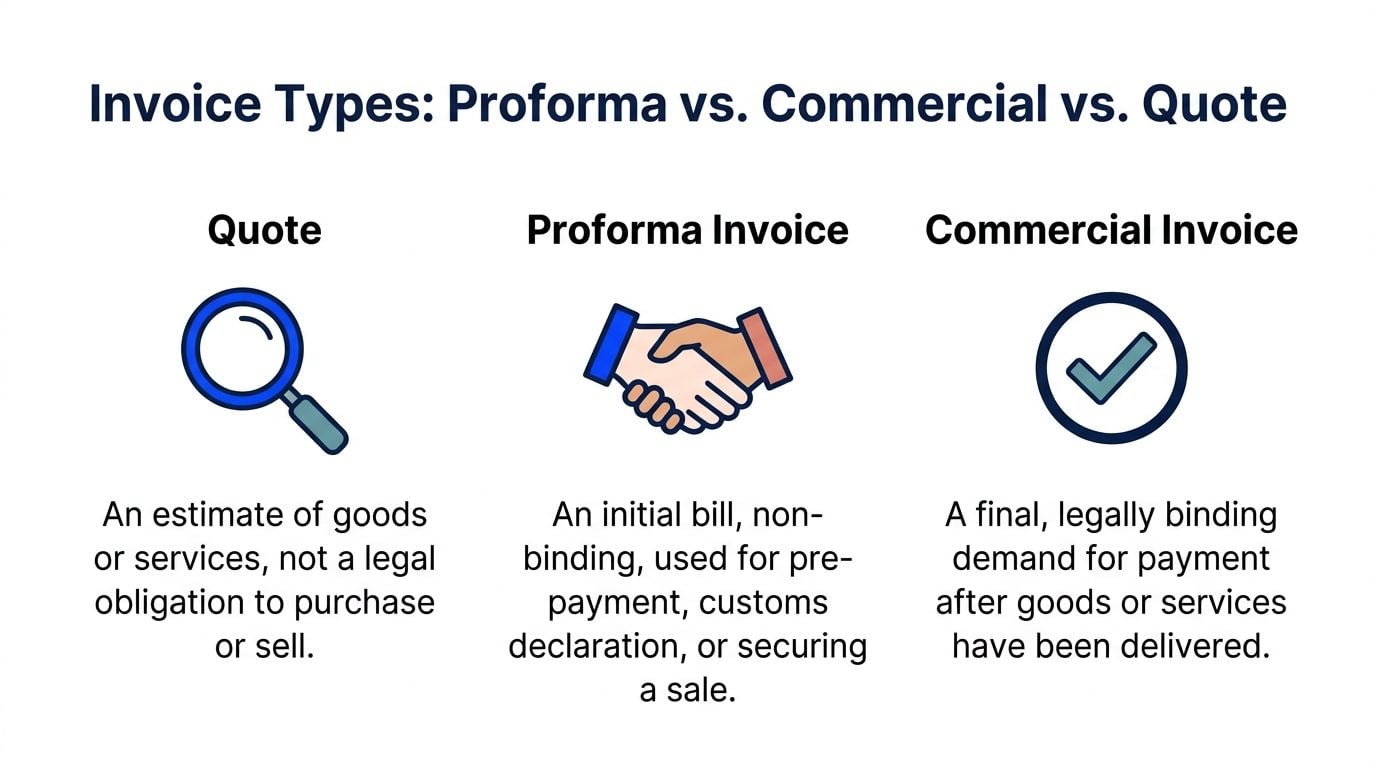
Use the restaurant analogy again.
- A quote is like asking, “About how much would dinner for ten cost?”
- A proforma invoice is like the restaurant writing out exactly what the event package includes before you confirm.
- A commercial invoice is the final bill after the event is delivered.
The simplest distinction
A quote starts the conversation.A proforma confirms the expected deal.A commercial invoice asks for payment for a real transaction.
That timing matters because accounting rules treat each document differently.
A proforma invoice may look like an invoice, but it should never be treated like one in your ledger.
Comparison table
Attribute
Quote
Proforma Invoice
Commercial Invoice
Primary purpose
Give an estimate or starting price
Confirm expected transaction details before final sale
Demand payment for goods or services delivered
When used
Early in the sales conversation
After terms are mostly agreed, before final fulfillment
After shipment, delivery, or completion
Level of detail
Often broad or summary-level
Usually detailed and structured like an invoice
Final and transaction-specific
Legal/payment status
Not a demand for payment
Non-binding quotation, not valid as final payment demand
Binding invoice used to request payment
Accounting treatment
Not recorded in AR/AP
Recorded in normal accounting workflow
Typical use cases
Early pricing discussions
Prepayment review, customs, approvals, scope confirmation
Final billing and accounting record
Why bookkeepers must keep them separate
Small businesses get into trouble. Because a proforma often looks polished, staff may save it into the same folder as final invoices, import it into software, or even chase payment against it.
That creates reporting problems. According to Planergy’s explanation of proforma invoice vs invoice, proforma invoices are non-binding quotations and should not enter AR/AP ledgers under GAAP/IFRS guidance. The same source notes that premature booking can inflate revenue forecasts by 15-20% in audited SME financials.
That’s not a paperwork issue. That’s a reporting issue.
Where people usually mix them up
Here are the most common misunderstandings:
- “It has line items, so it must be an invoice.” Not necessarily. Format doesn’t determine accounting treatment.
- “The client approved it, so we can book it.” Approval is not the same as delivery or earned revenue.
- “They paid from the proforma, so that becomes the invoice.” Payment may happen based on a proforma, but you still need proper final documentation.
- “A quote and a proforma are identical.” Sometimes they overlap, but a proforma is usually more formal and complete.
A quick test
If you’re unsure which document you’re looking at, ask three questions:
- Has the sale happened yet?
- Is this document asking for payment as a final legal demand?
- Should this appear in accounts receivable or accounts payable?
If the answer to the second and third questions is no, you’re probably looking at a quote or a proforma, not a commercial invoice.
When to Use a Proforma Invoice Domestic and International Scenarios
A proforma invoice became famous in international trade, but that doesn’t mean it belongs only there. It helps in two very different settings. One is moving goods across borders. The other is managing uncertain pricing before a domestic service sale is finalized.
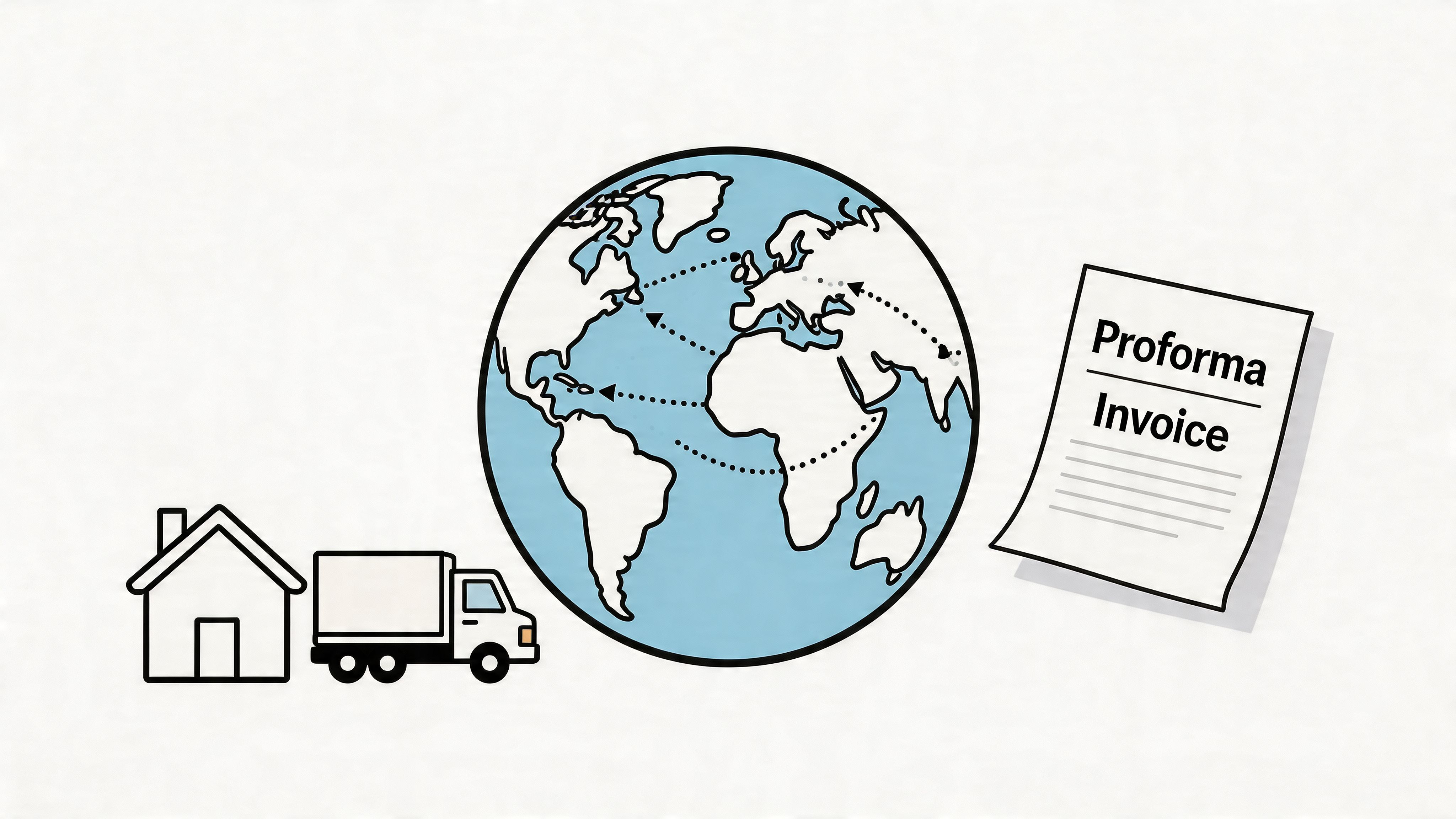
International trade use cases
A manufacturer shipping products overseas may need to send a proforma invoice before the commercial invoice exists. Customs authorities often need estimated transaction details to assess duties, taxes, and shipment information.
The trade role of proformas is long-standing. As noted in Salesforce’s overview of pro forma invoices, pro forma invoices trace back to 18th-century mercantile practices and were formalized in the U.S. via the Tariff Act of 1930. The same source says the WTO reported world merchandise exports reached $25 trillion in 2022, and pro formas facilitate over 70% of documented export transactions in major markets to pre-approve duties and avoid delays.
In that setting, a proforma invoice often includes details like:
- Product classification: The six-digit HS code or Schedule B code
- Country of origin: Important for customs treatment
- Unit price and total value: Needed for estimating duties and taxes
- Shipping terms: Such as port of loading and port of discharge
- Payment terms: So both sides know how settlement is expected to work
If you export goods, this document helps officials understand what’s crossing the border before the final billing paperwork is complete.
Domestic service use cases
This is the part most guides skip.
A local service business may not deal with customs at all, but it still faces the same commercial problem. The client wants more certainty than a quote gives, while the final amount may still depend on timing, scope, or usage.
Here are common domestic examples:
- Bookkeeping cleanup work: The client has messy records, and you need to estimate the work before knowing the exact final effort.
- IT support retainers: The provider can outline monthly support plus expected add-on work.
- SaaS billing reviews: A software vendor may estimate projected platform or processing fees before usage is known.
- Consulting projects: The consultant can define expected deliverables, fees, and payment stages before starting.
This is also where people often confuse invoices and receipts. If you want a simple refresher on the fundamental difference between an invoice and a receipt, that distinction helps make proformas easier to place in the paperwork sequence.
Two short examples
A furniture exporter in Texas sends a proforma invoice to a buyer in Europe. The buyer uses it to review item values, shipping terms, and customs details before goods ship.
A local accounting firm sends a proforma invoice for year-end cleanup work. The document lists the expected scope, estimated hours, software fees, and the date the estimate expires. The client approves the framework, the work begins, and the final invoice is issued later based on actual work performed.
Both businesses use the same type of document. The reason is identical. They need a formal summary of the expected deal before final billing becomes appropriate.
A short walkthrough may help if you want to see how practitioners explain the document in plain terms:
When a proforma is especially useful
Use one when the buyer needs detail, but the sale isn’t complete yet.
That usually includes:
- Advance approval needs: Procurement, manager sign-off, or finance review
- Prepayment arrangements: The buyer wants to verify expected totals before paying
- Border transactions: Customs needs shipment values and goods descriptions
- Variable fee work: The final amount depends on actual usage, hours, or delivered scope
- Longer sales cycles: Both sides want a written checkpoint before moving forward
Send a proforma when you need alignment, not when you need to recognize revenue.
How to Create a Perfect Proforma Invoice Template and Key Elements
A good proforma invoice should answer the buyer’s practical questions before they have to ask them. What are they buying? How much will it likely cost? How long is this price valid? What assumptions sit behind the total?
If your template leaves those points vague, the document won’t do its job.
Start with the label
Put Proforma Invoice at the top in a clear, unmistakable way. Don’t hide it in small text. Don’t rely on file names. The document itself should state what it is.
A simple disclaimer also helps. Something like “Pro Forma Invoice. Not Valid for Payment” or “Estimated charges only until final invoice is issued” reduces confusion.
Clear labeling protects both the seller and the buyer. It tells everyone this is a pre-sale document, not a final accounting record.
Include these core fields
Your template should usually contain:
- Seller details: Business name, address, contact person, email, phone
- Buyer details: Customer name, billing address, delivery address if different
- Reference number: A unique tracking number, even if it isn’t a final invoice number
- Issue date: When the proforma was created
- Expiration date: When the quoted terms stop being valid
- Itemized lines: Description, quantity, unit price, and line total
- Extra charges: Shipping, handling, taxes, or estimated duties if relevant
- Total estimated amount: Clearly marked as estimated if needed
- Payment terms: Deposit terms, advance payment expectations, due timing
- Delivery or service timing: Planned shipment date or expected service period
- Notes and assumptions: Anything that could change the final amount
Why each element matters
The expiration date protects you from old pricing being treated as permanent. The itemized lines reduce disputes because buyers can see exactly what you included. The notes section matters most for services, where the final bill may depend on actual work performed.
For international use, include any customs-related details the buyer or broker will need, such as product classification, origin, shipping terms, and declared values. For domestic services, the assumptions matter more than shipping fields.
Copy and adapt this template
PROFORMA INVOICE
SellerBusiness NameAddressEmailPhone
BuyerCustomer NameBilling AddressService or Delivery Address
Proforma Reference: PF-____Issue Date: ____Valid Until: ____
Description
Quantity
Unit Price
Estimated Line Total
Service or Product 1
Service or Product 2
**Estimated Subtotal:****Estimated Taxes/Fees:****Estimated Shipping or Other Charges:**Estimated Total:
**Payment Terms:****Delivery or Service Terms:****Assumptions or Variances:**Statement: Pro Forma Invoice. Non-binding. Final charges will be confirmed on the commercial invoice.
Two habits that improve accuracy
- Write descriptions the client would recognize. Internal shorthand creates avoidable disputes.
- State what may change. If usage, freight, scope, or timing could alter the final amount, say so directly.
A proforma invoice works best when it leaves little room for interpretation.
Proforma Invoices in Your Accounting Workflow Best Practices
The biggest accounting mistake with proformas is treating them like completed sales. That mistake usually starts innocently. Someone wants visibility in the dashboard, so they upload every document into the same workflow and sort it out later.
That approach creates bad numbers fast.
Keep proformas out of AR and AP
A proforma invoice belongs in your operational process, not your recognized revenue or payable records. It can support approval, planning, and communication, but it shouldn’t be booked like a commercial invoice.
This matters more now because domestic service use is growing. ShipMercury’s glossary entry on pro forma invoices notes that many guides ignore how accountants handle proformas without double-counting, and it cites a 28% rise in domestic pro forma usage amid economic uncertainty.
If your firm handles service businesses, that trend means the problem won’t stay occasional.
A clean workflow that works
A disciplined process usually looks like this:
- Create the proforma outside the ledgerStore it in a sales or approvals workflow, not in posted AR/AP.
- Wait for the triggering eventThat may be shipment, service delivery, milestone completion, or another contract-defined point.
- Issue the final invoiceOnce the transaction is real, create the commercial invoice with final amounts.
- Post only the final invoice to accountingThat’s the document that belongs in receivables, payables, tax reporting, and month-end review.
- Link the records for audit trailKeep the proforma attached or referenced so the team can trace how the final number developed.
What to track instead of booking it
If management wants visibility before final billing, use operational tracking fields rather than accounting entries.
For example, you can track:
- Approval status: Sent, viewed, accepted, expired, revised
- Expected value: Marked clearly as estimated, separate from recognized revenue
- Owner: Which salesperson, project manager, or account lead is responsible
- Conversion status: Whether it became a final invoice, was revised, or was abandoned
That gives the business useful information without corrupting the books.
If you want forecasts, build forecasts. Don’t turn proformas into fake invoices just because the dashboard needs numbers.
Small team reality
Many businesses blur these lines because one person wears five hats. The owner sells, fulfills, invoices, and reconciles. In that environment, document discipline matters even more.
If that sounds familiar, it may help to review signs your business could benefit from a professional bookkeeper. Even if you keep bookkeeping in-house, the article is a useful reminder that clean processes matter as much as clean software.
A practical naming rule
Use a separate numbering pattern for proformas, such as PF- rather than your final invoice sequence. That one habit reduces accidental posting, duplicate chasing, and messy file imports.
You’re not just labeling documents. You’re protecting your financial statements from premature data.
Stop Chasing Invoices How Booksmate Automates Collection
Manual document collection turns into a mess faster than one might expect. A bookkeeper downloads one invoice from Stripe, another from Amazon, a third from Microsoft, then checks an inbox for attachments that may be quotes, proformas, or final invoices with nearly identical filenames.
That’s how teams lose time and misfile documents.
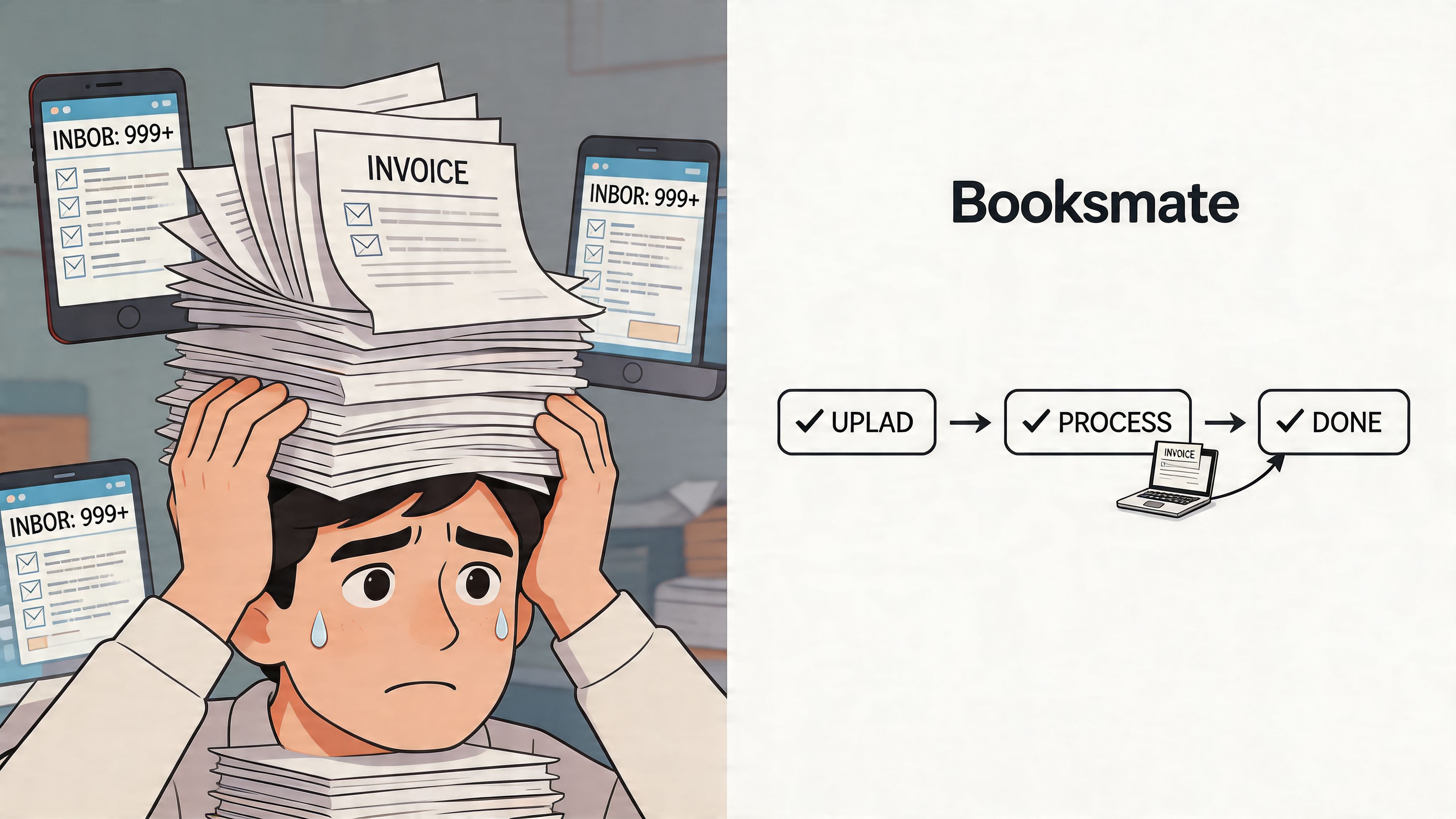
Booksmate tackles that operational problem by connecting to online portals and email inboxes so finance teams don’t have to log in everywhere manually. It collects invoices and receipts from the systems teams already use, then organizes them in one dashboard.
Where automation helps most
The challenge isn’t only finding documents. It’s identifying what kind of document each file is.
A strong workflow should separate:
- Proformas: Pre-sale or pre-finalization documents
- Commercial invoices: Final billing records
- Receipts: Proof of payment
- Other supporting documents: Statements, confirmations, or credit notes
Booksmate uses AI-powered data extraction to pull information from collected documents and prepare them for export to accounting software. For bookkeepers and accountants, that means less time opening files one by one just to classify them.
Why that matters for compliance
When proformas and final invoices sit in the same inbox, mistakes happen. A junior team member may export the wrong file, or an approver may mistake an estimate for a payable invoice.
Automation reduces that friction by centralizing document collection and making the review process more structured. Teams can search, verify, and organize faster instead of relying on memory and shared folders.
Best fit for busy finance teams
This kind of setup is especially useful for firms handling many clients, many vendors, or many portals at once. If your day disappears into downloading PDFs, checking email threads, and reconciling mismatched documents, central collection gives you a cleaner starting point before the accounting work even begins.
Common Proforma Invoice Mistakes and How to Avoid Them
Some people treat proforma invoices as harmless because they’re non-binding. That’s too casual. They may not be final invoices, but they still create legal, operational, and compliance risk when used carelessly.
Mistake one using vague labels
If the document looks like a real invoice but doesn’t clearly say pro forma, buyers can misread it. Staff can misread it too. That leads to duplicate payment requests, bad posting, and customer confusion.
In the U.S., labeling also matters from a consumer protection standpoint. American Express’s discussion of proforma invoices notes that some states, including California, require clear pro forma labeling to avoid deception concerns. The same source says FTC data showed an 18% rise in invoice-related complaints in 2025.
Mistake two forgetting privacy rules
Businesses often assume pre-sale paperwork has no data risk. That’s false. A proforma may include names, addresses, contact details, and pricing tied to a buyer.
In major markets like the EU, the same American Express source notes that pro formas with buyer data can trigger GDPR consent rules even before the sale is complete. That means sharing or storing these documents carelessly can create compliance problems before a transaction even closes.
Mistake three treating estimates like fixed promises
A proforma should communicate expected charges, not hide uncertainty. Service businesses run into trouble when they leave out assumptions, date limits, or scope boundaries.
Avoid that by adding simple controls:
- State the validity period clearly: Don’t let stale pricing linger
- Describe possible changes: Freight, usage, hours, taxes, and service scope may shift
- Name the triggering event for final billing: Shipment, completion, milestone approval, or delivery
- Separate it from final invoice numbering: That reduces accidental posting
“Non-binding” doesn’t mean “risk-free.” It means the document has a different purpose and needs different controls.
Mistake four storing everything in one pile
When proformas, quotes, final invoices, and receipts all live in the same folder with inconsistent naming, your team has to guess. Guessing is where duplicate entries and missed follow-ups begin.
Use distinct filenames, separate folders or tags, and a review rule for anything marked estimate, pro forma, draft, or preliminary. The cleaner your document handling, the fewer corrections you’ll need later.
Your Proforma Invoice Questions Answered
Can a proforma invoice become legally binding
Not by itself as a final payment demand. But the surrounding agreement, acceptance, or contract terms can still matter. Treat the proforma as a supporting commercial document, not as your substitute for a proper contract or final invoice.
Do I always need a commercial invoice after a proforma
If the sale goes ahead, you usually need final billing documentation after delivery, shipment, or completion. The proforma sets expectations. The commercial invoice records the actual transaction.
Can a customer pay from a proforma invoice
They might, especially in prepayment arrangements. But payment doesn’t remove the need for proper final invoicing and correct accounting treatment.
Should proformas have expiration dates
Yes. An expiration date helps prevent arguments over old pricing and stale assumptions.
Can I revise a proforma invoice
Yes. If scope, quantity, timing, or estimated fees change, issue a revised version and keep a clear reference trail so no one relies on the wrong document.
If your team spends too much time hunting through inboxes and vendor portals for proformas, invoices, and receipts, Booksmate can help centralize collection, organize documents, and prepare them for export to your accounting workflow. It’s built for bookkeepers, accountants, and finance teams that want less downloading, less manual sorting, and fewer document mix-ups.