Articles
Sample Balance Sheet for Small Business: A Simple Guide
You open your accounting software looking for a clear answer to a simple question: how is my business doing right now? Instead of clarity, you get a pile of open invoices, supplier bills, loan balances, and a report you half-recognize but don’t fully trust.
That’s where a sample balance sheet for small business becomes useful. It isn’t just a formal report for your accountant or bank. It’s the snapshot that tells you what your business owns, what it owes, and what’s left for you as the owner.
For many owners, the hard part isn’t understanding the idea. It’s getting accurate numbers onto the page without chasing paperwork for hours. That’s especially true when customer invoices live in one system, supplier bills arrive by email, and receipts sit inside vendor portals you forget to check.
Your Guide to the Small Business Balance Sheet
A lot of small business owners feel behind on this stuff. They know a balance sheet matters, but the document looks stiff, technical, and built for accountants instead of real people running payroll, answering customers, and trying to keep cash moving.
That feeling makes sense. A 2025 survey by Accounting Today revealed that 68% of small business bookkeepers spend over 15 hours weekly manually reconciling vendor invoices, while templates still miss automated imports and real-time receivables aging from email and portal scans, according to this small business balance sheet templates discussion. When the inputs are messy, the report won’t feel trustworthy.
Why owners get stuck
Usually, the problem isn’t the math. It’s the collection process.
- Cash is easy: You can pull your bank balance quickly.
- Receivables get messy: Customer invoices may sit across Stripe, PayPal, email, or your invoicing app.
- Payables get buried: Supplier bills often arrive in inboxes, PDFs, or portal accounts.
- Timing creates confusion: A balance sheet only works if every number reflects the same date.
If you already handle your books in-house, practical resources on small business bookkeeping can help you build stronger routines around these reports.
Practical rule: A balance sheet isn’t intimidating because the formula is hard. It’s intimidating because business owners rarely receive clean, up-to-date inputs in one place.
Once the numbers are gathered properly, the report becomes far easier to read than expected.
The Accounting Equation Explained Simply
Every balance sheet rests on one line:
Assets = Liabilities + Equity
If that feels abstract, use a house.
You buy a house. The house itself is the asset. The mortgage is the liability. The part you own, meaning your deposit plus any amount of the loan you’ve paid off, is equity. The full value of the house must always equal the bank’s share plus your share.
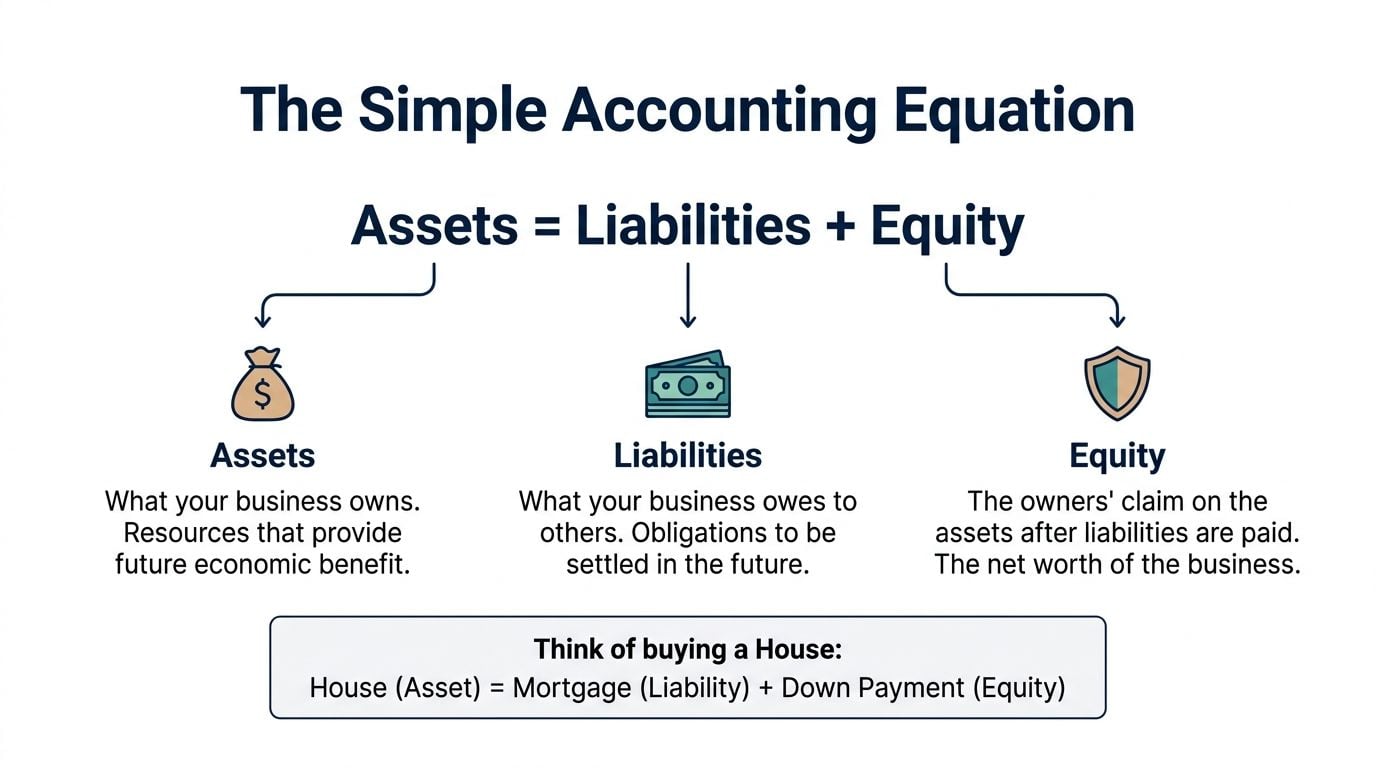
That same logic applies to your business. If your company owns cash, equipment, inventory, or unpaid customer invoices, those assets had to come from somewhere. They were funded either by debt, owner investment, or profits left in the business.
What each part means
Here’s the plain-English version:
Term
Meaning in simple language
House analogy
Assets
What your business owns or controls
The house
Liabilities
What your business owes to others
The mortgage
Equity
What belongs to you after debts are considered
Your ownership stake
The reason this matters is simple. A balance sheet doesn’t just list numbers. It shows how your business is financed.
Why it always has to balance
Suppose your business buys equipment. One of two things usually happens. You pay cash, which means one asset goes down and another asset goes up. Or you borrow money, which means assets increase and liabilities increase too.
That’s why the report must stay balanced. Every transaction affects at least two pieces of the puzzle.
If you want another plain-language explanation of the basic accounting equation, that resource is helpful for seeing how the relationship works outside textbook jargon.
A balance sheet is less about memorizing categories and more about answering one question: where did the business resources come from?
Once you understand that, the form starts to feel logical instead of technical.
Anatomy of a Small Business Balance Sheet
A typical small business balance sheet has three sections: assets, liabilities, and equity. What confuses most owners is not the headings. It’s the line items underneath them.
Assets you’ll usually see
Cash is money in your business bank account. If your checking account holds operating funds, that number belongs here.
Accounts receivable is money customers owe you. If you sent an invoice but haven’t been paid yet, it’s an asset because you expect to collect it.
Inventory is the value of products you plan to sell. For a retail shop, that could be boxed stock on shelves or in storage.
Equipment covers longer-term tools the business uses. Think ovens for a bakery, laptops for a consultant, or machines in a workshop.
A useful way to think about assets is by timing.
- Current assets are expected to turn into cash, be sold, or be used relatively soon.
- Non-current assets stay in the business longer and support operations over time.
Liabilities that show up most often
Accounts payable is money you owe suppliers or vendors. If a supplier sent a bill and you haven’t paid it yet, it belongs here.
Short-term loans are debts due relatively soon. A credit line or loan balance that needs repayment in the near term usually fits this category.
Long-term loans are obligations that stretch beyond the short term. Equipment financing or a larger business loan often sits here.
Liabilities are also split by timing.
Liability type
What it means
Example
Current liabilities
Debts due sooner
Supplier bills, short-term loan balances
Long-term liabilities
Debts due later
Larger business loan obligations
Equity often causes the most confusion
Owners often look at equity and ask, “Is this just profit?” Not exactly.
Owner’s capital is the money you’ve put into the business. If you started the business with your own funds, that stake appears here.
Retained earnings are profits left in the business rather than taken out. Over time, this number reflects accumulated results.
If assets are the house and liabilities are the mortgage, equity is your ownership stake after the debt is accounted for.
One quick warning about labels
The exact account names can differ across software and business types. One balance sheet might say “owner’s capital,” another might say “member’s equity” or “shareholder equity.” Don’t let the wording throw you off. The purpose is the same: it shows what portion of the business belongs to the owner after liabilities are considered.
When you review any sample balance sheet for small business, ask three questions instead of staring at labels:
- What does the business own?
- What does it owe?
- What’s left for the owner?
That framing clears up most of the confusion.
Sample Balance Sheets for Common Businesses
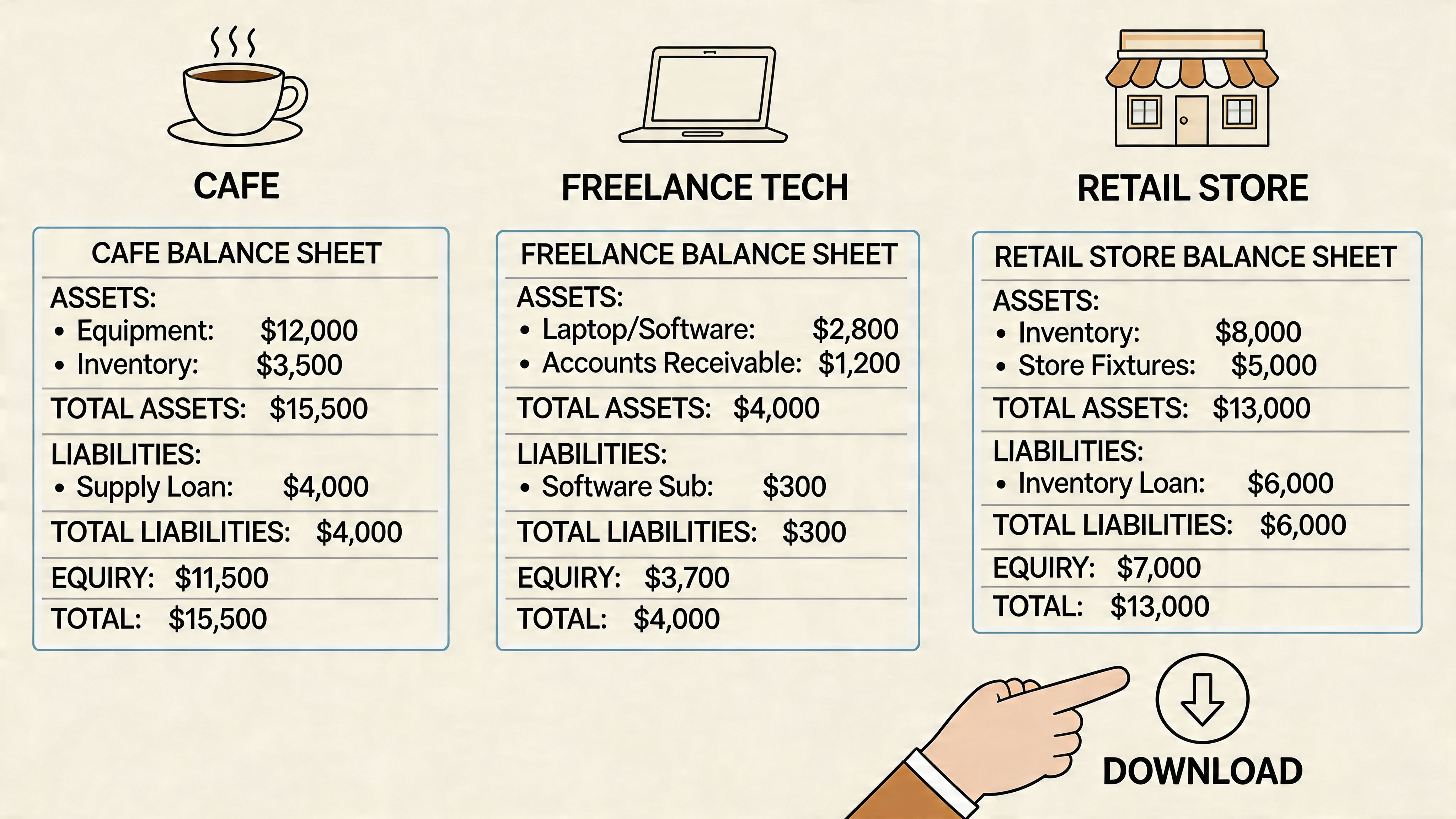
Examples make this click faster than definitions do. A bakery and a service business may look very different day to day, but both still follow the same accounting equation.
Example one, a bakery
A practical bakery example shows how a product-based business typically carries a mix of cash, receivables, inventory, and equipment. In that sample, total assets are $17,500, made up of cash of $5,000, accounts receivable of $2,000, inventory of $2,500, and equipment of $8,000, based on this small business balance sheet example.
On the other side, the bakery has $6,500 in liabilities, including accounts payable of $1,500 and a business loan payable of $5,000. Owner’s equity totals $11,000, made up of owner’s capital of $8,000 and retained earnings of $3,000. The sheet balances because $17,500 in assets equals $6,500 in liabilities plus $11,000 in equity.
That example is useful because it feels like a real business. A bakery needs ingredients on hand, equipment to operate, and enough cash to handle bills before every customer has paid.
Why the bakery example matters
This sample also shows a healthy pattern. The business has liquid resources such as cash and receivables, while also carrying operating assets like inventory and equipment.
Here’s the bakery in a simpler layout:
Bakery balance sheet item
Amount
Cash
$5,000
Accounts receivable
$2,000
Inventory
$2,500
Equipment
$8,000
Total assets
$17,500
Accounts payable
$1,500
Business loan payable
Total liabilities
$6,500
Owner’s capital
Retained earnings
$3,000
Total equity
$11,000
Example two, a service business
A service business usually has fewer physical assets. You may have cash, customer invoices waiting to be paid, and some equipment like laptops or office tools. You probably won’t have much inventory, if any.
That changes the look of the balance sheet, but not the structure. Assets still sit on one side. Liabilities and equity still explain how those assets were funded.
A service business balance sheet often feels easier to read because there are fewer moving pieces:
- Cash often matters most because payroll and overhead need funding.
- Accounts receivable can become the key asset if clients pay on terms.
- Equipment is usually smaller than in a product business.
- Accounts payable and loans still matter because service firms also owe vendors and lenders.
The shape of the balance sheet changes by industry. The equation never does.
That’s why using a sample balance sheet for small business is so helpful. You don’t need an identical business. You just need a model that shows where each category belongs.
How to Build Your Balance Sheet Step by Step
Building your own balance sheet gets easier when you stop thinking of it as an accounting report and treat it like a collection exercise. You’re gathering numbers from specific places, placing them in the right buckets, and checking that both sides match.
Start with one reporting date
Pick a date first. Every number must reflect that same moment in time.
If your bank balance is from month-end but your supplier bills are from a week later, the report won’t be reliable. Consistency matters more than complexity.
Gather the source documents
Most small business owners can build a first draft from a short list of records:
- Bank statements for your cash balances.
- Customer invoice reports for accounts receivable.
- Supplier bills or payable reports for accounts payable.
- Loan statements for short-term and long-term debt.
- Asset records for equipment and other longer-term items.
- Depreciation records if your accountant tracks asset value reductions over time.
Place each number in the right category
Use this quick sorting guide:
- Money in the bank goes under assets.
- Money customers owe you goes under accounts receivable.
- Stock for sale goes under inventory.
- Equipment used by the business goes under non-current assets.
- Bills you owe vendors go under accounts payable.
- Loan balances go under liabilities.
- Owner contributions and retained profits go under equity.
A sample balance sheet published for September 30, 2025 shows how this works in practice. It records total assets of $105,000, balanced by $55,000 in liabilities and $50,000 in equity, while also reflecting items like equipment depreciation and accounts receivable from sales, as shown in this balance sheet example.
Do the final check
Once everything is entered, compare both sides.
Final check
What to confirm
Assets total
Add all asset accounts
Liabilities total
Add all current and long-term debts
Equity total
Add owner capital and retained earnings
Balance test
Assets must equal liabilities plus equity
If the numbers don’t balance, don’t assume the problem is complicated. It’s often something ordinary like a missing bill, an invoice report from the wrong date, or equipment entered at cost without updated depreciation.
Treat an unbalanced sheet like a missing-piece puzzle, not a crisis. One account is usually misclassified, omitted, or dated incorrectly.
That approach keeps the work manageable.
Checking Your Balance Sheet Health and Accuracy
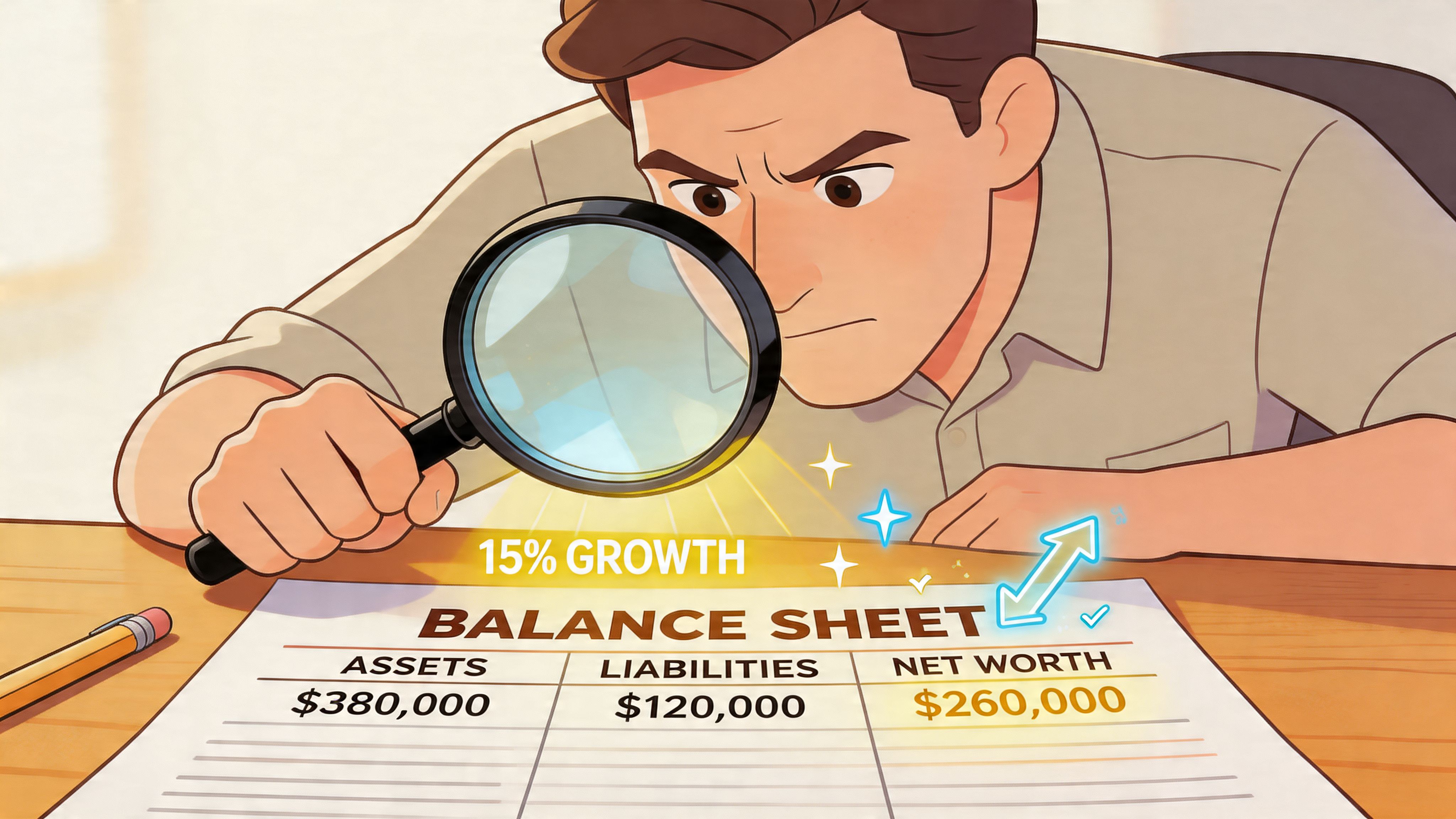
Once the sheet balances, the next question is whether it tells a healthy story. A finished report should help you judge liquidity, debt pressure, and possible bookkeeping mistakes.
Current ratio and working capital
The current ratio compares current assets with current liabilities. It helps answer a practical question: can your business cover near-term obligations without scrambling?
One sample shows $150,000 in current assets and $90,000 in current liabilities, producing working capital of $60,000 and a current ratio of 1.67. That falls inside the ideal range of 1.5 to 2.0, indicating solid short-term solvency, according to this discussion of balance sheet metrics for small business.
That same sample also shows how inventory efficiency can be read from the balance sheet context. With cost of goods sold of $50,000 and average inventory of $2,000, the inventory turnover ratio is 25, which signals very strong sales relative to stock levels.
Debt-to-equity and quick ratio
Another useful lens is debt relative to owner value. In the previously noted sample dated September 30, 2025, the business has $55,000 in liabilities and $50,000 in equity, creating a debt-to-equity ratio of 1.1. That points to a moderate level of debt rather than an extreme debt load.
That example also shows a current ratio of 3.0 and a quick ratio of 2.52, based on $63,000 in quick assets and $25,000 in current liabilities. Those figures suggest strong short-term solvency, though they can also hint that cash or receivables may be sitting idle if collections are slow.
For a quick walkthrough of how business owners use these reports in practice, this short video is a helpful companion:
Red flags worth checking
You don’t need a full ratio library to spot trouble. Start with these:
- It doesn’t balance: There’s a bookkeeping error somewhere.
- Receivables look too high: Customers may be paying slowly, or old invoices haven’t been cleaned up.
- Payables keep growing: Vendor pressure may be building.
- Cash looks low compared with short-term bills: Liquidity may be tightening.
- Equipment values never change: Depreciation may not be updated.
A balance sheet becomes useful when you read it like a story instead of a requirement. It tells you whether the business is carrying enough near-term strength, where debt is sitting, and whether the numbers deserve your trust.
Automate Your Way to a Faster Balance Sheet
Most owners don’t struggle with the idea of the balance sheet. They struggle with the repeated, manual work needed to keep accounts receivable and accounts payable current.
That’s the weak point in many otherwise decent reports. Customer invoices arrive through payment platforms, supplier bills land in inboxes, and receipts sit inside vendor portals. If someone has to open each location, download documents, type values into a spreadsheet, and reconcile them by hand, the balance sheet will often be late by the time it’s finished.
A more practical approach is to automate the document collection stage. Some teams use accounting software workflows, some rely on bank feeds plus invoice apps, and some use tools built for invoice retrieval. Booksmate is one example. It connects to email inboxes and selected online portals, fetches invoices and receipts, extracts key data with AI, organizes the documents, and prepares them for export to accounting software.
That matters because a dynamic balance sheet depends on current receivables and payables, not just last month’s estimates. When those inputs are captured consistently, the report stops being a once-a-year form and becomes a usable management tool.
If you want a cleaner way to gather invoice data before building your next balance sheet, take a look at Booksmate. It’s designed to collect invoices and receipts from email inboxes and online portals, organize them in one place, and reduce the manual work that often slows down accurate reporting.