Articles
What Are the Five Foundations of Personal Finance?
You’re probably dealing with some version of this right now. Client invoices are due, a few business expenses landed on a personal card because it was faster, receipts are scattered across email and supplier portals, and your bank balance looks healthy until you remember payroll, tax, software renewals, and the card payment due next week.
That low-grade stress isn’t just a bookkeeping problem. It’s a foundations problem.
When people ask what are the five foundations of personal finance, they usually expect a consumer finance checklist. Budget. Save. Pay off debt. Buy insurance. Invest. That’s fine as far as it goes, but for business owners, accountants, and bookkeepers, the value is deeper. These foundations create decision-making clarity. They help you separate urgent from important, personal risk from business risk, and short-term cash pressure from long-term wealth building.
I look at these foundations the way a controller looks at any stable operation. You need clean inputs, clear priorities, and repeatable habits. If the data is messy, the plan falls apart. If the plan is vague, emotion takes over. Good personal finance works the same way good finance operations work inside a business.
Why Financial Foundations Matter for Business Professionals
A lot of business owners are competent operators and poor household CFOs. They can price work, chase receivables, negotiate with vendors, and still feel unsure about their own money. That mismatch is common, and it has consequences.
The five foundations became popular because too many people were trying to manage money without a usable framework. The gap is visible in the numbers. 75% of American teens lack confidence in their personal finance knowledge, 25% of adults report having no one they can ask for trusted financial guidance, and Americans owed over $1.03 trillion in credit card debt as of Q2 2023 according to financial literacy data compiled by Annuity.org.
For business professionals, that problem shows up in familiar ways:
- Blurred boundaries: Personal cards cover business software, travel, or ad spend.
- Reactive decisions: A slow-paying client turns into a cash crisis because there was no personal buffer.
- False confidence: Revenue looks strong, but cash discipline is weak.
- Administrative drag: Missing invoices and inconsistent records make every decision slower.
Why this hits founders and finance staff harder
Employees with regular salaries can still struggle, but owners and independent professionals face more moving parts. Income can be uneven. Tax obligations aren’t withheld automatically. One delayed payment can affect both the household and the business.
That’s why the five foundations matter so much in a professional context. They give you an order of operations. Instead of asking, “What should I do with money this month?” you ask, “Which foundation is weak, and what fixes it?”
Practical rule: If your finances rely on memory, you don’t have a system. You have a temporary workaround.
The business case for personal financial order
A disorganized personal financial life bleeds into work. It changes how people price, borrow, save, and respond to pressure. I’ve seen owners take bad client work because they needed immediate cash. I’ve seen bookkeepers delay investing in software because they were carrying personal card balances and couldn’t stomach another monthly bill.
Strong foundations reduce that pressure. They make it easier to keep clean books, say no to bad deals, manage risk, and make long-range decisions without panic. That’s the point of the framework. Not perfection. Stability.
Foundation 1 Master Your Cash Flow with Smart Budgeting
Budgeting isn’t about restriction. It’s about visibility.
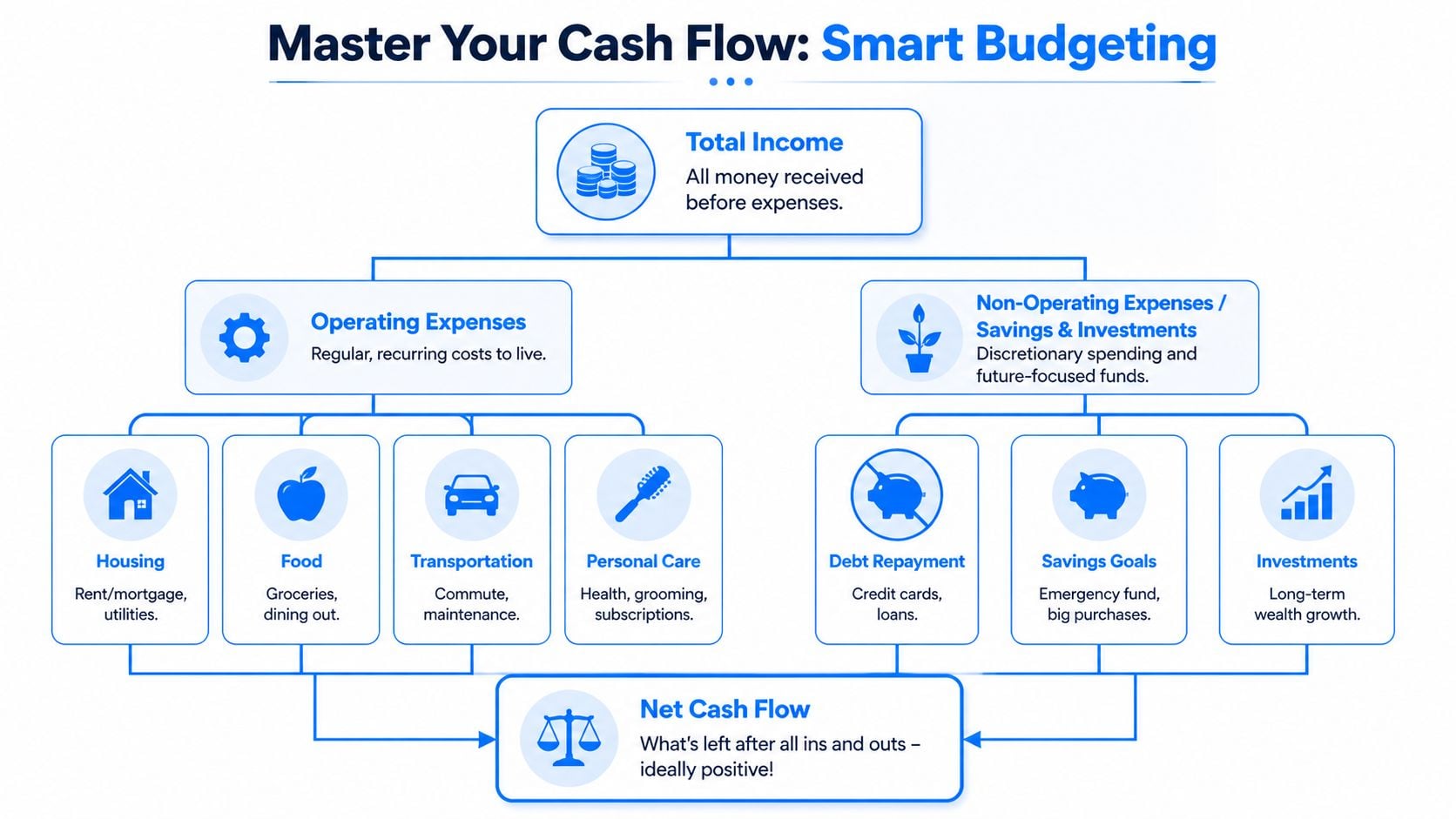
If I were reviewing a business with no P&L discipline, I wouldn’t trust its strategy. Personal finance works the same way. You can’t make sensible choices about debt, savings, or investing if you don’t know what’s coming in, what’s going out, and what those outflows are doing for you.
The simplest working model is to treat your household like an operating entity. Income comes in. Essential expenses keep life running. Other outflows either support future goals or weaken them.
Use a framework that’s easy to maintain
A lot of people fail at budgeting because they choose a format they won’t keep up with. Start with one of these:
- 50 30 20 structure: 50% for needs, 30% for wants, and 20% for savings is a practical benchmark cited in this overview of personal finance foundations.
- Zero-based budgeting: Every dollar gets a job before the month starts. That doesn’t mean every dollar gets spent. It means every dollar gets assigned.
- Owner salary model: If your business income fluctuates, pay yourself a steady draw and build the budget around that number, not around your best month.
The discipline matters because small leakages add up. The same source notes that a Princeton study of over 10,000 households found that overspending by 5% can lead to 15% lower retirement balances. That’s a budgeting problem, not just an investing problem.
What works and what doesn’t
Here’s what I’ve seen work in practice:
Approach
Works when
Fails when
Simple category budget
Income is stable enough to predict core spending
Categories are too broad to catch drift
Zero-based budget
You want tighter control and clear trade-offs
You stop tracking real transactions
Separate personal and business cards
You need cleaner reporting and easier review
You keep making “just this once” exceptions
What doesn’t work is guessing. Manual backfilling also tends to fail because people get busy, then reconstruct spending from memory, then lose confidence in the numbers.
Good budgeting depends on good data hygiene
This matters more for business owners than most advice admits. If receipts sit in inboxes, invoices live across Amazon, Google, Microsoft, Stripe, and PayPal, and transactions hit mixed cards, your budget won’t stay accurate for long. Clean records are what make a budget usable.
Budgeting gets easier the moment collection becomes automatic and review becomes routine.
The goal isn’t to build a beautiful spreadsheet. The goal is to make month-end personal cash flow obvious enough that you can act on it quickly.
Foundation 2 Build Your Safety Net with Emergency Savings
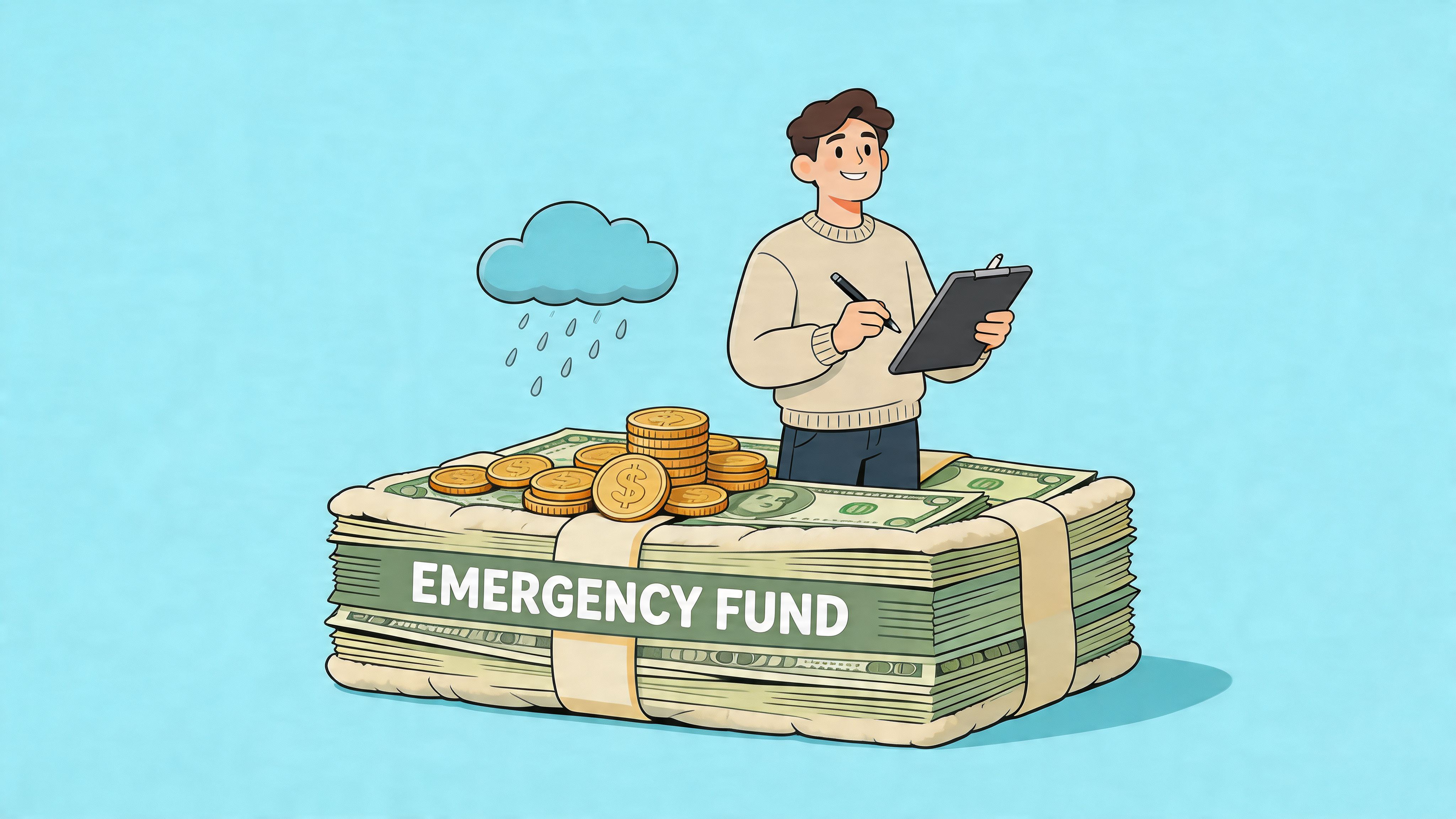
An emergency fund changes behavior before it changes your balance sheet.
Without a cash buffer, every surprise becomes a decision under stress. A delayed client payment, an urgent car repair, a laptop replacement, or a seasonal slump can push you toward the wrong fix. Usually that means expensive debt, raiding tax money, or skipping obligations you should’ve planned for.
That’s why I treat emergency savings as absolutely essential for owners and freelancers. Variable income makes the need stronger, not weaker.
Start smaller than you think
One reason people avoid this foundation is that the target feels too large. That’s why many frameworks recommend a $500 emergency fund as the first step. As explained in Shoeboxed’s summary of the Five Foundations, that number is intentionally reachable and helps build momentum while covering small, unexpected expenses that might otherwise force more borrowing.
That’s smart behavioral design. People don’t need a heroic first move. They need an achievable one.
A small emergency fund won’t solve every problem. It will solve enough small ones to stop the constant financial backsliding that keeps people stuck.
For business owners, define two layers of protection
You need to think beyond a generic “rainy day fund.” In practice, I like two lenses:
- Household essentials Keep enough set aside to handle core living costs during an income interruption.
- Business shock absorption Account for irregular receivables, urgent software or equipment costs, and operating surprises that owners often cover personally.
If you want a useful framework for mastering your finances, start by identifying your true essentials. Not ideal spending. Essential spending.
How to build it without starving the business
A common mistake is waiting for the perfect month to save. That month rarely arrives. Better options:
- Sweep a fixed amount weekly: Smaller transfers are easier to sustain than one large monthly move.
- Save from every client payment: Tie the habit to inflows so you don’t depend on willpower.
- Park the money outside your operating account: If it’s too visible, you’ll justify using it.
A real emergency fund is boring on purpose. If it feels available for ordinary spending, it isn’t an emergency fund.
Once the starter fund is in place, build toward a larger reserve based on your essential expenses and income volatility. The exact target will vary. The principle won’t. Cash reserves buy time, and time lets you make better decisions.
Foundation 3 Manage Debt and Leverage Credit Strategically
Debt isn’t one thing. That’s where most advice falls apart.
A revolving credit card balance used to cover routine overspending is very different from a well-structured business loan used for equipment, expansion, or working capital. One drains flexibility. The other can support growth if the math is sound and repayment is realistic.
That distinction matters because debt carries both financial and psychological weight. As noted earlier, consumer debt is widespread. 60% of U.S. adults carried credit card debt in 2019, and 23% of adults ages 18 to 29 had credit card debt more than 90 days overdue. That should tell you this isn’t mainly a knowledge issue. It’s a systems issue.
Separate harmful debt from strategic debt
A simple way to assess any debt is to ask three questions:
- Does it fund consumption or capacity?
- Can I repay it from reliable cash flow?
- Would I still take it if the next quarter is weaker than expected?
If the debt funds a lifestyle gap, it’s usually harmful. If it funds productive capacity and your repayment assumptions are conservative, it may be justified.
Build a repayment plan you’ll actually follow
There are two practical payoff methods:
- Avalanche approach: Prioritize the highest-cost balances first.
- Snowball approach: Clear smaller balances first if quick wins help you stay engaged.
Either can work. The wrong method is the one you abandon after two billing cycles.
For business owners, clean records matter here more than people realize. Lenders look for consistency. You also need your own clarity. If business and personal expenses are mixed, you can’t judge your real debt position with confidence.
Credit should support a plan. It shouldn’t patch over the absence of one.
A lot of people also underestimate how everyday habits affect future borrowing. If you want a grounded explanation of what impacts your credit score, review the basic drivers and then map them against your monthly behavior, not your intentions.
The goal isn’t to fear debt. It’s to remove expensive, chaotic debt and use credit carefully when it improves outcomes.
Foundation 4 Protect Your Assets and Your Future
Protection is the least exciting foundation, which is exactly why people postpone it.
Savings, debt payoff, and investing feel active. Insurance feels like paying for something you hope never to use. But from a controller’s perspective, protection is what stops a single event from wiping out years of discipline.

Cover the risks that can break the plan
For most business owners and finance professionals, the key protection areas are straightforward:
- Health insurance: A major health issue can disrupt both income and household stability.
- Disability cover: If your income depends on your ability to work, this matters more than many people think.
- Term life insurance: Relevant if others depend on your income.
- Professional liability or business cover: Important if your work creates client exposure.
- Property protection: Home and auto losses can spill into business cash flow fast.
A founder with no disability protection but a solid investment account is protecting the wrong thing. The income engine comes first.
Don’t just buy policies. Document well
Insurance gets much easier when your records are clean. That applies before a claim and during one. You need to know what you own, what it’s worth, what you paid, and how to prove it.
For homeowners, comparing policy details matters as much as price. If you’re reviewing options in that market, a guide to secure Florida home insurance coverage is useful because it pushes you to compare actual terms, not just premiums.
A simple protection review
Use this once a year:
Protection area
Question to ask
Income
If I couldn’t work, what replaces my earnings?
Dependents
Who would be exposed if I died unexpectedly?
Liability
Could one client issue create a serious financial hit?
Property
Could I prove ownership and value quickly?
Protection isn’t about buying every possible policy. It’s about identifying the risks that would do real damage and covering those first. If you skip this foundation, the other four stay exposed.
Foundation 5 Grow Your Wealth Through Investing
Investing is where the earlier discipline starts to compound into freedom.
Too many people delay this stage because they think they need a perfectly clean slate first. In real life, the decision is often more nuanced. If you wait until every obligation disappears, you may give up years of growth that you can’t recover later.

Don’t let debt payoff become an excuse to never invest
There’s a valid contrarian view here. According to Paladin Registry’s discussion of the five foundations, debt-averse portfolios underperform by 1.5% annually during low-rate periods when investors over-emphasize debt payoff. The same source notes that 40% of U.S. workers are in the gig economy, which makes income diversification through side work and additional revenue streams a practical part of wealth building.
That doesn’t mean you should invest while ignoring toxic debt. It means you should think in terms of return, risk, and timing, not slogans.
What this looks like for owners
Business owners usually have more than one investing lane:
- Retirement accounts: SEP IRA, Solo 401(k), or similar options depending on structure and income.
- Taxable brokerage investing: Useful for flexibility outside retirement wrappers.
- Business reinvestment: Sometimes the best return is in the business, but only if it produces durable cash flow.
- Income diversification: Additional service lines, advisory work, or side ventures can reduce concentration risk.
The mistake is treating these as all-or-nothing choices. They’re usually sequencing choices.
Start with consistency, not complexity
If your cash flow is still messy, investing will feel sporadic and stressful. If your records are clean and your monthly plan is stable, investing becomes operational. You automate contributions, review allocations, and avoid turning every market move into a personal crisis.
This short video gives a useful visual explanation of how the foundations connect to long-term wealth:

Wealth building usually looks ordinary while it’s happening. The excitement people want is often the thing that hurts returns.
If you’re asking what are the five foundations of personal finance really for, this is the answer. They create the conditions for steady investing without constant financial firefighting.
Frequently Asked Questions
Business owners usually don’t struggle with the ideas. They struggle with applying them when real life gets messy. These are the questions that come up most often.
Common decisions in the real world
Question
Answer
My income changes every month. Can I still follow the five foundations?
Yes. Base your plan on a conservative owner-pay number, not on your highest revenue month. Keep personal essentials lean and let surplus months strengthen reserves, reduce debt, or fund investments.
Should I reinvest in my business before building personal savings?
Not automatically. If the business needs every spare dollar, your household is carrying more risk than you think. Build enough personal stability that one rough quarter doesn’t force bad business decisions.
I’m overwhelmed. What’s the first step?
Clean up the data. Gather accounts, cards, recurring bills, loan balances, and recent spending records. Once the numbers are visible, the next action usually becomes obvious.
Should I pay off all debt before I invest anything?
Not always. Expensive consumer debt deserves urgency. Lower-cost debt may justify a more balanced approach if you can save and invest consistently at the same time.
How separate should personal and business finances be?
Very separate. Separate cards, separate accounts, and separate review routines make tax, borrowing, budgeting, and decision-making much easier.
What if my spouse or business partner isn’t as organized as I am?
Build a simple system they can follow. Complexity kills consistency. Shared visibility and a few recurring check-ins beat an elaborate plan no one maintains.
A practical order that holds up
If someone handed me a messy financial life and asked for the shortest route to control, I’d use this order:
- Get clean records
- Build a working budget
- Create the starter emergency fund
- Stop debt from growing
- Protect key risks
- Invest steadily once the system holds
That order works because it reflects how finance behaves. You can’t manage what you can’t see. You can’t protect what you haven’t stabilized. And you can’t invest confidently while every surprise knocks you off course.
The question behind most other questions
Individuals often ask about tactics, but the underlying issue is usually this: “How do I stop money from feeling chaotic?”
The answer is structure. Not motivation. Not hacks. Not a perfect spreadsheet you abandon in three weeks.
If you’re a business owner, accountant, or bookkeeper, you already know the principle. Clean data leads to better reports. Better reports lead to better decisions. Personal finance follows the same logic.
If you want a cleaner way to support these foundations in daily practice, Booksmate helps by automatically collecting invoices and receipts from portals and inboxes, extracting the key data, and organizing everything for export into your accounting workflow. For business owners and finance teams, that means less manual chasing, better records, and a clearer view of the cash flow decisions that shape both personal and professional financial health.