Articles
What Is Expense Reimbursement? A Simple Guide (2026)
At the end of the month, a lot of businesses still run expense management from a shoebox, a shared folder, or a pile of forwarded emails.
An employee buys train tickets for a client meeting, someone else grabs printer ink on their personal card, and a manager pays for lunch during a site visit. Weeks later, the bookkeeper is chasing faded receipts, employees are asking when they’ll be paid back, and nobody is fully sure which purchases were approved.
That messy situation is exactly why expense reimbursement matters. It is not an accounting task only. It is the system a business uses to pay people back for legitimate work costs they covered themselves.
When that system is weak, the damage spreads. Employees carry the cash burden, finance teams waste time, and mistakes slip into the books. The average worker now pays $320 per month out of pocket for business expenses, and workers collectively front $8 billion annually in work-related costs, while reimbursement delays cause employees to lose nearly $300 per year from late or missed payments, according to WorkLife’s reporting on reimbursement delays.
The Messy Shoebox Problem and Its Solution
A new business owner usually notices the problem before they learn the term.
It starts with a few small purchases. A team member buys postage. Someone pays for parking. A laptop charger gets replaced on the way to a meeting. None of it looks serious on its own. Then month-end arrives, and the business has ten different people sending screenshots, PDFs, and half-legible receipts.
What the shoebox costs
The visible problem is clutter. The hidden problem is friction.
Employees are doing the company more than a favor when they spend personal money on work needs. They are temporarily financing the business. That creates stress, especially when repayment is slow or unclear.
A manual process also creates operational drag:
- Employees hesitate to spend: Some delay necessary purchases because they do not want to be out of pocket.
- Bookkeepers chase documents: Time goes into follow-ups instead of clean reconciliation.
- Managers approve inconsistently: One person says yes to a meal, another rejects a similar one.
- Records weaken over time: Receipts disappear, details fade, and tax support gets shakier.
Tip: If your reimbursement process depends on memory, inbox searches, or a desk drawer full of receipts, it is already too fragile.
The solution is structure, not paperwork for its own sake
What is expense reimbursement? In plain language, it is a formal way for a business to repay employees for approved business costs they personally paid first.
Good reimbursement systems do something simple. They turn “I paid for this for work” into a clear, documented, reviewable transaction.
That matters for accounting, tax, and fairness. It also matters for basic recordkeeping. If you need a practical reminder of what solid documentation looks like, ATO's record-keeping requirements are a useful example of how seriously tax authorities treat complete and organized business records.
Understanding Expense Reimbursement Fundamentals
Think of expense reimbursement as a company IOU with rules.
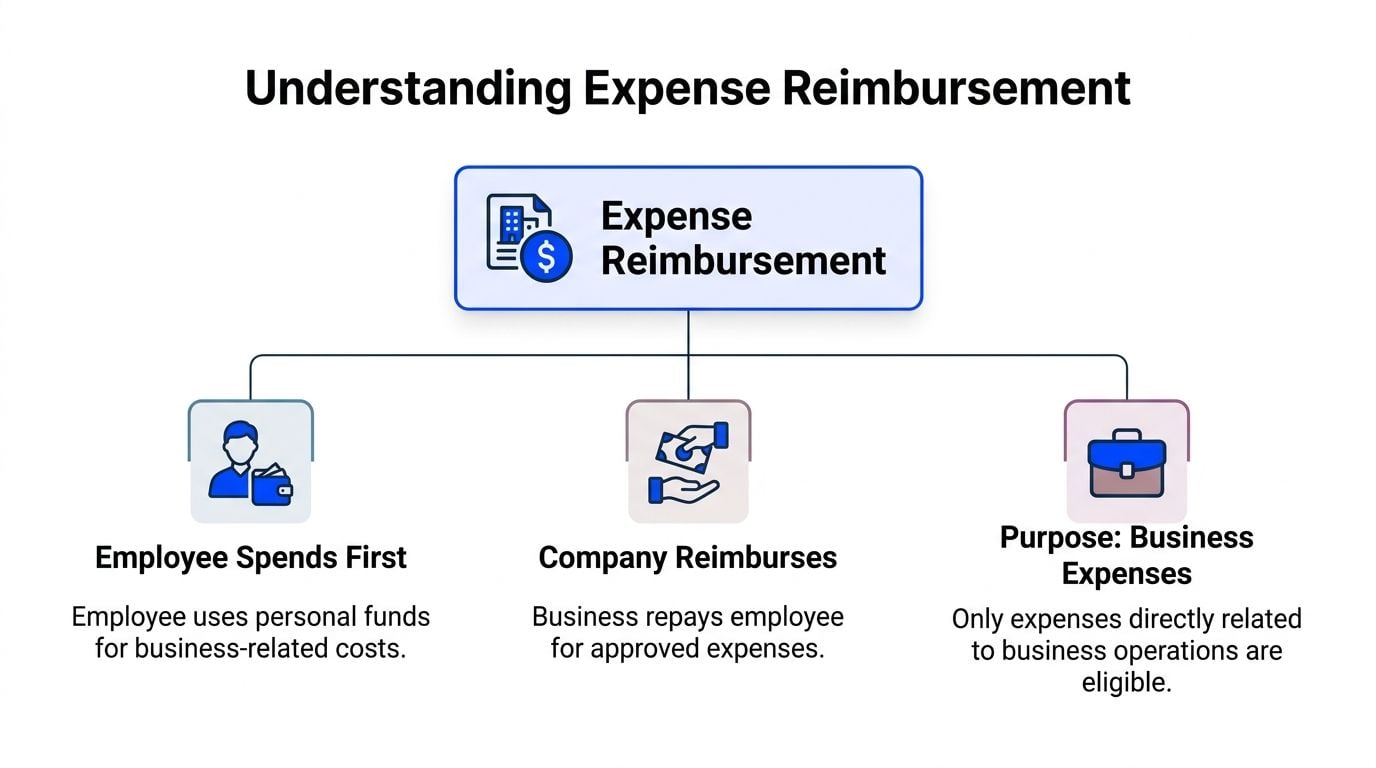
An employee pays for something the business needed. The company checks that the purchase was legitimate, documents it, and pays the employee back. That is the core idea.
The basic definition
Expense reimbursement is the repayment of out-of-pocket business expenses that an employee covered with personal funds.
A simple example helps. If your sales manager buys a hotel room for a client trip on their own card, the business can reimburse that cost after the manager submits the receipt and the trip details.
Three parts must be true for the concept to make sense:
- The employee spends first: Personal funds are used up front.
- The expense is business-related: It supports the employee’s job duties or company operations.
- The business repays after review: Payment comes after the claim is checked against policy.
Why businesses use reimbursement systems
A reimbursement process does more than move money back to the employee.
Control
Without a process, spending becomes scattered. Reimbursement creates visibility. The business can see who spent what, when, where, and why.
That matters whether you are reviewing software purchases, mileage claims, or travel receipts.
Compliance
Reimbursement is tied to tax and payroll rules. If records are weak, the business can create avoidable tax problems. A proper process helps prove the expense was legitimate and documented.
Fairness
Employees need to know the rules in advance. They should not have to guess whether a taxi, meal, or supply purchase will be repaid. A clear reimbursement system removes that uncertainty.
Key takeaway: A reimbursement policy is not about saying “yes” or “no” to spending. It is how a business creates consistency.
How reimbursement differs from corporate cards
Corporate cards reduce the need for employees to front their own money. Reimbursement does not replace cards in every case.
Instead, it fills the gap when:
- a worker needs to make a one-off purchase
- a vendor does not accept the company’s usual payment method
- a business is too small to issue cards broadly
- a purchase happens unexpectedly in the field
That is why understanding what is expense reimbursement matters even if your company also uses card programs.
Common Types of Reimbursable Expenses
Most confusion comes from one phrase: business expense.
People hear it and think it covers anything work-adjacent. It does not. The better question is, “Would a reasonable person see this purchase as necessary for the employee to do their job?”
Travel and accommodation
Travel is one of the most common reimbursement categories.
Examples often include flights, train tickets, hotel stays, taxis, rideshares, parking, tolls, and baggage fees for approved work travel. If an employee attends a conference, visits a client, or travels between business locations, these are often reimbursable if your policy allows them.
Common limits usually focus on reasonableness. A standard hotel may be fine. A luxury upgrade may not be.
Meals and client-related spending
Meals create more debate than almost any other category.
A meal during approved business travel may qualify. A client lunch may qualify if there is a clear business purpose. A casual coffee bought during a normal commute usually will not.
A practical rule helps. If the employee can explain who was involved, what the business purpose was, and why the expense happened, the claim is easier to support.
Supplies and small operational purchases
These are the “I grabbed it because we needed it” expenses.
They can include office supplies, printer ink, cables, shipping materials, or software bought for an immediate work need. These purchases often look minor, but they add up quickly and are easy to lose track of without receipts.
Home office and remote work items
For remote teams, reimbursement may cover internet-related business use, headsets, webcams, desks, monitors, or approved software.
This area needs tight policy wording. Some companies reimburse only pre-approved items. Others cover a limited range of remote-work necessities but exclude furniture upgrades or general household costs.
Professional development
Training costs can also fall under reimbursement.
Examples include course fees, certification exams, conference registrations, or learning materials connected to the employee’s role. Businesses usually set boundaries here, such as requiring manager approval before the expense is incurred.
Vehicle use
If an employee uses a personal vehicle for work, the business may reimburse mileage, tolls, or parking related to that trip.
Regular commuting is usually treated differently from business travel between job-related locations. Policy wording matters most here, because employees often assume “driving for work” includes all driving connected to their job.
Practical test: If you cannot describe the business purpose in one clear sentence, the expense is probably not ready for reimbursement.
Navigating Tax and Compliance Rules
At this point, expense reimbursement transitions from a convenience issue to a tax issue.
In the United States, the key framework is the IRS accountable plan. Under these rules, reimbursements can be non-taxable to employees, but only if the business follows specific requirements. According to Tesseon’s summary of IRS accountable plan rules, the expense must have a business connection, be substantiated with receipts within 60 days, and any excess advance must be returned within 120 days. If those conditions are not met, the reimbursement becomes taxable wages and increases payroll tax liabilities.
The three tests that matter
The rules sound technical, but the logic is simple.
Business connection
The expense must directly relate to the employee’s job.
If a technician buys materials for a service call, that has a business connection. If the same employee buys something personal and tries to bundle it into a claim, it does not.
Adequate accounting
The employee must provide documentation. That usually means receipts, dates, amounts, vendors, and a business purpose.
The timing matters too. “I’ll submit it eventually” is not a compliance system.
Return of excess amounts
If the company gives an advance and the employee spends less than expected, the extra amount must be returned within the required timeframe.
That rule often gets overlooked in smaller businesses. It still matters.
A short explainer can help frame the concept:

What happens when the rules are ignored
The consequence is more than a messy file.
If a reimbursement fails accountable plan rules, the payment can be treated like wages. That means payroll reporting, withholding, and a larger administrative burden for the business. A process that felt informal suddenly affects payroll tax handling.
This is why receipt deadlines and documentation standards are not “finance being picky.” They protect the tax treatment of the reimbursement.
Regional variation makes things harder
Businesses with people in different states or countries face another layer of complexity. General advice often says reimbursement rules vary by jurisdiction, but that line hides a real operational problem.
For example, Tipalti’s discussion of expense reimbursement compliance notes that Texas guidelines specify expense advances within 30 days and substantiation within 60 days. Even if your business is small, that kind of variation means one vague policy can create risk when teams operate across multiple locations.
Tip: Build your policy around the strictest documentation habit you need, not the loosest one you think you can get away with.
The Reimbursement Process Step by Step
A reimbursement claim moves through more people than many owners realize.
The employee starts it. A manager usually validates it. Finance or bookkeeping checks the details, posts the entry, and pays it. If one person drops the ball, the whole process slows down.
Step one through step three
1. The employee pays for the expense
This is the starting point. The worker uses personal funds for an approved business need.
At this stage, the most important job is simple. Keep the receipt and note the business purpose while it is still fresh.
2. The employee submits a claim
The claim should include the date, vendor, amount, category, and reason for the purchase. If your team uses forms, email, or an expense app, the key is consistency.
A weak submission sounds like, “Taxi after meeting.” A strong one sounds like, “Taxi from airport to client office for scheduled sales presentation.”
3. A manager reviews it
The manager’s role is not to approve spending mechanically. They are checking whether the purchase was necessary, within policy, and properly described. Many businesses discover they do not have a policy at this stage. They have habits.
Step four and step five
4. Finance or bookkeeping processes the claim
This step includes coding the expense correctly, checking the receipt, and making sure the reimbursement is recorded properly.
According to Alaan’s explanation of reimbursement accounting, proper accounting follows double-entry principles by debiting the relevant expense account and crediting cash. The same source notes that AI-OCR extraction can auto-populate receipt data with 98% accuracy, helping reduce manual entry errors tied to 22% of mis-categorizations.
That matters because reimbursement is not finished when the manager clicks approve. It is finished when the transaction lands correctly in the books.
5. The employee gets paid back
Payment may happen through payroll or as a separate bank transfer, depending on the business. What matters most is predictability.
If employees know claims are paid on a regular schedule, they trust the system more and ask fewer status questions.
Where bottlenecks usually appear
Most delays come from a few repeat issues:
- Missing proof: The employee forgot the receipt or submitted an incomplete screenshot.
- Slow approval: A manager sits on the request.
- Unclear coding: Finance has to guess the category.
- Out-of-policy spending: The employee bought first and asked later.
Best practice: Write down who owns each step. “Someone in finance handles it” is not a workflow.
Building a Clear and Fair Expense Policy
A good policy removes guesswork before spending happens.
It tells employees what they can buy, what proof they need, when they must submit claims, and who signs off. It also protects the finance team from making judgment calls from scratch every time.
What your policy should cover
Policies work best when they are written in plain language. If an employee needs legal interpretation to understand whether parking is reimbursable, the policy is too vague.
The most useful version usually covers:
- Who is covered: Employees only, or also certain other workers if your process includes them
- Eligible expenses: Travel, meals, supplies, software, mileage, and other approved categories
- Non-eligible expenses: Personal items, commuting, upgrades, fines, or undocumented purchases
- Required documents: Receipts, invoices, mileage logs, meeting notes, or client names where relevant
- Submission deadlines: Clear timelines for turning in claims
- Approval flow: Who reviews first, and who processes payment
Key Elements of an Expense Reimbursement Policy
Policy Element
What to Include
Employee scope
Which workers the policy applies to and any role-based differences
Reimbursable categories
A practical list of approved expense types with examples
Non-reimbursable items
Clear exclusions so employees know what will be rejected
Documentation rules
What proof is required, in what format, and how complete it must be
Submission timing
Internal deadlines for claims and supporting records
Approval workflow
Which manager or finance role approves each type of claim
Payment timing
How and when reimbursements are issued
Exceptions process
Who can approve unusual situations and how that approval is documented
Why specificity matters
Regional rules can complicate even a simple policy. As noted in Tipalti’s overview of regional reimbursement variation, Texas guidelines specify expense advances within 30 days and substantiation within 60 days. That is a good reminder that a multi-state or global business cannot rely on vague internal habits.
A strong policy is also fairer. It stops one manager from approving expensive dinners while another rejects modest claims because “that’s not how I do it.”
If you want fewer disputes, write examples into the policy. People follow examples faster than abstract rules.
Common Pitfalls and How Automation Solves Them
Manual reimbursement processes fail in ordinary ways.
A receipt goes missing. A claim arrives late. Someone enters the wrong amount from a blurry image. A duplicate request slips through. None of these mistakes feels dramatic in isolation. Together, they create cost, delay, and distrust.
The most common manual failures
Some problems hit employees first. Others hit finance first. Most hit both.
Lost or weak documentation
Paper receipts fade. Email attachments disappear. Screenshots get cropped. When proof is weak, the business struggles to verify the claim and support the accounting entry.
Slow reimbursement cycles
Employees wait, then follow up, then resend documents. The bookkeeper checks the inbox, asks a manager, and re-creates the trail.
That is not inefficient only. It trains staff to avoid making necessary purchases or to treat the process as a fight.
Fraud and policy violations
Expense abuse is easier when tracking is loose. According to ExpenseOut’s reimbursement statistics and trends, companies lose up to 5% of annual revenue to expense fraud and policy violations, and 75% of businesses say manual tracking increases that risk.
Reimbursement needs controls, not solely trust. If you are reviewing your wider approval environment, these internal controls best practices offer a helpful framework for thinking about authorization, documentation, and oversight.
Why automation changes the equation
Automation is framed as a convenience upgrade. In reimbursement, it is closer to infrastructure.
When systems collect receipts digitally, extract key fields, and route approvals consistently, they remove many of the failure points that manual processes create.
Here is what automation does well:
- Captures records early: Receipts are stored before they are lost.
- Standardizes submissions: Every claim includes the same core data fields.
- Flags exceptions faster: Missing documents or unusual amounts are easier to spot.
- Reduces rekeying: Finance teams do less copy-and-paste work.
- Creates an audit trail: Approvals and edits are easier to trace later.
ExpenseOut also reports that businesses adopting automation can reduce processing time by 60% and cut costs by 35% through more efficient workflows and fewer manual steps.
Key takeaway: Automation is not replacing judgment. It is removing avoidable clerical work so people can focus on review, policy, and accuracy.
What this means for a growing business
A founder with five employees can sometimes survive on email and spreadsheets.
A business with more spenders, more vendors, more remote work, or more travel cannot. At that point, reimbursement stops being a side task and becomes an operating process. If you keep treating it like a side task, the friction keeps growing.
Frequently Asked Questions About Expense Reimbursement
What is the difference between an accountable plan and a non-accountable plan
An accountable plan follows the required tax rules for business connection, documentation, and return of excess advances. When those rules are met, reimbursements are generally non-taxable to the employee.
A non-accountable plan does not meet those standards. In that case, the reimbursement can be treated as taxable wages.
How long should a business keep reimbursement records
Keep reimbursement records according to your tax, payroll, and accounting record retention requirements in the jurisdictions where you operate.
The key point is more than keeping the receipt. It is keeping the receipt tied to the business purpose and approval trail.
Can independent contractors be reimbursed too
They can, but the process is different from employee reimbursement and should be handled carefully.
For contractors, reimbursement terms are often set by contract. The business should spell out what expenses are billable, what proof is required, and how those costs will appear on invoices or payment records. Do not assume your employee policy automatically applies to non-employees.
Should reimbursement be paid through payroll or separately
Either can work, depending on your systems and compliance setup.
What matters is accurate treatment, clear records, and a consistent payment process. Many businesses prefer separate handling so reimbursement activity is easier to track and reconcile.
If your team still spends hours downloading receipts from Amazon, Stripe, Google, Microsoft, PayPal, and email inboxes, Booksmate can help you collect those documents automatically, extract the data with AI, and organize everything for export to your accounting software. It is built for bookkeepers, accountants, and finance teams that want a cleaner reimbursement workflow without the usual manual chase.