

Imagine your business’s finances are a story. The income statement is the exciting movie, showing all the action—sales, expenses, and profits—over a few months or a year. The balance sheet? It’s a single, perfectly captured photo.
It’s your business’s financial selfie. A snapshot in time that shows exactly where you stand on one particular day. For any small business owner, it’s an absolutely essential tool for making smart decisions and proving you’re on solid ground.
Your Business’s Financial Selfie Explained
So, what does this “selfie” actually show? It’s a clean, organized breakdown of your company’s financial health that answers three simple but crucial questions: What do we own? What do we owe? And what’s actually left over for us, the owners?
I get it. When you’re busy running the show, juggling sales, and putting out fires, digging into financial statements can feel like a chore you’d rather save for tax season. But ignoring your balance sheet is like driving a car without a dashboard. You might be moving forward, but you have no idea how fast you’re going, how much fuel is in the tank, or if the engine is about to overheat.
Think of it as your financial early-warning system. It helps you spot small issues before they spiral into massive problems.
The Unbreakable Rule of Balance
The entire report hinges on one simple, powerful formula. It’s the golden rule of accounting.
Assets = Liabilities + Equity
This isn’t just a suggestion; it’s a law. The two sides of the equation must always be equal, which is exactly where the balance sheet gets its name. Every single transaction you make will touch at least two parts of this formula, keeping everything in perfect sync. This is the foundation of double-entry bookkeeping.
For instance, say you take out a $10,000 business loan. Your cash (an asset) goes up by $10,000, but so does your loans payable (a liability). The scale stays perfectly balanced.
Why Your Balance Sheet Matters More Than You Think
A clean, up-to-date balance sheet does so much more than just keep your books in order. It’s one of the first documents lenders and investors will ask for. They scan it to gauge your company’s health and decide if you’re a good bet. A strong balance sheet can be your ticket to better loan terms or the key to landing that investor you’ve been chasing.
Ultimately, it gives you the real answers to the questions that keep you up at night:
Do we have enough cash on hand to make payroll and pay our bills next month?
Are we leaning too heavily on debt to keep the lights on?
Is the net worth of my business actually growing?
This financial snapshot tells you about your liquidity (can you pay your immediate bills?), your leverage (how much of the business is funded by debt?), and your overall solvency. Getting a handle on these numbers is the first step to turning confusing data into confident, strategic decisions. Without it, you’re just guessing.
Deconstructing Assets, Liabilities, and Equity
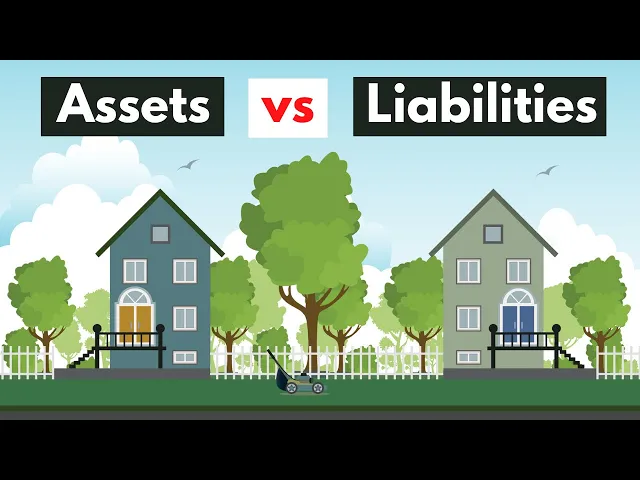
Every single balance sheet, no matter the business, is built on three core parts that follow one simple, unbreakable rule: Assets = Liabilities + Equity. Getting your head around what each piece represents is the key to unlocking the story your finances are trying to tell you.
Let’s break down this fundamental equation.
Think of your business as a house. The house itself, plus everything valuable you own inside it, represents your assets. The mortgage you still owe the bank is your liability, and the portion you’ve actually paid off and truly own is your equity. It really is that straightforward.
This diagram shows you exactly how it all fits together.
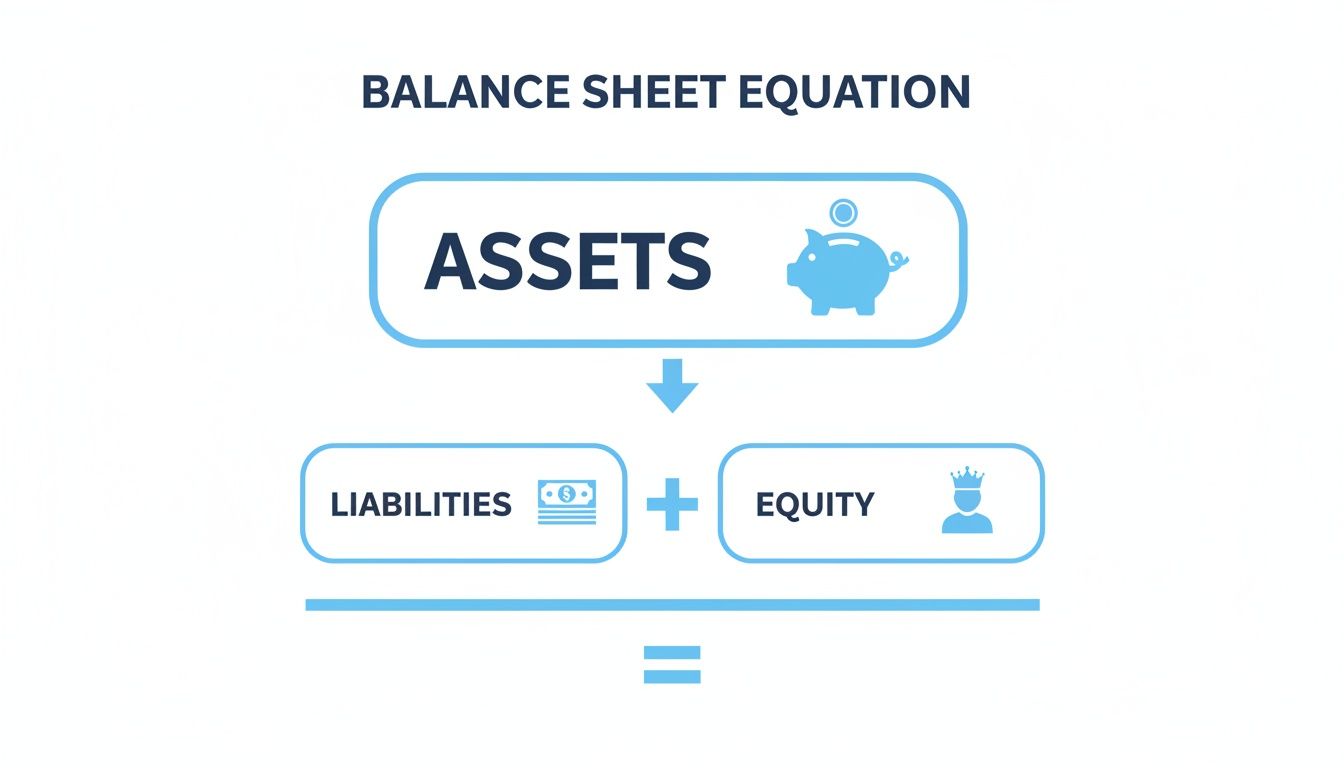
As you can see, everything the business owns (Assets) is funded by either what it owes to others (Liabilities) or what the owners have invested (Equity). This is why it’s called a balance sheet—both sides of the equation must always be equal.
What Your Business Owns: Assets
Assets are all the valuable resources your company owns that will provide a future benefit. Basically, it’s all the stuff that helps you operate your business and bring in cash. To make things clearer, we split them into two groups.
Current Assets These are the resources you expect to use or convert into cash within one year. They’re a fantastic snapshot of your business’s short-term health.
Cash and Equivalents: This is the most obvious one—the money sitting in your business bank accounts.
Accounts Receivable: Money you’re owed. Think of all the invoices you’ve sent to clients that haven’t been paid yet.
Inventory: For businesses that sell physical goods, this is the value of all the products you have on hand, ready to be sold.
For example, a freelance designer’s current assets would be the balance in their bank account and any outstanding invoices. A coffee shop’s would be the cash in the register, its bank balance, and the value of all its coffee beans, milk, and cups.
Non-Current Assets These are your long-term investments—the things you don’t plan on turning into cash within a year. They form the backbone of your business operations.
Property, Plant, and Equipment (PP&E): This is all the big-ticket physical stuff: buildings, company vehicles, machinery, and even your office furniture.
Intangible Assets: These are valuable assets you can’t physically touch, like patents, trademarks, and copyrights.
A designer’s high-end computer is a non-current asset. For the coffee shop, it’s that fancy espresso machine they invested in.
What Your Business Owes: Liabilities
On the flip side, liabilities are your financial debts and obligations to other people or companies. Just like assets, we categorize them based on when they’re due, which helps you stay on top of your financial commitments.
Liabilities represent outside claims on your company’s assets. Keeping them in check is vital for long-term stability and avoiding cash flow crises.
Current Liabilities These are the debts you need to settle within the next year. Managing these closely is absolutely critical for your day-to-day survival.
Accounts Payable: The money you owe to your suppliers and vendors for things you’ve already received.
Short-Term Loans: Any loan or line of credit that needs to be paid back in a year or less.
Accrued Expenses: These are expenses you’ve racked up but haven’t paid for yet, like the next payroll for your employees.
Long-Term Liabilities These are financial obligations that are due more than a year from now.
Long-Term Loans: Think of a multi-year small business loan or a mortgage on your office building.
Bonds Payable: If you’ve borrowed money from investors through bonds, this is where that debt lives.
If you don’t manage your liabilities well, you can run into serious trouble. In fact, cash flow problems are the third biggest financial headache for 51% of small businesses. When your customer payments (an asset) are slow to come in, it gets a lot harder to pay your supplier bills (a liability) on time. This tug-of-war shows up right on the balance sheet and can be a major red flag for lenders. You can see more in this research about small business revenue statistics and their common challenges.
What’s Left Over: Equity
So, what’s left after you subtract all your liabilities from your assets? That’s your equity. Often called “net worth,” it represents the owner’s true stake in the company. On paper, it’s the real measure of your business’s value.
Equity is made up of two key things:
Paid-In Capital: This is the money or other assets the owners initially put into the business to get it off the ground. For our freelance designer, this might be the $5,000 they personally invested to buy a laptop and software.
Retained Earnings: This is the running total of all the profit your business has made over the years, minus any money paid out to the owners (as dividends or draws). It’s profit you’ve chosen to reinvest back into the business to help it grow.
If our coffee shop made a $20,000 profit last year and the owner decided to keep $15,000 of it in the business account to upgrade equipment, that $15,000 gets added to retained earnings. Seeing that number grow is a powerful sign of a healthy, thriving business.
How to Create Your First Balance Sheet
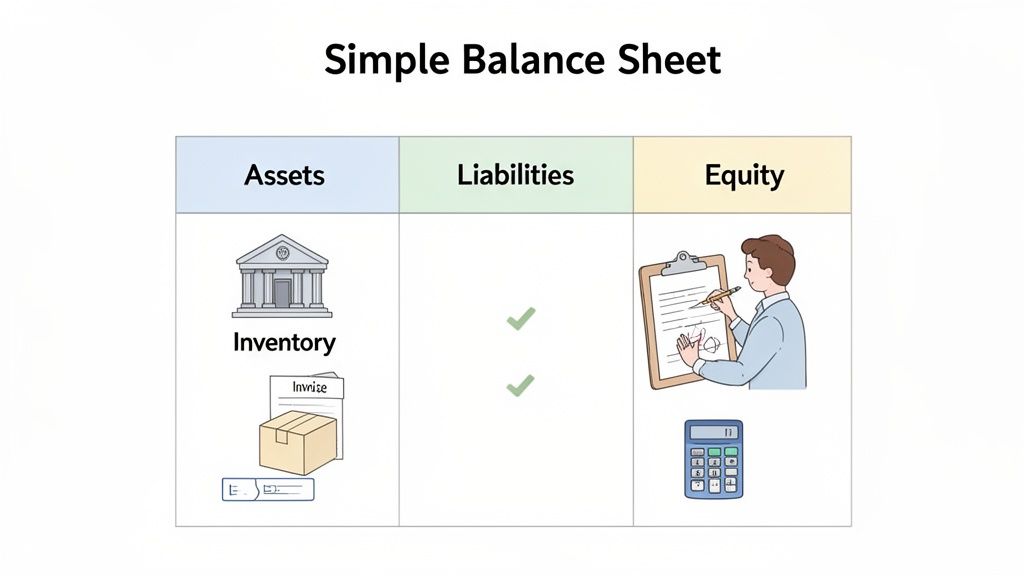
Alright, let’s roll up our sleeves and put all this theory into practice. Building your first balance sheet might seem like a huge task, but it’s really just a matter of following a few logical steps. This isn’t just about checking a box for your accountant; it’s about gaining a powerful snapshot of your business that you can actually use.
Think of it like you’re about to assemble some IKEA furniture. You start by laying out all the pieces, then you follow the instructions to put them together. Let’s get started.
Choose Your Reporting Date
First things first: you need to pick a date. A balance sheet is a financial snapshot, meaning every number on it reflects your business’s position on one specific day. Common choices are the last day of the year (December 31st) or the end of a quarter (March 31st).
The real power comes from consistency. By preparing your balance sheets for the same date each period (monthly, quarterly, or annually), you can easily compare them side-by-side. This is how you spot trends and see how your business is evolving.
Step 1: Gather Your Financial Documents
Now it’s time to go on a little scavenger hunt for your financial records. Don’t be tempted to rush this part—the accuracy of your balance sheet completely depends on the quality of the documents you start with.
You’ll want to have these items ready to go:
Bank and Credit Card Statements: Get the most recent statements for every business account.
Loan Agreements: This includes any small business loans, lines of credit, or commercial mortgages.
Inventory Records: If you sell products, you’ll need an up-to-date count of your inventory and what it’s worth.
Accounts Receivable Aging Report: This is your list of all unpaid customer invoices—basically, who owes you money.
Accounts Payable Aging Report: This is the opposite—a list of all the bills you owe to your suppliers.
Fixed Asset Records: Gather the details on your big-ticket items like company vehicles, machinery, or property. Make sure you have their original cost and purchase dates.
Once you have this pile of documents, you’re ready for the next step.
Step 2: List Your Assets
Okay, let’s start with the good stuff. Go through your documents and make a list of everything your business owns that has value. I find it helps to split them into two piles: current and non-current assets.
Current Assets: Add up the cash in your bank accounts, the total amount customers owe you (your accounts receivable), and the value of your inventory.
Non-Current Assets: List the value of your long-term stuff like equipment, vehicles, and buildings. Just remember to factor in depreciation if you have older assets.
Add both groups together to get your Total Assets. This is the first big number for your balance sheet puzzle.
Step 3: Tally Your Liabilities
Next up, it’s time to look at what your business owes. Using those same source documents, pull together a complete list of all your debts and obligations.
Just like with assets, we’ll split these into two categories:
Current Liabilities: Tally up your credit card balances, what you owe suppliers (accounts payable), and any portion of a loan that’s due within the next 12 months.
Long-Term Liabilities: Add up the remaining balances on any business loans or mortgages that you’ll be paying off for more than a year.
Combine these two to calculate your Total Liabilities. This number shows what outside parties have a claim on.
Your balance sheet is only as accurate as the data you feed it. Double-entry bookkeeping is the system that ensures every transaction is recorded in two accounts, making sure the fundamental equation always stays in balance.
Step 4: Calculate Equity and Balance Your Sheet
This is the final step where it all comes together. To find your owner’s equity, you’ll use that simple formula we talked about: Assets - Liabilities = Equity.
Practically speaking, you’ll add up your initial investment into the business (paid-in capital) and any profits you’ve reinvested over time (retained earnings). This gives you your Total Equity.
Now for the moment of truth. Add your Total Liabilities and your Total Equity together. That final number should be exactly equal to your Total Assets. If it matches, pop the confetti—you’ve officially created your first balance sheet!
To make this process even smoother, you might want to look into automating your financial statements in Excel. It can save you a ton of time and cut down on manual errors, especially as you start doing this more often.
From Raw Numbers to Smart Decisions
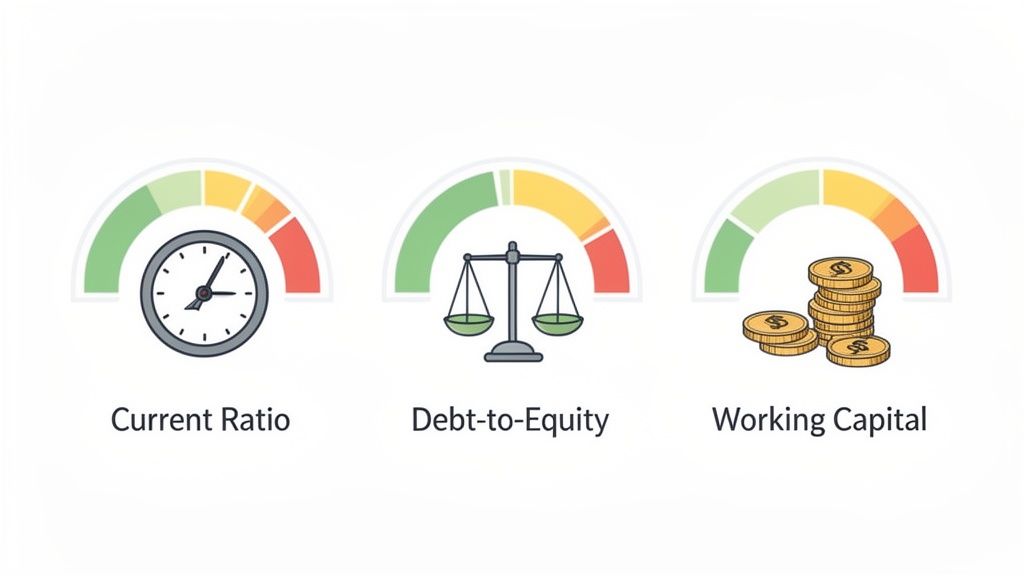
Putting together a balance sheet is a huge step, but the real magic happens when you learn how to read it. This isn’t just about making the numbers add up; it’s about learning the language of your business. By digging into a few key ratios, you can start to understand the story your finances are telling you—and use that story to spot risks, jump on opportunities, and make decisions with real confidence.
Think of these ratios as your business’s vital signs. They give you a quick, clear check-up on its overall health. Let’s walk through the most important ones.
Key Balance Sheet Ratios for Small Business Owners
Your balance sheet is packed with information, but these ratios distill it down into actionable insights. The table below breaks down the must-know formulas and what they really mean for your day-to-day operations and long-term strategy.
Ratio | Formula | What It Measures |
|---|---|---|
Current Ratio | Current Assets / Current Liabilities | Your ability to cover short-term bills and obligations. A key measure of liquidity. |
Debt-to-Equity Ratio | Total Liabilities / Owner’s Equity | How much of your business is financed by debt versus your own investment. It’s a snapshot of your financial risk. |
Working Capital | Current Assets - Current Liabilities | The cash available to fund your daily operations. This shows your operational efficiency and short-term financial health. |
By regularly checking these numbers, you can catch small problems before they become big ones and steer your business in the right direction.
Can You Pay Your Bills? The Current Ratio
Let’s get straight to the point: can your business cover its immediate debts? The current ratio answers this critical question with one simple number. It’s a head-to-head comparison of your short-term assets and your short-term liabilities, giving you a clear snapshot of your liquidity.
The Formula: Current Assets / Current Liabilities = Current Ratio
A ratio above 1.0 is what you want to see—it means you have more assets on hand than you owe in the near future. For a comfortable safety net, most experts recommend aiming for a ratio between 1.5 and 2.0.
If your ratio dips below 1.0, it’s a red flag. It might mean you’ll have a tough time paying your bills on time. This is your cue to take action, like chasing up unpaid invoices or paying down a high-interest credit card. It’s the best way to avoid the classic trap of being “asset-rich but cash-poor.”
Are You Relying Too Much on Debt? The Debt-to-Equity Ratio
How much of your company is funded by loans versus your own skin in the game? That’s what the debt-to-equity ratio tells you. It measures your financial risk by showing just how much you rely on borrowed money to keep things running—something lenders and investors look at very closely.
The Formula: Total Liabilities / Total Owner’s Equity = Debt-to-Equity Ratio
A high ratio can mean your business is taking on a lot of risk. While taking on some debt is often necessary for growth, leaning on it too heavily can leave you exposed if interest rates rise or the economy takes a dip.
What’s a “good” ratio? It really depends on your industry, but a general rule of thumb is that a ratio below 1.0 is considered pretty safe, while anything over 2.0 might be a warning sign. For small businesses in the U.S., this is a real concern. While they generate a massive $13.3 trillion in revenue, 39% carry debt over $100,000, and 51% struggle with uneven cash flows, which makes keeping this ratio in check essential for survival.
If your ratio is on the high side, it’s time to focus on paying down loans or boosting your equity by reinvesting profits back into the business.
Do You Have Enough Fuel for Daily Operations? Working Capital
Working capital is the lifeblood of your business. It’s the cash you have on hand to handle all the day-to-day stuff, from paying your suppliers and making payroll to buying new inventory.
The Formula: Current Assets - Current Liabilities = Working Capital
A positive working capital number is a great sign. It means you have more than enough in your short-term asset column to cover all your short-term bills. A negative number, however, could signal a cash crunch on the horizon.
For instance, if a small shop has $80,000 in current assets (like cash and inventory) and $50,000 in current liabilities (like bills from suppliers), their working capital is a healthy $30,000. That positive buffer means they’re in a solid position to manage their daily financial needs without stress.
While the balance sheet gives you a fantastic snapshot, it doesn’t tell the whole story. To get a complete picture, you also need to look at how your business performs over time. Tools like a Profit and Loss Analyzer can offer deeper insights into your operational performance. When you combine both views, you get a powerful, well-rounded understanding of where your business truly stands.
Common Balance Sheet Mistakes to Avoid
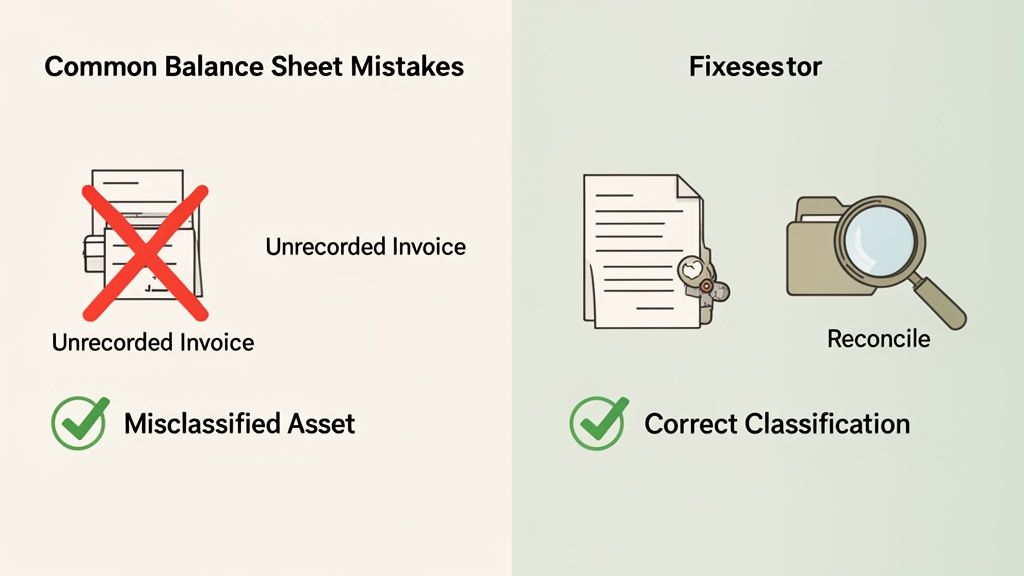
Putting together your balance sheet is a fantastic step, but even the most diligent business owners can stumble into a few common traps. The problem is that these little mistakes can warp your financial picture, leading you to make bad calls or run into nasty surprises later.
Luckily, once you know what to look for, most of these errors are pretty easy to spot and prevent. Think of your balance sheet as a finely tuned recipe—if one ingredient is off, the whole thing can be ruined. Getting the details right is what makes it a reliable tool.
Misclassifying Assets and Expenses
This is probably the most common mix-up I see. It’s easy to confuse an asset with a regular expense, but the difference is crucial. A simple rule of thumb: if you buy something that will provide value for more than a year, it’s almost always an asset. If its value gets used up quickly, it’s an expense.
Let’s say you buy a new, high-end printer for $3,000. That’s a piece of equipment you’ll use for years, so it belongs on your balance sheet as a non-current asset. Recording it as an immediate “office supply” expense on your income statement is a mistake. Doing so understates your company’s value and makes you look less profitable than you really are.
Overlooking Accrued Expenses and Liabilities
It’s so easy to forget about bills you’ve racked up but haven’t paid yet. We call these accrued expenses, and they are liabilities. You have to record them in the period you incurred the cost, not just when the money actually leaves your bank account.
A few classic examples include:
Employee wages that have been earned but won’t be paid out until the next pay cycle.
Supplier invoices you’ve received but haven’t settled yet.
Loan interest that has accumulated but isn’t officially due for a few more weeks.
Forgetting to record a $5,000 supplier invoice makes it seem like you have fewer liabilities than you do. This artificially bumps up your working capital and net income, giving you a false (and dangerous) sense of financial security.
This is a critical area to watch. Even profitable businesses can get blindsided by cash flow problems, and seemingly small omissions can hide big vulnerabilities over time.
These oversights can have real consequences. For example, in 2026, 58.4% of small businesses expect to hit or beat their revenue targets. But that optimism can be misleading if the numbers are wrong. With 40.9% facing rising costs and 23.1% struggling with cash flow, accurate liability tracking has never been more vital. You can dig into more of these numbers in these small business growth trends from Bluevine’s latest report.
Forgetting to Reconcile Accounts Regularly
At the end of the day, your balance sheet is only as good as the data you feed it. If you aren’t regularly reconciling your bank, credit card, and loan statements with your own books, you’re practically guaranteed to have errors pop up.
Reconciliation is just the process of making sure the transactions in your accounting software match what your bank says. It’s the only real way to catch bank errors, fraudulent charges, or simple typos. If you let this slide, small mistakes can snowball into a massive headache, making it nearly impossible to figure out why your balance sheet won’t balance. For any small business, consistent reconciliation is the bedrock of trustworthy financials.
Frequently Asked Questions
Alright, even after breaking it all down, you probably have a few questions rattling around. That’s completely normal! Let’s tackle some of the most common ones we get from business owners just like you.
How Often Should I Prepare a Balance Sheet?
Think of it like a regular health check-up for your business. For most small businesses, running a balance sheet quarterly is a fantastic rhythm. It’s often enough to spot trends and make smart decisions without bogging you down in paperwork.
However, if your business is growing fast, deals with big seasonal swings, or is just feeling a cash flow crunch, you’ll want to switch to a monthly review. That extra frequency gives you a much tighter grip on the numbers when you need it most. At the absolute minimum, you’ll need to prepare one annually for tax season.
Can I Create a Balance Sheet Myself?
You absolutely can! Armed with the guide you just read and some decent accounting software, you have everything you need to create your own balance sheets for a small business. Honestly, it’s one of the best ways to truly understand the nuts and bolts of your company’s finances.
That being said, I always recommend having an accountant or bookkeeper look things over, especially for your first few attempts. A second pair of expert eyes can spot small errors you might have overlooked and, more importantly, offer advice on what the numbers are actually saying. It’s a partnership that pays for itself as you grow.
An accountant’s review provides a crucial second look. A 2021 survey found that 67% of accountants believe the balance sheet is the most underused—yet most vital—tool for business decision-making.
What Is the Difference Between a Balance Sheet and an Income Statement?
Here’s the easiest way to remember it: a balance sheet is a snapshot, and an income statement is a movie.
The Balance Sheet: This report is your financial position at a single moment in time. It’s like taking a photo on December 31st that answers the question, “What do we own and what do we owe right now?”
The Income Statement (P&L): This report shows your financial performance—your revenue, expenses, and profit—over a period of time, like a full quarter or month. It tells the story of how you did, answering, “How profitable were we over the last three months?”
You really need both to get the full story of your business’s financial health. They work together.
My Balance Sheet Does Not Balance. What Should I Do?
First off, take a deep breath. Don’t panic! This is a super common issue, and it almost always points to a simple bookkeeping error that you can find.
Start by just double-checking your numbers. A simple typo is often the culprit. If that doesn’t fix it, look at your recent transactions to make sure everything was recorded in the right account. A classic mistake is putting a debit in a credit column or vice versa. Finally, reconcile your bank and credit card statements against your books. This process is your secret weapon; it almost always shines a light on the discrepancy and hammers home why clean, consistent data is everything.
Tired of manually hunting down invoices and receipts to build your balance sheet? Booksmate connects to your supplier portals and email inboxes to automatically fetch financial documents, uses AI to extract the data, and organizes everything in one place, ready for your accounting software. Get your time back and ensure your data is always accurate by visiting Booksmate.