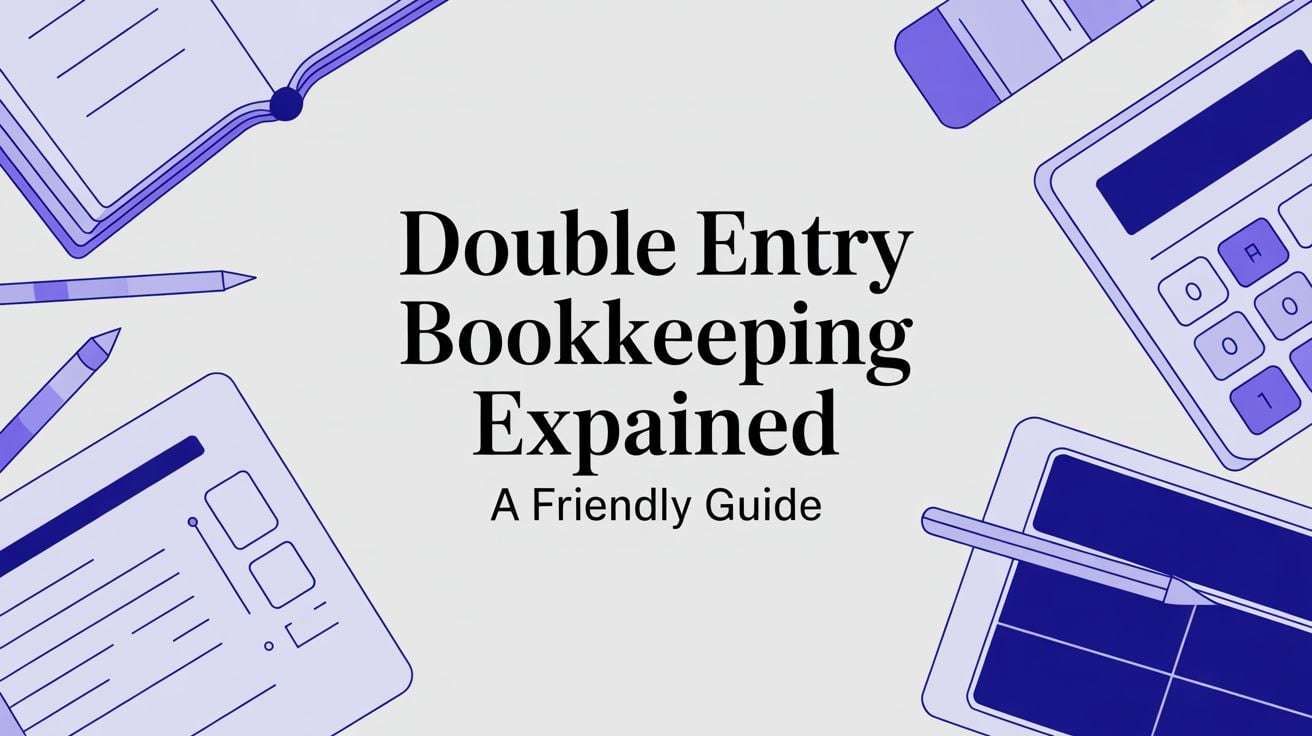
Double Entry Bookkeeping Explained (With Examples)
Double entry bookkeeping in plain English: debits, credits and the accounting equation, with simple worked examples for small businesses.

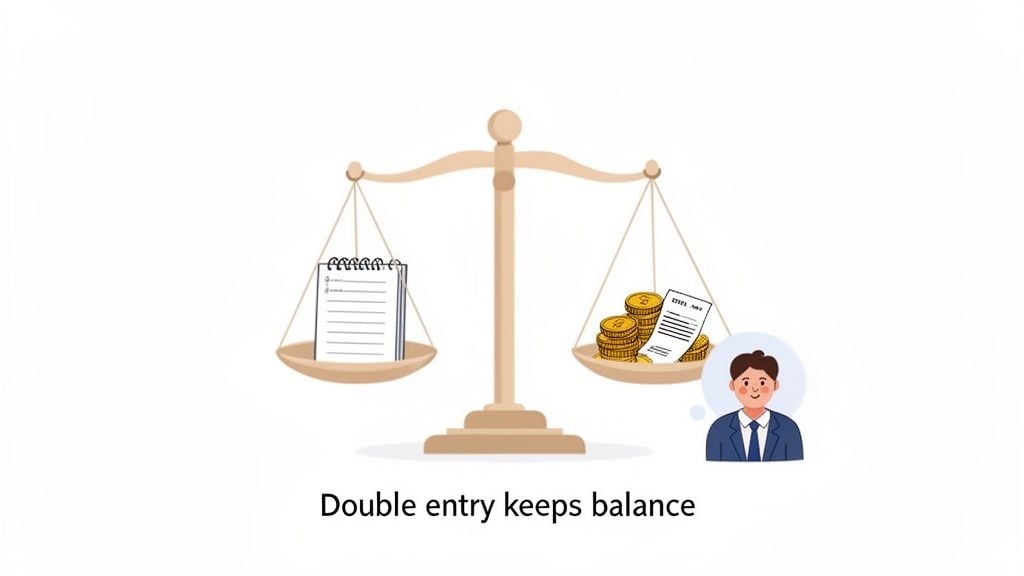
Think of your business's finances as a perfectly balanced scale. This is the simple, powerful idea behind double-entry bookkeeping: for every action, there's an equal and opposite reaction that keeps your books perfectly level. It’s a method that ensures incredible accuracy and gives you a true, complete picture of your financial health.
What Is Double Entry Bookkeeping and Why Use It
At its heart, double-entry bookkeeping is a system for recording the full story of every financial transaction. It's a huge leap from single-entry bookkeeping, which is a lot like a simple checkbook register where you just track money coming in or going out. Double-entry tracks both sides of the coin.
Here’s a practical example: when you make a sale for $100, you don’t just have more cash. Your business also earned that money as revenue. The double-entry system captures both of these facts at the same time. One entry shows your cash account increasing, and a second, corresponding entry shows your revenue account increasing.
The Power of a Balanced System
This two-sided approach is what makes it so incredibly reliable. Since every entry has a matching partner, your books are designed to always be in balance. If they’re not, you have an immediate red flag that a mistake was made somewhere, which makes finding and fixing errors much, much easier.
This built-in, self-checking mechanism is why it's the gold standard for any serious business. It lays the groundwork for real financial clarity and offers some major advantages:
- Improved Accuracy: The system's balanced nature is your first line of defense against errors. If your debits and credits don't match, you know instantly it's time to investigate.
- Complete Financial Picture: It goes way beyond just tracking cash. You get a clear view of what you own (assets), what you owe (liabilities), and the actual net worth of your business (equity).
- Smarter Decision-Making: With detailed reports like a Balance Sheet and Income Statement automatically generated from your entries, you can make strategic moves based on a solid understanding of your numbers.
- Audit and Loan Readiness: Clean, balanced books make tax time a breeze. They're also non-negotiable when you're applying for a business loan or looking for investors.
By recording every transaction in two accounts, you create a checks-and-balances system that ensures your financial records are always complete, accurate, and reliable. This isn't just about plugging in numbers; it's about building a trustworthy financial story for your business.
Moving from a simple list of income and expenses to a proper double-entry system is a game-changer for any growing company. Once you've got these fundamentals down, you can put them into practice with a great guide on the freelance bookkeeping recipe for success that shows you how to apply these concepts in the real world.
Here is the rewritten section, designed to sound completely human-written and natural.
The Unbreakable Rule of the Accounting Equation
Everything in double-entry bookkeeping boils down to one surprisingly simple, perfectly balanced rule. It’s the foundation that ensures your books are always accurate, and it governs every single financial move your business makes.
We call it the accounting equation, and it looks like this:
Assets = Liabilities + Equity
Think of this as your business's financial bedrock. On one side, you have everything the business owns (its assets). On the other, you have a breakdown of who has a claim to those assets—either creditors (what it owes) or the owners (what’s left). Let's unpack what that really means.
What Are Assets?
First up, Assets. These are all the valuable things your business owns that will help you make money now or in the future. It’s not just about the cash sitting in your bank account, either.
Assets are a mix of tangible and intangible resources that keep your business running.
- Cash: The most obvious one—the money in your business accounts.
- Accounts Receivable: This is the money your customers owe you for products or services they've already received.
- Inventory: All the products you're holding onto, ready to be sold.
- Equipment: Think computers, vehicles, machinery, or any tools you use to get the job done.
- Property: Any land or buildings owned by the company.
Simply put, if your business owns it and can use it to generate revenue, it's likely an asset.
What Are Liabilities and Equity?
Now for the other side of the scale. Liabilities and Equity explain how all your assets were paid for.
Liabilities are simply what your business owes to other people or companies. These are your debts and financial obligations. Think of them as outside claims on your company's assets. Common examples include:
- Accounts Payable: The bills you owe to your suppliers and vendors.
- Loans Payable: Money you've borrowed from a bank or lender that you have to pay back.
- Credit Card Balances: Any outstanding debt on your company credit cards.
That brings us to Equity. This is what truly belongs to the owners. After you’ve paid off all your liabilities, whatever is left over is the equity. It’s the owners' slice of the pie, representing their financial stake in the business.
The accounting equation is the foundation of the balance sheet, one of the most critical financial statements. It shows that everything a business owns (its assets) is financed by either borrowing money from others (liabilities) or by the owners' contributions (equity).
Let's see it in action. Imagine you start a bakery and buy a new oven for $10,000 using a business loan. Your assets (Equipment) go up by $10,000, and your liabilities (Loans Payable) also go up by $10,000. The equation stays perfectly balanced: $10,000 (Assets) = $10,000 (Liabilities) + $0 (Equity). No matter the transaction, this scale always remains level.
Learning the Language: Debits and Credits Made Simple
To really get the hang of double-entry bookkeeping, you have to learn its language. And that language boils down to two words: debits and credits. Now, the single biggest hurdle for most people is thinking of these as "good" and "bad," or "plus" and "minus." My advice? Throw that idea right out the window.
Instead, let's simplify. Think of them as nothing more than directions for your entries.
- A debit is just an entry on the left side of an account's ledger.
- A credit is just an entry on the right side.
That's it. Seriously. Whether a debit or a credit makes an account go up or down depends entirely on what type of account it is. Once you learn the simple rules, you can apply them to absolutely any transaction that comes your way.
The Five Core Account Types
Every single transaction in your business, from buying a coffee to landing a huge contract, will touch at least two accounts. These accounts all fall into five main categories, which are the building blocks of that accounting equation we just looked at.
- Assets: This is all the stuff your company owns that has value. Think cash in the bank, your computers, or the inventory on your shelves.
- Liabilities: This is everything your company owes to others. This includes bank loans, credit card balances, and bills you need to pay to your suppliers.
- Equity: This represents the owner's (or owners') stake in the company. It's what would be left over if you sold all your assets and paid off all your liabilities.
- Revenue (or Income): The money your business earns from selling its products or services. It's the lifeblood of your operation.
- Expenses: These are the day-to-day costs of being in business. We're talking about rent, employee salaries, software subscriptions, and marketing costs.
This is where it all connects. The accounting equation shows how these pieces fit together to keep your books balanced.
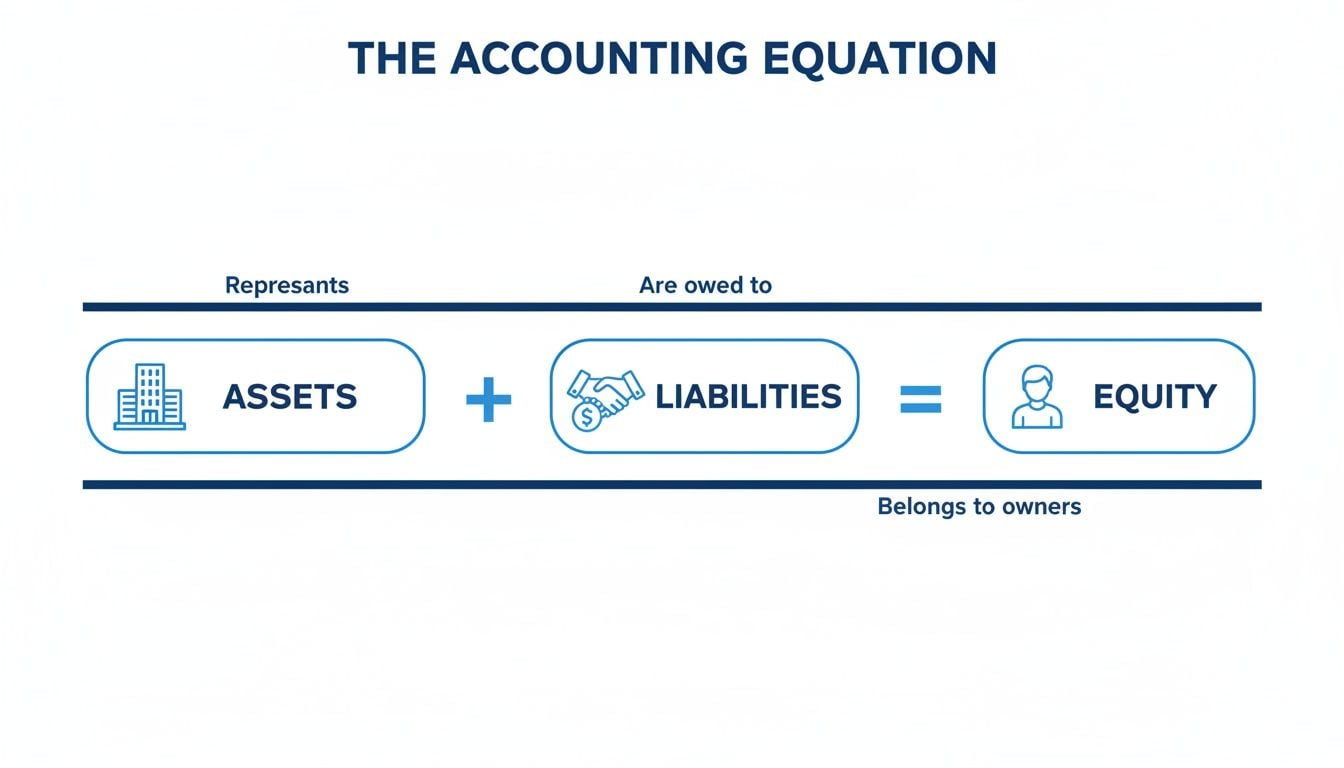
Think of it this way: everything the business owns (Assets) is claimed by someone. It's either claimed by lenders and suppliers (Liabilities) or by the owners (Equity).
The Simple Rules of Debits and Credits
Alright, let's put it all together into a simple framework. This table is the cheat sheet for double-entry bookkeeping—get this down, and you've unlocked the whole system.
The Rules of Debits and Credits
Account Type
To Increase the Account
To Decrease the Account
Asset
Debit
Credit
Expense
Liability
Equity
Revenue
Memorizing this table is the key. Notice the pattern: Assets and Expenses behave one way, while Liabilities, Equity, and Revenue behave the opposite way.
Let's walk through a real-world example. Say you just finished a project and the client pays you $500 in cash.
Your Cash (an Asset) has increased. To increase an Asset, the rules say you debit it. At the same time, your Service Revenue (a Revenue account) has also increased. To increase a Revenue account, you credit it.
You've made two entries that balance each other out: a $500 debit to Cash and a $500 credit to Service Revenue. The books are perfectly balanced, and you've recorded the complete story of that transaction.
I know it can feel a bit backward at first, especially seeing a "credit" increase what you've earned. But trust the process. By sticking to these rules for every transaction, you build an incredibly reliable and error-proof financial record for your business. It turns financial chaos into a clear, repeatable system.
Putting It All Together with Real Business Examples
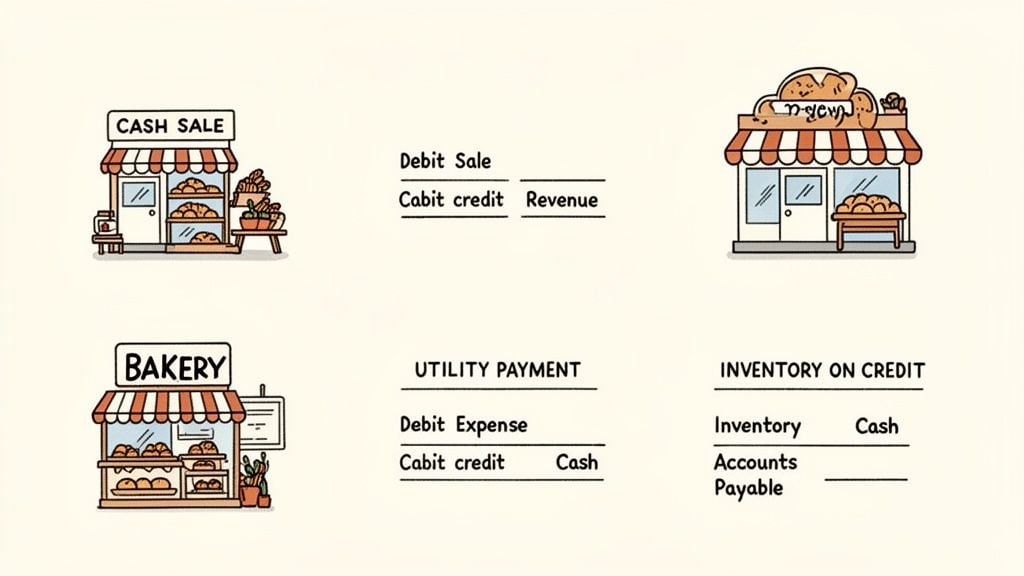
Okay, the theory is great, but let’s be honest—it all feels a bit abstract until you see it in action. This is where the lightbulb moment happens for most people. Seeing how double-entry bookkeeping handles everyday business scenarios is what makes the rules click into place.
To help visualize this, we'll use a simple tool called a T-account. It's just a graphic that looks like a capital "T," with debits recorded on the left and credits on the right. It’s a classic, straightforward way to see how any single transaction impacts two different accounts.
Example 1: Making a Cash Sale
Let's say you run a small bakery. A customer comes in, falls in love with a box of your famous cookies, and pays you $25 in cash. Simple, right? But in the world of bookkeeping, two things just happened.
First, your cash went up. Cash is an Asset, and as we know, you increase an Asset with a debit. At the same time, you made a sale, which counts as Sales Revenue. Revenue boosts your Equity, and we increase Revenue with a credit.
Here’s the breakdown in T-account format:
Cash (Asset)
Debit +$25
Sales Revenue
Credit +$25
See? The $25 debit and the $25 credit are perfectly equal, keeping your accounting equation balanced. More importantly, you've not only tracked that you have more cash but also documented why you have it. That's the magic.
Example 2: Paying a Utility Bill
The end of the month rolls around, and so does the $150 electricity bill for your bakery. You pay it right away from your business bank account. Once again, this single payment creates two entries.
Your Cash (an Asset) has gone down. To show a decrease in an Asset, we use a credit. The reason the cash went down is you paid a business cost, which we’ll track in a Utilities Expense account. Expenses decrease your Equity, and you record that by debiting the expense account.
Let's look at the T-accounts for this:
Utilities Expense
Debit +$150
Credit -$150
Even though your cash balance dropped, your books are still perfectly balanced. The $150 debit to Utilities Expense and the $150 credit to Cash tell the complete story of that transaction, reflecting a necessary cost of doing business.
Example 3: Buying Inventory on Credit
You're running low on flour, a critical ingredient. You order $300 worth from your supplier, and they give you 30 days to pay. This is what's known as buying "on account" or "on credit."
Your Inventory (an Asset) just increased, so you'll debit that account to show you have more supplies on hand. But since you haven't paid yet, you've also created a liability—you owe your supplier money. This debt is called Accounts Payable. To show an increase in a Liability, we credit it.
Here’s how it breaks down:
- Inventory (Asset): You’ll debit this account for $300 to reflect the new flour you have.
- Accounts Payable (Liability): You’ll credit this account for $300 to show you have a new IOU.
Notice that no cash changed hands here, but your financial situation definitely changed. This is a huge advantage of double-entry bookkeeping; it captures these crucial non-cash events that single-entry systems completely miss, giving you a much truer picture of your business's financial health.
Example 4: Receiving an Owner Investment
To fund a new oven for the bakery, you decide to invest an additional $5,000 of your own money into the business. You transfer the cash directly into the company’s bank account.
The business's Cash (an Asset) has increased by $5,000, so you'll debit the Cash account. That money also increases your personal investment, or stake, in the company. We record this in an Owner's Equity account. And to increase an Equity account, you credit it.
The T-accounts would look like this:
Debit +$5,000
Owner's Equity
Credit +$5,000
Walking through these common situations, you can really see the elegant, two-sided nature of every transaction. This simple but powerful method ensures nothing slips through the cracks, painting a complete and balanced financial story for your business.
From Timeless Principles to Modern Automation

Double-entry bookkeeping is a brilliant system, a time-tested method for keeping your finances in perfect balance. But it has one major weakness: it’s only as reliable as the information you put into it. If your source documents are a mess, your books will be, too. It’s the classic “garbage in, garbage out” problem.
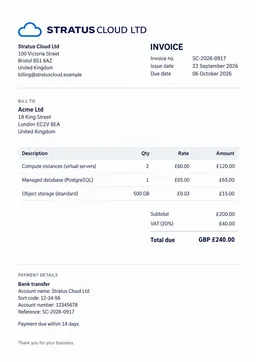
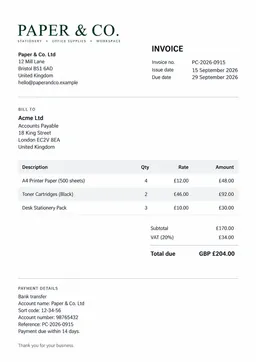
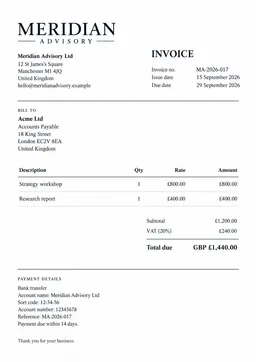
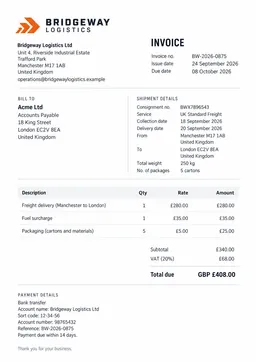
Think about it. Where do all your invoices and receipts actually live? They’re probably scattered everywhere—a few in your email, some hiding in vendor portals like Amazon or Google, and others saved as random PDFs on your hard drive. Trying to manually track down and enter every single one isn't just a headache; it’s how errors creep into your books.
This is where a 500-year-old accounting principle gets a huge boost from 21st-century tech. Modern automation tools are built to solve this exact data-gathering problem for good.
How Automation Gathers Perfect Source Data
Instead of you spending hours chasing down paperwork, automation platforms like Booksmate get to work behind the scenes. They securely connect to your email and online supplier accounts, automatically fetching every invoice and receipt the second it’s issued.
This hands-off approach gives you two game-changing advantages:
- Completeness: You can finally stop worrying about missing invoices or forgotten expenses. The system grabs every single document, giving you a complete and accurate picture of your finances.
- Accuracy: We all make mistakes. A simple typo or transposing a couple of numbers during manual data entry can throw everything off. By fetching data directly from the source, automation completely eliminates these human errors.
Once a document is collected, smart technology scans it, pulls out all the key details—vendor, date, total amount, line items—and organizes it all in one clean, central dashboard.
The point of automation isn't to replace double-entry bookkeeping, but to strengthen its very foundation. It ensures every debit and credit is based on verified, accurate source documents, freeing you up from the tedious manual work.
Getting Your Data Ready for Your Accounting System
With all your financial documents neatly collected and organized, the last piece of the puzzle is getting that clean data into your accounting software. Automation tools make this incredibly simple, turning what used to be a long, manual process into just a few clicks.
This kind of smooth integration is at the heart of modern accounting. For example, many systems simplify the process of importing bank statements into accounting software like Xero. By automating all the data collection on the front end, you guarantee that the double-entry system we’ve been talking about is running on pristine information.
Ultimately, this means you can stop wrestling with piles of paperwork and start focusing on what the numbers actually mean for your business.
Common Questions About Double-Entry Bookkeeping
Once you start putting these ideas into practice, you're bound to have a few questions. Let's walk through some of the most common ones we hear from business owners who are just getting their sea legs with double-entry.
Can I Get By with Single-Entry for My Small Business?
You absolutely can, but it's a bit like trying to navigate a new city with only half a map. Single-entry does a decent job of tracking cash coming in and going out, but that's where its usefulness ends. It gives you no real insight into what you own (assets), what you owe (liabilities), or the actual value of your business (equity).
Double-entry bookkeeping really becomes a must-have once your business hits certain milestones. You'll need it when:
- You're ready to apply for a business loan and the bank asks for financials.
- You start holding inventory or buying significant equipment.
- You need to generate a proper Balance Sheet or Income Statement.
At that point, making the switch is the only way to get a complete and accurate picture of your company's financial health.
What Are the Most Common Mistakes to Watch Out For?
Honestly, the most frequent slip-ups are simple human errors. We see a lot of transposition errors (typing $94 instead of $49, for example) or accidentally recording a transaction in the wrong account category. It happens to everyone.
Here's the good news: the double-entry system has a built-in safety net. Because every debit must have an equal credit, your books are designed to balance. If they don't, you get an immediate red flag that something's off, which makes hunting down and fixing the mistake much, much easier.
How Does This Actually Help with Taxes and Reports?
Think of double-entry as the engine that creates your most important financial reports: the Balance Sheet and the Income Statement. Every single time you record a balanced journal entry, you're feeding data directly into these statements.
This means you’re always prepared. When tax season rolls around, or a lender wants to see your numbers, you don't have to scramble. You have accurate, reliable reports ready to go because your daily bookkeeping is already doing the heavy lifting. It’s the most direct line between your day-to-day transactions and high-level business insights.
Tired of chasing down invoices and receipts? Booksmate automates the entire collection process, fetching documents from your emails and supplier portals. It ensures your double-entry system is built on a foundation of perfect, error-free data. Learn more about automating your bookkeeping.