Articles
Basic Bookkeeping for Small Business Made Simple
Let’s be honest—for most small business owners, “bookkeeping” sounds like a four-letter word. It brings up images of dusty ledgers, complicated spreadsheets, and a whole lot of stress. But what if I told you it’s really just about one thing? Knowing where your money is going.
Think of it as the financial heartbeat of your company. It’s the simple, steady rhythm of tracking every dollar that comes in and every dollar that goes out.
Your Guide to Stress-Free Bookkeeping

Getting a handle on your books is genuinely one of the most powerful moves you can make. It’s the difference between flying blind and confidently steering your business toward its goals. This isn’t about becoming a CPA overnight. It’s about learning to read the story your numbers are trying to tell you.
And that story is critical. A shocking 82% of small businesses that fail do so because of poor cash flow management. Good bookkeeping isn’t just a “nice-to-have”—it’s your first line of defense, giving you a crystal-clear picture of where you stand so you can sidestep those common, costly traps.
More Than Just Tallying Numbers
When you do it right, bookkeeping stops being a chore and becomes your secret weapon. It’s what helps you:
- Make Smarter Decisions: Should you hire that new team member? Is it the right time to invest in that new piece of equipment? Your books have the answers, taking the guesswork out of big decisions.
- Take the Pain Out of Tax Time: Imagine tax season being a calm, organized review instead of a frantic paper chase. That’s what you get with clean records, not to mention the peace of mind that you’re claiming every single deduction you’re entitled to.
- Get the Funding You Need: If you ever want a loan or need to bring on investors, the first thing they’ll ask for is your financials. Organized books show you’re a stable, well-managed business, making it infinitely easier to secure capital.
Unfortunately, I’ve seen too many entrepreneurs learn these lessons the hard way. A SCORE study found that messy books can cost small businesses thousands in overpaid taxes and missed revenue, often from simple mistakes like miscategorizing an expense. The same study revealed that a staggering 60% of small business owners feel they’re in over their heads with accounting, which leads directly to these preventable errors.
To get started on the right foot and build a solid financial foundation, this guide on bookkeeping basics for small business is an excellent next step.
The Four Pillars of Small Business Bookkeeping
To build a bookkeeping system that actually works for you, it helps to focus on four key areas. These are the essential components every business owner must track for accurate financial management.
Here’s a simple breakdown of what they are and why they’re so important.
| The Four Pillars of Small Business Bookkeeping |
| :--- | :--- | :--- |
| Pillar | What It Is | Why It Matters | | Tracking | The daily process of recording every financial transaction, including income and expenses. | Provides the raw data needed for all financial analysis and reporting. | | Reconciling | Matching your internal records against your bank and credit card statements. | Ensures accuracy, catches errors, and helps prevent fraud. | | Reporting | Generating key financial statements like the Profit & Loss and Balance Sheet. | Translates your raw data into actionable insights about your business’s health. | | Compliance | Managing tax obligations, payroll, and maintaining records for potential audits. | Keeps your business in good legal standing and avoids costly penalties. |
Mastering these four pillars will give you the control and clarity you need to not just survive, but truly thrive. Let’s dive into how to put them into practice.
Understanding the Language of Your Business
Let’s be honest—the word “bookkeeping” can make even the most passionate business owner’s eyes glaze over. It sounds complicated, stuffy, and frankly, a little scary. But I promise you, it’s not. If you can manage a personal budget, you already have the basic skills you need.
The trick is learning to speak the language of your business’s finances. It’s all about turning a pile of receipts and a list of sales into a clear story about where your money comes from and where it goes. Once you get the hang of it, you’ll unlock the insights you need to make smarter decisions.
Your Financial Filing Cabinet: The Chart of Accounts
Imagine trying to run an office by tossing every single document into one giant shoebox. It would be pure chaos, right? In bookkeeping, your “filing cabinet” is called the Chart of Accounts.
It’s simply a customized list of categories you create to sort every transaction your business makes. Instead of a shoebox mess, every receipt, invoice, and payment has a designated folder. This simple act of organizing is what lets you pull real, meaningful information from your numbers.
A basic Chart of Accounts for a small business might look something like this:
- Cash in Bank: The money sitting in your business checking account.
- Accounts Receivable: What customers owe you for products or services they’ve already received.
- Office Supplies: All those pens, paper, and printer ink purchases.
- Software Subscriptions: Monthly fees for tools like your CRM or email marketing service.
- Sales Revenue: The total income you’ve earned from doing what you do best.
This structure is the foundation for turning raw data into a clear picture of your financial health.
The Five Core Account Types
Every single category in your Chart of Accounts fits into one of five main groups. Getting your head around these five building blocks is the key to understanding everything else.
- Assets: This is all the valuable stuff your business owns. Think of the cash in the bank, the computer you’re working on, or the delivery van you use for jobs. It’s what you have.
- Liabilities: This is what your business owes to other people. That van loan, your company credit card balance, or an unpaid bill from a supplier—those are all liabilities. It’s what you owe.
- Equity: This one sounds complicated, but it’s just the owner’s stake in the company. It’s what’s left over for you after you subtract everything you owe (Liabilities) from everything you own (Assets).
- Revenue (or Income): This is the good stuff! It’s the money your business earns from selling your products or services.
- Expenses: These are the costs of doing business. You have to spend money to make money, and this category tracks everything from rent and salaries to advertising and utility bills.
The Fundamental Bookkeeping Equation The entire world of bookkeeping rests on one simple, powerful equation that connects three of these types: Assets = Liabilities + Equity. This formula must always, always be in balance. It’s your built-in system for checking your work.
Single-Entry vs. Double-Entry Bookkeeping
So, how do you actually record all these transactions? There are two main ways to go about it: single-entry and double-entry.
Single-entry bookkeeping is basically a glorified checkbook register. You log money in and money out, and that’s it. It’s simple, and for a solo freelancer with very few transactions, it might be enough to get by. The big downside? It’s easy to make mistakes and it doesn’t give you a complete financial picture.
Double-entry bookkeeping is the universally accepted standard for a reason. It’s how every serious business and accountant operates. The core idea is that every transaction affects at least two accounts, which keeps the whole system in balance.
Here’s a practical example: You buy a new laptop for your business for $1,000, paying with your debit card.
With double-entry, you would make two moves:
- You increase your “Equipment” asset account by $1,000 (you gained a laptop).
- You decrease your “Cash” asset account by $1,000 (the money left your bank).
See how that works? One account went up, another went down, and the core equation (Assets = Liabilities + Equity) remains perfectly balanced. This two-sided approach is a powerful self-auditing tool that drastically reduces errors and gives you the data you need for essential reports like a Balance Sheet or an Income Statement.
For any small business with plans to grow, moving to a double-entry system isn’t just a suggestion—it’s a necessity.
Building Your Simple Bookkeeping Routine
Let’s be honest: no one starts a business because they love bookkeeping. But good bookkeeping isn’t about spending hours buried in spreadsheets at the end of the month. The secret is building small, consistent habits that turn a dreaded chore into a simple, manageable part of your day. A solid routine keeps your financial data up-to-date, making big things like strategic planning and tax prep feel surprisingly easy.
Think about it—every little invoice from Amazon or a payment from PayPal that you forget to track is a loose thread. Pull enough of those, and the whole thing unravels. It’s a huge reason why a shocking 82% of small businesses that close their doors cite cash flow problems. It all starts with tracking the money coming in and the money going out. You can read this small business guide to see just how deeply cash flow issues can impact a business.
This diagram shows how bookkeeping systems often evolve as a business grows, starting simple and becoming more powerful over time.
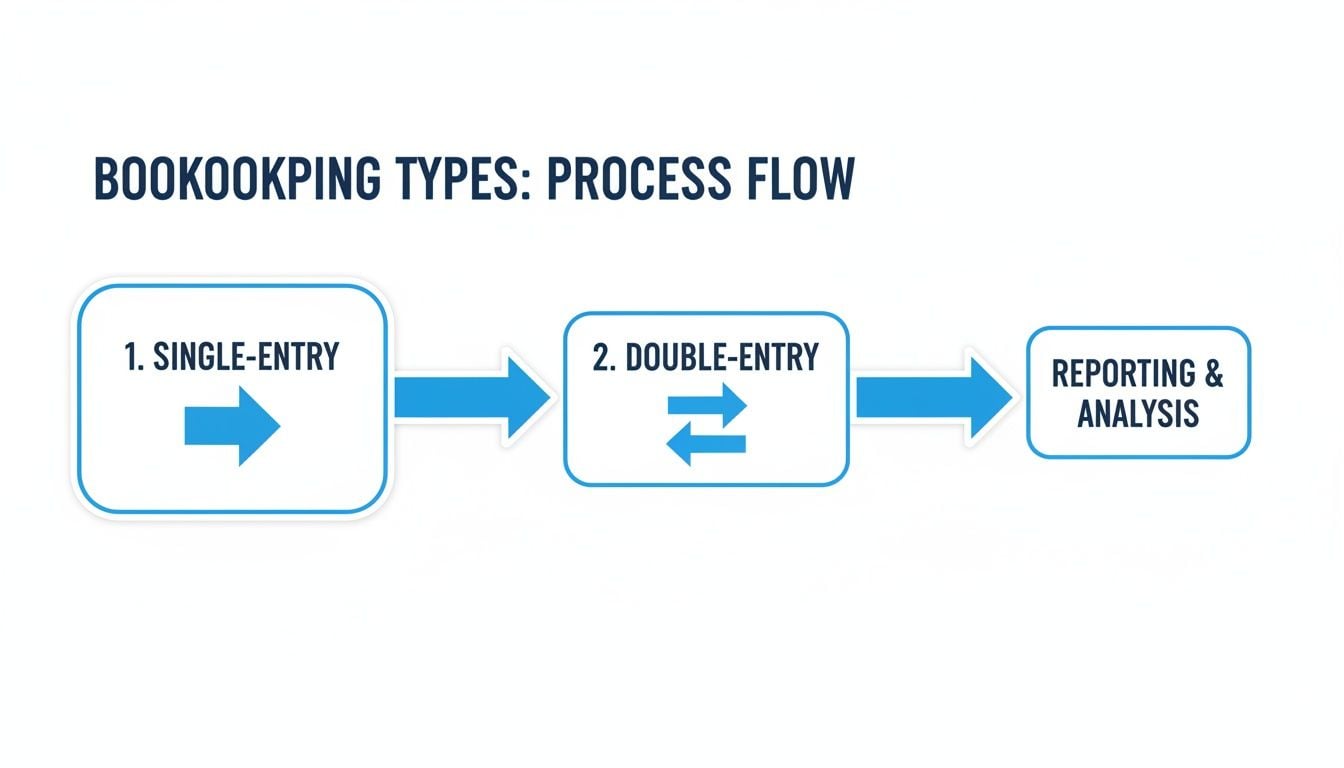
Moving from a basic single-entry system to double-entry bookkeeping is a natural step for any growing company that needs a clearer, more accurate financial picture.
Daily Bookkeeping Tasks (5-10 Minutes)
Your daily goal is simple: capture everything. Don’t let a single receipt or invoice fall through the cracks. These quick habits are your best defense against a mountain of paperwork later.
- Capture Receipts: The moment you get a paper receipt, snap a photo of it with your phone. A good app can digitize it on the spot, so you don’t have to worry about losing track of tiny but important expenses.
- File Digital Invoices: When an invoice lands in your inbox, don’t just leave it there. Immediately save it to a dedicated folder in the cloud (like Google Drive or Dropbox). A little organization now saves a huge headache later.
Weekly Bookkeeping Tasks (30-60 Minutes)
Now it’s time to make sense of everything you’ve collected. Set aside a block of time each week—maybe Friday mornings with your coffee—to process the week’s financial activity. This keeps you on top of your cash flow.
- Categorize Transactions: Go through your bank feed and the receipts you saved. Assign every single transaction to the right category in your Chart of Accounts (think “Office Supplies,” “Marketing Spend,” or “Client Revenue”).
- Send Customer Invoices: Don’t wait to bill your clients. As soon as a project is done, send that invoice out. The faster you invoice, the faster you get paid. It’s that simple.
- Follow Up on Payments: Take a quick look at your accounts receivable. Who hasn’t paid you yet? Send a friendly, polite reminder for any overdue invoices. You’d be surprised how often a gentle nudge is all it takes.
This weekly rhythm is the heart of a good bookkeeping habit. It stops the end-of-month scramble before it starts and gives you a real-time pulse on your business’s health.
The Magic of Automation Manually typing in invoice details is not only boring, it’s a recipe for typos. Tools like Booksmate can completely take this off your plate. You can connect it to your email or supplier accounts, and it will automatically pull your invoices, read all the key info (vendor, date, amount), and get it organized for you. This frees you up to actually think about what the numbers mean instead of just keying them in.
Monthly Bookkeeping Tasks (1-3 Hours)
Once a month, it’s time to zoom out and look at the big picture. This is your chance to double-check your work and generate the reports that tell you the story of your business.
Key Monthly Actions:
- Reconcile Your Accounts: This is the most important step. You absolutely have to do it. Compare your bookkeeping records against your monthly bank and credit card statements, line by line. This process proves your books are accurate and helps you catch any mistakes, weird charges, or potential fraud right away.
- Review Financial Reports: Pull your key financial statements: the Profit and Loss (P&L), Balance Sheet, and Cash Flow Statement. But don’t just file them away! Look at them. Ask questions. “Which service made me the most money this month?” “Why are my expenses creeping up?”
- Manage Payroll and Taxes: If you have a team, make sure payroll is processed and everyone is paid correctly. This is also the time to review any sales tax you’ve collected and set aside money for your upcoming income tax payments.
When you break it down like this, basic bookkeeping for small business stops being one giant, scary thing and becomes a series of small, manageable tasks. This simple routine is what gives you the clarity to make smart decisions and build a business that lasts.
How to Read Your Financial Report Cards
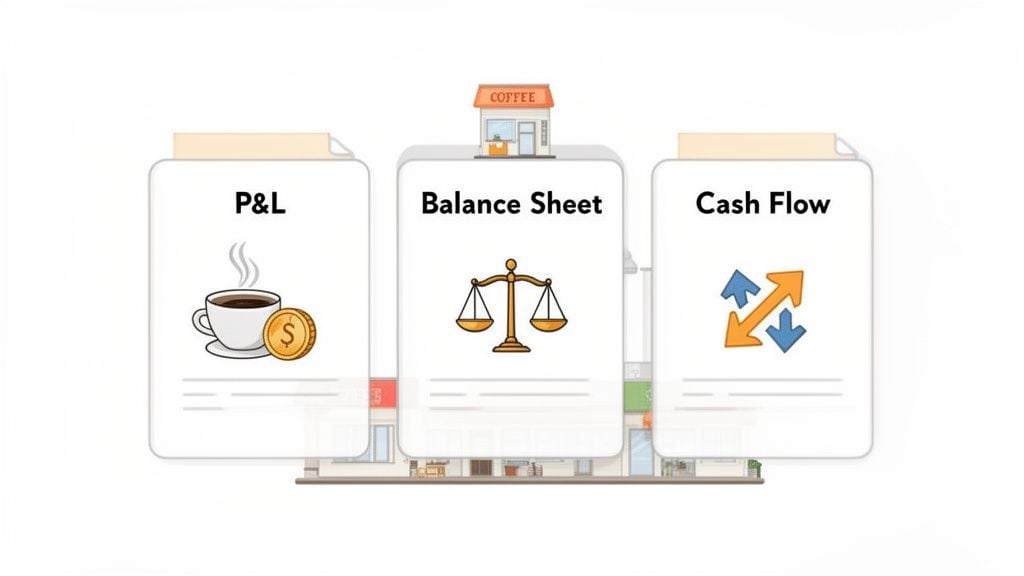
So, you’ve been diligently tracking every sale and expense. Now what? All that hard work isn’t just about keeping tidy records; it’s about generating the story of your business’s financial life. This story is told through three critical documents: your financial statements.
Think of them as your business’s report cards. Each one tells you something different about how you’re doing, and together, they give you a complete picture so you can make smarter decisions. Getting a handle on these is a core part of basic bookkeeping for small business, yet it’s surprising how many owners fly blind.
In fact, one study found that 42% of owners jump in with very little financial know-how, which is a huge risk. But you’re here to change that. These reports are your compass, built from the six things you’ve been tracking: income, expenses, payroll, receipts, bank transactions, and tax records. You can read more on how financial reports guide small business success to see just how powerful they are.
Let’s break down the big three using a simple coffee shop to see what they really mean.
The Profit and Loss Statement (P&L)
The Profit and Loss (P&L) Statement, sometimes called an Income Statement, answers one crucial question: “Is my business actually making money?” It gives you the answer for a specific period, like a month or a quarter, by subtracting all your costs from your total sales.
For our little coffee shop, a P&L would lay it all out:
- Revenue: All the money brought in from selling lattes, pastries, and bags of beans.
- Cost of Goods Sold (COGS): The direct costs of making what you sold—think coffee beans, milk, sugar, and cups.
- Expenses: Everything else it takes to keep the lights on, like your barista’s wages, the shop’s rent, and marketing costs.
The number at the very bottom is your net profit or net loss. The P&L tells you if your prices are working, if your costs are too high, and if your business model is sustainable in the long run.
The Balance Sheet
While the P&L looks at a period of time, the Balance Sheet is a snapshot. It tells you the financial health of your business on one specific day by answering, “What do I own, and what do I owe?”
It’s all built on one simple, powerful formula: Assets = Liabilities + Equity.
- Assets: Everything your coffee shop owns that has value. This could be the cash in the bank, your fancy espresso machine, or the inventory of beans in the back.
- Liabilities: Everything your shop owes to others. This includes that loan you took out for the espresso machine or the bill you haven’t paid yet to your pastry supplier.
- Equity: This is your stake in the company. It’s what’s left over when you subtract all your liabilities from your assets—the true value you’ve built.
A bank will absolutely pour over your Balance Sheet if you ever apply for a loan. It shows them your company’s net worth and how financially stable you are.
The Cash Flow Statement
This might be the most important report for your day-to-day survival. The Cash Flow Statement answers the most practical question of all: “Where did my actual cash go?” It tracks the real dollars moving in and out of your bank account.
A business can be profitable on paper (P&L) but go bankrupt because it ran out of cash. This happens all the time—you’re waiting on customer payments, but your rent, payroll, and supplier bills are all due now. The Cash Flow Statement is your early warning system.
This report breaks down your cash movements into three areas:
- Operating Activities: The cash that comes from your main business, like customers buying coffee.
- Investing Activities: Cash you spend on or get from long-term assets, like buying a new delivery van or selling old equipment.
- Financing Activities: Cash from investors or lenders, like taking out a loan or putting more of your own money into the business.
By looking at these three reports together, you get the full story. You’ll see your profitability (P&L), your net worth (Balance Sheet), and your actual ability to pay the bills (Cash Flow). This is what empowers you to decide with confidence when it’s time to hire, expand, or reinvest.
Choosing the Right Bookkeeping Software
Let’s be honest—bookkeeping can feel like a total grind. But getting the right tools in place can completely flip that script, turning your biggest headache into one of your most powerful business advantages. The key isn’t finding one single, perfect program. It’s about building a smart “tech stack” that works for you.
Your accounting software is the heart of this system. Think of platforms like QuickBooks, Xero, or Wave as the command center for your finances. It’s where you’ll reconcile your bank accounts, run reports, and get that high-level view of how your business is really doing.
But the real magic happens when you start connecting other tools to this command center. The goal is to create a system that automates the most mind-numbing tasks, slashes the risk of human error, and can easily grow right along with your business.
What to Look For When Choosing Your Software
When you’re just starting, the sheer number of options can feel paralyzing. My advice? Ignore all the bells and whistles you won’t use. Instead, just focus on these four things:
- Cost: Find a solution that fits your budget now but has clear upgrade paths for later. Some tools, like Wave, have fantastic free plans, while others like QuickBooks or Xero operate on a tiered monthly subscription.
- Ease of Use: You shouldn’t need an accounting degree to figure it out. Is the interface clean and intuitive? A good user experience makes a world of difference when you’re learning the ropes.
- Scalability: Think about where you want to be in a year or two. Will this software still work for you when you need to handle payroll, track inventory, or manage different currencies? Don’t box yourself in.
- Integrations: How well does it play with others? Make sure the software can smoothly connect to your bank, your payment processor (like Stripe or PayPal), and any other apps you rely on.
Doing a bit of homework here pays off. Reading a detailed comparison like this one on QuickBooks vs Xero vs Sage can help you see the pros and cons for your specific industry or business type.
Building Your Automated Tech Stack
Beyond your main accounting hub, adding a specialized tool to handle your most repetitive task can be a complete game-changer. For most business owners, that task is manual data entry—specifically, getting all the details from your invoices into your books.
Instead of spending hours manually downloading PDFs from vendor portals or digging through your inbox to type in invoice details, you can have a tool fetch and process it all for you. This is how you make sure no expense is ever missed and your data is always up to date.
For instance, a service like Booksmate can plug directly into your email and connect to hundreds of supplier portals—think Amazon, Google, or your phone company. It automatically grabs new invoices, uses AI to read all the key information (vendor, date, amount, etc.), and neatly organizes it.
This is what it looks like in practice—a clear dashboard showing you exactly what’s been collected and processed.
With all your documents pulled into one place automatically, you can see at a glance what’s paid and what’s pending, all without lifting a finger.
This is the essence of a smart tech stack. The specialized tool does the “grunt work” of collecting and organizing documents, and your accounting software handles the big-picture reconciliation and reporting. This frees you up to stop being a data entry clerk and start focusing on what the numbers are telling you about your business.
Staying Compliant and Making Tax Time Easy
Let’s talk about something every business owner dreads: tax time. Great bookkeeping is more than just a good habit for tracking your progress; it’s your secret weapon for a stress-free tax season. When your records are clean and organized, you’re not just staying on the right side of the law—you’re ensuring you don’t pay a penny more in taxes than you absolutely have to.
Think of it this way: a consistent bookkeeping routine turns that chaotic, end-of-year scramble into a simple, calm review. Instead of frantically digging through a shoebox of receipts, you’ll have everything ready to go for your accountant. It’s the key to making tax season a non-event and keeping your business on solid ground all year long.
Separate Business and Personal Finances
If you only take one piece of advice from this guide, let it be this: draw a thick, uncrossable line between your business and personal finances. This is, without a doubt, the most common mistake new business owners make, and it creates a massive, tangled mess. It makes it nearly impossible to track your real profitability, justify deductions, and can turn an audit into a nightmare.
Getting this right is surprisingly simple. Just follow these steps:
- Open a dedicated business bank account. Every dollar your business earns goes in here. Every business expense is paid from here. No exceptions.
- Get a business credit card. Use this card only for business purchases. This simple step makes tracking your deductible expenses a breeze.
- Pay yourself a formal salary. When you need to take money for personal use, don’t just pull cash from the drawer. Transfer it from your business account to your personal one as an owner’s draw or a regular salary.
This separation isn’t just “good practice”—it’s the absolute foundation of professional bookkeeping and running a real business.
Understand Deductible Expenses
One of the best parts of running a business is that many of your costs can lower your tax bill. The IRS allows you to deduct expenses that are both “ordinary” (common in your line of work) and “necessary” (helpful for running your business). Carefully tracking these is how you maximize your deductions and keep more of your hard-earned money.
So, what counts? Here are a few common examples:
- Office supplies and software subscriptions (like your accounting software!)
- Marketing and advertising costs
- Business-related travel and meals
- Salaries and contractor payments
- Rent and utilities for your office or storefront
By tagging every expense with the right category as it happens, you’re guaranteeing you won’t miss out on these valuable write-offs when it’s time to file.
Why Payroll Bookkeeping Matters
If you have a team, payroll adds a whole new layer to your bookkeeping. It’s not just about cutting checks. You’re responsible for calculating wages, withholding the correct amount for federal, state, and FICA taxes, and then sending those payments to the right government agencies on time.
Getting payroll wrong can lead to steep penalties from the IRS and, just as importantly, unhappy employees. With tax laws constantly shifting, many small business owners find that using a dedicated payroll service is a smart investment. It saves a ton of time and provides priceless peace of mind.
These services handle all the nitty-gritty calculations, tax filings, and payments for you, so you know it’s all being done by the book.
And in the unlikely event of an audit? Your detailed, organized records are your best friend. They prove you’ve been diligent and transparent from day one, which can make the entire process far less stressful. By building these habits into your weekly routine, you create a financially sound business that’s always ready for whatever comes its way.
Common Bookkeeping Questions Answered
Even with the best game plan, you’re going to have questions. It’s completely natural when you’re figuring out the world of bookkeeping for your small business. Let’s clear up a few of the most common hurdles I see new owners face.
So, how often do you really need to be in your books? A monthly review is a must, but if you wait 30 days, you’re letting small fires turn into big problems.
The real secret is building a small, consistent habit. Try spending just 5-10 minutes daily snapping photos of receipts or saving invoices as they come in. Then, set aside about 30 minutes weekly to categorize those transactions and see who has paid you (and who hasn’t). This simple rhythm prevents a frantic, overwhelming scramble down the road.
Should I DIY or Hire a Professional?
This is the big one, and there’s no single right answer. When you’re just starting out with a handful of transactions, you can absolutely do your own books. Modern, user-friendly software makes this easier than ever before.
But there comes a point when it’s time to call in a pro. You’ll know it’s time to hire a bookkeeper or accountant when:
- You’re spending more time crunching numbers than you are on actually running your business.
- Your finances are getting more complex—maybe you’ve hired your first employee, started managing inventory, or have several different ways you make money.
- You have that nagging feeling that your numbers might be wrong, and the stress is starting to get to you.
Think of it this way: hiring a pro isn’t just an expense; it’s an investment in your own sanity and your company’s growth. They don’t just record numbers—they give you the peace of mind to focus on what you do best.
The single biggest mistake beginners make is mixing business and personal finances. Opening a separate business bank account is non-negotiable. It simplifies tracking, protects your personal assets, and makes tax time infinitely easier.
Getting these common points of confusion sorted out will give you a much clearer path forward. The goal isn’t to be perfect from day one. It’s about building good financial habits now that will set your business up for success for years to come.