Articles
Single Entry Bookkeeping: Simple Guide for 2026
Ever tried balancing your personal checkbook? If you can handle that, you’ve already got the basic idea behind single-entry bookkeeping. It’s the simplest way to track your business finances, focusing on one thing and one thing only: cash. Money comes in, you write it down. Money goes out, you write it down. That’s it.
This no-frills approach is exactly why so many new business owners find it so appealing right out of the gate.
A Simple Start to Financial Tracking
Think of it as keeping a running financial diary for your business. You’re not getting tangled up in debits and credits or complex accounting rules. You’re simply creating a log of your cash flow—adding income from sales and subtracting payments for expenses as they happen.
The system works on a cash basis, which is a crucial point. A transaction only gets recorded when actual cash changes hands. So, if you send an invoice to a client, you don’t log that income until the payment hits your bank account. Likewise, a bill from a supplier doesn’t become an official expense until you’ve actually paid it.
Who Benefits From This Simplicity?
So, who is this super-simple method really for? It’s a perfect match for anyone whose business finances are still relatively uncomplicated.
We see it work wonders for:
- Freelancers and Solopreneurs: If you’re a one-person show offering services, your income and expenses are likely straightforward enough for this to be a perfect fit.
- Micro-Businesses: Think small, cash-based businesses, often with no employees. This method keeps things lean and manageable.
- New Startups: When you’re just getting your venture off the ground, you need a system that’s easy to set up and maintain without a steep learning curve.
The core idea behind single-entry is to provide a clear, real-time view of your cash flow without the formalities of traditional accounting. It answers one fundamental question: “How much cash do I have right now?”
The time savings alone can be a game-changer. A 2023 survey revealed that 42% of U.S. micro-businesses (firms with fewer than 10 employees) rely on single-entry methods, reporting time savings of up to 70% compared to more formal accounting. You can read more about the history and practice of this method on its Wikipedia page.
Single Entry vs. Double Entry at a Glance
To really grasp what makes single-entry bookkeeping unique, it helps to see it side-by-side with its more sophisticated cousin, double-entry bookkeeping. While single-entry gives you a great snapshot of your cash, double-entry provides a complete financial picture by ensuring the accounting equation (Assets = Liabilities + Equity) always balances.
Here’s a quick breakdown of how the two stack up against each other.
Single Entry vs Double Entry at a Glance
This quick comparison highlights the core differences between the two main bookkeeping methods, showing where each one shines.
Feature
Single Entry Bookkeeping
Double Entry Bookkeeping
Complexity
Very simple, like a checkbook
More complex, requires accounting knowledge
Transactions
Recorded once (income or expense)
Recorded twice (as a debit and a credit)
Target User
Freelancers, solopreneurs, cash-only businesses
All business types, especially growing ones
Error Tracking
No built-in error detection
Self-balancing, which helps identify errors
Financial Reports
Generates a simple income statement
Generates a full suite of reports (Balance Sheet, etc.)
As you can see, the right choice really depends on your business’s complexity and your need for detailed financial reporting. Single entry is all about simplicity and speed, whereas double entry is built for accuracy and depth. For a fuller explanation, see our double-entry bookkeeping guide.
How Single Entry Bookkeeping Actually Works
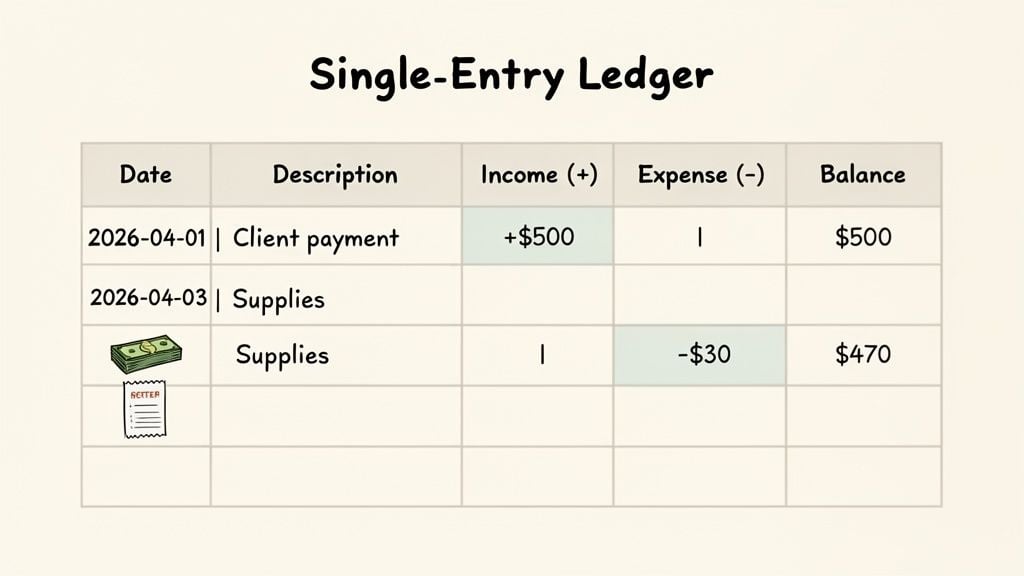
Alright, let’s get down to brass tacks. What does single-entry bookkeeping look like day-to-day? The best way to think about it is like a super-simple checkbook register for your entire business. Every time money moves, you make one simple entry. That’s it.
This system is all about cash. A transaction only gets recorded when cash actually hits your bank account or leaves it. That invoice you sent to a client? It doesn’t count until they pay you. That bill from a supplier? It’s just a piece of paper until you send the money. This tight focus on real cash flow is exactly what makes it so straightforward.
Your Cash Book: The Heart of the System
The core of single-entry bookkeeping is a running log, which we call a cash book. This can be a simple notebook, a spreadsheet you build yourself, or a basic digital tool. Each line in your cash book represents one event—either money coming in (income) or money going out (an expense).
Getting started is a breeze. You only need a few columns to track everything, which is why anyone can pick it up without a degree in finance.
Here’s what your simple ledger needs:
- Date: When the money actually moved.
- Description: A quick note so you remember what it was for (e.g., “Payment from Client A,” “New office chair”).
- Income (+): A column for all the money you receive.
- Expense (-): A column for all the money you spend.
- Balance: A running total that shows you exactly how much cash you have after each transaction.
That running balance is the most powerful part. It gives you a live, up-to-the-minute answer to the single most important question for any new business: “How much cash do I really have right now?”
Think of single-entry as telling one side of the financial story: the journey of your cash. It doesn’t get bogged down with tracking assets or liabilities; it just shows the simple, clear path of what came in and what went out.
Putting It Into Practice: A Real-World Example
Seeing it in action makes it all click. Let’s follow a freelance designer, Alex, who starts the week with $1,200 in their business bank account.
Example 1: Getting Paid by a Client
On Monday, a client’s $850 payment for a logo project finally lands in Alex’s account.
Alex opens their spreadsheet and makes a new entry:
- Date: October 23
- Description: Payment from “Creative Co.” for logo project
- Income (+): $850
- Expense (-): $0
- Balance: $2,050 (The old $1,200 balance + $850 in new income)
Example 2: Buying New Software
The next day, Alex buys a new design software subscription for $300.
They simply add another line right underneath the first one:
- Date: October 24
- Description: Annual subscription for “DesignPro” software
- Income (+): $0
- Expense (-): $300
- Balance: $1,750 (The new $2,050 balance - the $300 expense)
Just like that, with two simple entries, Alex knows their exact cash position. The simplicity is a lifesaver. Of course, while you can do this by hand, tools can make it even easier. For instance, a platform like Booksmate could snap a picture of the “DesignPro” software invoice, pull out the important details, and get it ready to be classified, which cuts down on a lot of typing.
This running log gives you a crystal-clear history of your cash flow, letting you see exactly where your money comes from and where it goes at a glance.
The Pros and Cons of Single-Entry Bookkeeping
The simplicity of single-entry bookkeeping can feel like a godsend, especially when you’re just getting your business off the ground. It’s fast, it’s easy, and you definitely don’t need a finance degree to figure it out. But is it too good to be true?
Well, like any tool, it’s brilliant for some jobs and completely wrong for others. To make the right call for your business, you need to understand exactly what you’re gaining with its simplicity and what you’re giving up. Let’s get real about the pros and cons to see where this method shines and where its simplicity starts to hold you back.
The Upside: Keeping Things Simple and Lean
For a freelancer or a brand-new small business owner, the benefits of a single-entry system are immediate. The main draw is just how straightforward it is, which saves you both time and money right out of the gate.
- It’s Incredibly Easy: Seriously, if you can handle a personal checkbook or a basic spreadsheet, you’ve got this. There are no debits, credits, or confusing accounting rules to memorize. The learning curve is practically flat.
- It Saves a Ton of Time: You’re not making two entries for every single transaction, which slashes the time you spend on your books. When you’re a solopreneur wearing all the hats, that time is gold. It’s more time you can spend on what actually makes you money.
- It’s Cheap to Start: You don’t need fancy, expensive software. A simple spreadsheet program or even a physical ledger book is all you need to get a single-entry system running. This keeps your startup costs low when every penny counts.
And that time savings isn’t just a small perk; it’s a real operational advantage. For instance, data from QuickBooks on its 7 million small business users revealed that 28% use a single-entry approach, saving an average of 12 hours per month. A similar trend is seen among the 5.5 million SMEs in the UK, where 22% stick with this simpler method. If you’re curious about the data behind small business accounting, you can explore some of the academic research here.
The Downside: The Hidden Risks and Blind Spots
While the pros are tempting, the drawbacks of single-entry bookkeeping are critical to understand, especially as your business starts to grow. Its greatest strength—its simplicity—is also its biggest weakness, creating blind spots that can cause major headaches down the road.
The biggest problem with single-entry is that it’s incomplete. It only tracks cash in and cash out. It completely ignores the other half of your financial picture: your assets and your liabilities. You’re only seeing part of the story.
Here are the most important limitations to keep in mind:
- It’s Prone to Errors: There’s no built-in safety net. In a double-entry system, debits have to equal credits, so if something is off, you know right away. With single-entry, a simple typo—entering $500 instead of $50—can go completely unnoticed until you sit down to manually check your bank statement. By then, you may have already made bad decisions based on bad data.
- You Can’t Create a Balance Sheet: A single-entry system simply can’t generate a balance sheet. This is the report that shows what you own (assets) and what you owe (liabilities). Without it, you have no real way to track business loans, credit card debt, or the value of your equipment. This is a deal-breaker if you ever want to get a loan or bring on investors, as they will absolutely demand a balance sheet.
- It Offers Very Limited Insight: This method gives you a basic profit and loss statement based on cash, and that’s about it. You can’t easily track inventory, see who owes you money (accounts receivable), or keep tabs on who you owe (accounts payable). This makes it incredibly difficult to plan for the future or manage growth. For example, if you take out a $10,000 business loan, your single-entry log just shows a $10,000 cash deposit. There’s no clear way to track the loan balance as you make payments, leaving you with a fuzzy and incomplete picture of your real financial obligations.
Is Single-Entry Bookkeeping Right for Your Business?

Choosing your first bookkeeping system is a lot like picking a vehicle. You could go for a high-performance sports car, but if you’re just running errands around the neighborhood, a simple, trusty bicycle is all you really need. Single-entry bookkeeping is that bicycle—it’s uncomplicated, easy to get the hang of, and perfect for a straightforward journey.
The real question is, is that the journey your business is on right now?
The answer comes down to your company’s current size, its structure, and what you see on the horizon. Not every new venture needs the bells and whistles of a complex double-entry system right out of the gate. For many, starting simple isn’t just easier; it’s smarter.
Who Is the Ideal Candidate for Single-Entry Bookkeeping?
So, who is this for? I’ve seen single-entry work wonders for specific types of businesses where simplicity is the biggest asset. If your day-to-day operations look anything like this, you’re probably in the right place.
This method is a fantastic fit for:
- Solopreneurs and Freelancers: If you’re a one-person show—a writer, consultant, or graphic designer—your financial life is likely pretty clean. Money comes in from clients, and money goes out for business expenses. Single-entry is practically built for you.
- Cash-Based Micro-Businesses: Think of a weekend coffee cart, a stall at the local farmers’ market, or a dog-walking service. When your transactions are mostly cash or simple bank transfers, this system tracks your profitability without the headache.
- Startups with No Inventory: If you’re not selling physical products, you get to sidestep one of the major accounting hurdles. Service-based startups that don’t need to track inventory as an asset can thrive on a single-entry system.
This isn’t just a hunch; the numbers back it up. A 2022 World Bank report found that 58% of small, informal businesses in the EU and U.S. lean on single-entry methods. Why? It can slash their financial setup time by a massive 80% compared to jumping straight into a double-entry system.
Let’s Get Real: Two Scenarios
Let’s see how this looks in the real world.
Meet Sarah, the Freelance Designer Sarah works from her home office, juggling a few clients each month. Payments land in her bank account, and her expenses are just as straightforward—software subscriptions, a new laptop, and some online ads. For her, a simple single-entry spreadsheet is more than enough to see what’s coming in, what’s going out, and to get her taxes filed without any drama.
And Here’s Tom with His Coffee Cart Tom runs a mobile coffee cart on weekends. His costs are beans, milk, and cups. His revenue is all the lattes and espressos he sells. Since everything is handled with cash or a quick card tap, a single-entry log lets him see his daily profit at a glance. No complex ledgers needed.
This simple flowchart breaks down the trade-offs you’re making.
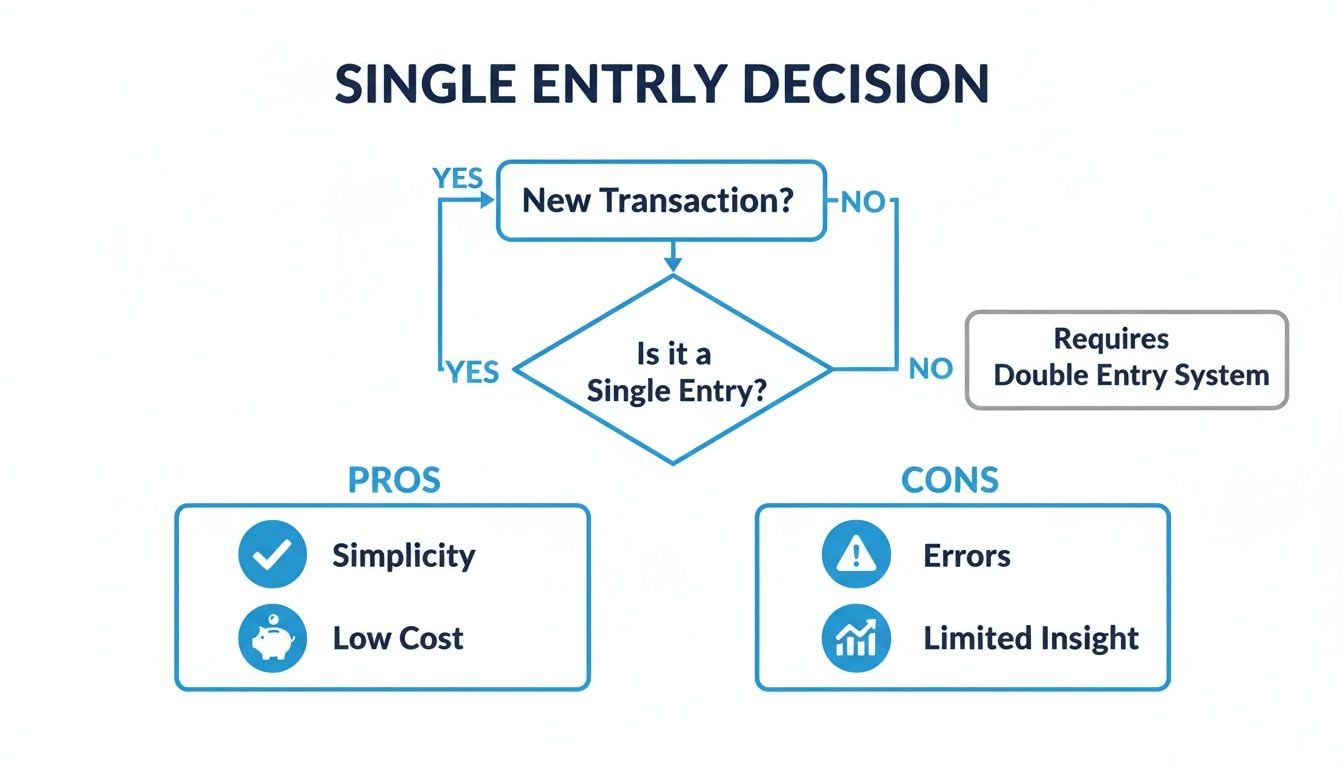
As you can see, the path is simple and low-cost, but it doesn’t offer the deep financial insights or error-checking capabilities you get from more advanced systems.
To make this crystal clear, run through this quick checklist to see if single-entry bookkeeping is a good match for your business right now.
Business Checklist: Should I Use Single-Entry?
Checklist Item
Yes / No
Guidance
Is your business a sole proprietorship or single-person LLC?
Single-entry is ideal for simple business structures.
Do you operate primarily on a cash basis?
If you don’t deal with accounts receivable or payable, this system works well.
Do you have a low volume of transactions per month?
Fewer transactions mean less room for error and easier manual tracking.
Do you have no physical inventory to track as an asset?
Service-based businesses are a perfect match.
Are you NOT seeking outside investment or bank loans?
Investors and lenders require financial statements that single-entry can’t produce.
Do you have no employees (only contractors)?
Payroll adds complexity that’s better managed with double-entry.
If you answered “Yes” to most of these, single-entry is likely a solid choice for your current stage. If you found yourself answering “No,” you might already be feeling the need for something more robust.
When to Graduate to Double-Entry
The beautiful simplicity of single-entry has its limits. As your business grows and becomes more complex, you’ll eventually find that “simple” has turned into “insufficient.” Knowing the signs will help you make the leap to double-entry before your books become a mess.
Think of it like your first apartment. It was perfect for a while, but eventually, you needed more space and better features. Your accounting system is the same—you have to upgrade to support your growth.
The writing is on the wall, and it’s time to upgrade if you:
- Want to Seek Investment: Venture capitalists and angel investors will expect a full set of financial statements, including a balance sheet. Single-entry can’t generate one.
- Need to Take on Debt: Just like investors, banks need to see the full picture of your assets and liabilities to gauge risk before lending you money. A cash-in, cash-out log won’t be enough.
- Hire Your First Employees: Once you’re managing payroll, tax withholdings, and benefits, you’ve entered a new world of financial complexity. A double-entry system is built to handle this.
- Start Holding Inventory: Selling physical products means you have inventory, which is an asset. You need a system that can track its value, and that’s a job for double-entry.
- Need Deeper Business Insights: Are you trying to figure out which service is most profitable? Or maybe you need a clearer view for cash flow forecasting? These deeper analytics are where double-entry really shines.
Starting with single-entry bookkeeping is a smart, strategic move for a new business. It gives you clarity and control when you need it most, with the full understanding that as you become more successful, you’ll graduate to a system that can grow with you.
Setting Up Your First Single-Entry System
Ready to finally get a handle on your business finances? Here’s the good news: setting up a single-entry bookkeeping system is something you can knock out in less than an hour. You don’t need to be an accountant or buy expensive software to get started—just a bit of organization.
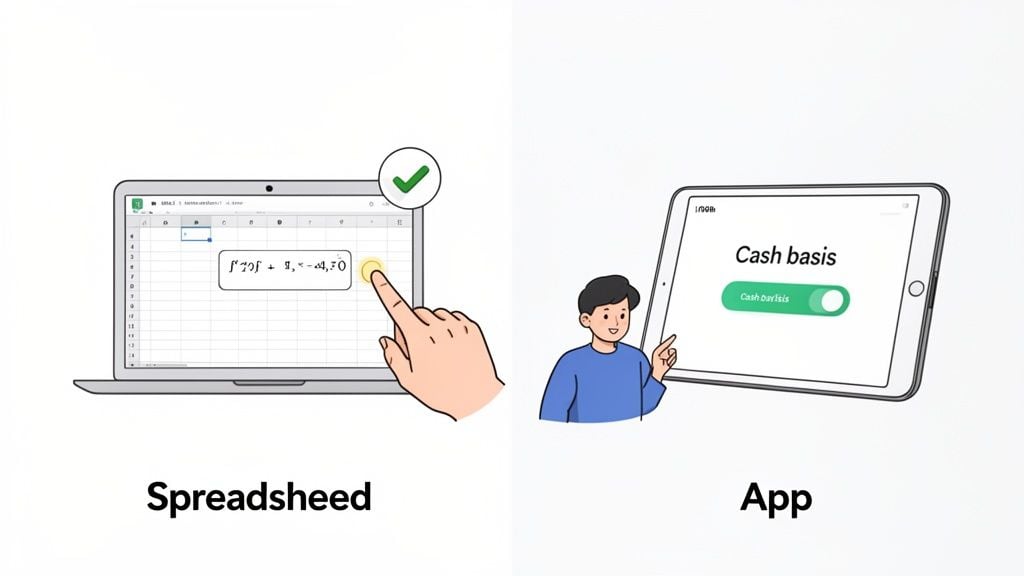
We’re going to look at the two most popular ways to do this. You can go the old-school, DIY route with a simple spreadsheet, or you can use a modern app set up for cash-basis accounting. Honestly, both work great. It really just boils down to what feels right for you.
The Classic Spreadsheet Method
The humble spreadsheet is the original, and still one of the best, tools for a single-entry system. It’s free, you can customize it however you like, and you’re in complete control. All you need is a program like Microsoft Excel, Google Sheets, or Apple Numbers.
Here’s a quick guide to building your own cash book from scratch.
1. Create Your Core Columns Fire up a new spreadsheet and label your columns. These five are the bare essentials for tracking your money effectively:
- Date: When the money actually moved in or out of your account.
- Description: A quick note so you remember what the transaction was for. Be specific! “Logo design for Client B” is a lot more helpful than just “Income.”
- Income (+): This column is for any money coming in.
- Expense (-): This one is for any money going out.
- Balance: A running total of how much cash you have on hand.
2. Set Up the “Magic” Formula This is the little trick that turns your static sheet into a live-updating ledger. In the very first row of your “Balance” column (let’s call it cell E2), just type in your starting cash. This might be the initial deposit you made into your business bank account.
Now, in the cell right below that one (E3), you’ll pop in a simple formula. Assuming your columns are A through E, it would look like this: =E2+C3-D3. This tells the spreadsheet to take the previous balance, add the income from this row, and subtract the expense.
Once that’s in, just grab the tiny square in the bottom-right corner of the E3 cell and drag it all the way down the column. Voila! Your balance will now update automatically with every new line you add.
That simple formula is what transforms your spreadsheet from a basic list into a dynamic cash book. This running balance gives you an instant, at-a-glance snapshot of your financial health after every single transaction.
Using Software for a Single-Entry Approach
If managing a spreadsheet feels a bit too hands-on, you’re in luck. Many modern accounting tools can be simplified to function just like a single-entry system. This approach offers a great middle ground—you get the simplicity you need, but with a slicker interface and some very handy automation.
The secret is to set the software to cash-basis accounting. Nearly all popular platforms will ask you to choose this during setup. By selecting cash basis, the software will only log income when cash is in your hand and expenses when you’ve actually paid them, perfectly mimicking how a single-entry system works.
Here’s the typical process for getting set up:
- Pick a User-Friendly Tool: Look for software known for being simple and intuitive. You don’t need a complex platform built for a massive corporation.
- Choose “Cash Basis” During Setup: This is the most important step. As the software walks you through the setup wizard, it will ask you to pick between cash and accrual. For this simple approach, always choose cash.
- Connect Your Business Bank Account: This is where the real magic happens. By securely linking your bank, the software can pull in all your transactions automatically. No more manual data entry!
- Categorize Your Transactions: Your main task becomes simply reviewing the imported transactions and telling the software what they were for (e.g., “Client Payments,” “Software Subscriptions,” “Office Supplies”).
This method keeps the focus on the simple flow of cash but takes the tedious data entry off your plate. For example, using a platform like Booksmate can help you automatically capture invoice data and line it up for classification, saving even more time and keeping your records sharp. It’s the best of both worlds: the ease of single-entry with the power of modern tech.
Avoiding Common Mistakes (And Staying on the Right Side of the IRS)
Choosing a simple system like single-entry bookkeeping is a great way to reclaim your time, but don’t let its simplicity fool you. There are a few classic blunders that can trip up even the sharpest entrepreneurs, turning your straightforward records into a real headache.
The good news? A little bit of discipline is all it takes to keep your books clean, accurate, and ready for tax season. For most small businesses, this method is perfectly fine, as long as you play by the rules.
The Golden Rule: Don’t Cross the Streams
I can’t stress this enough: keep your business and personal finances separate. This is the number one rule of business finance, no matter what bookkeeping method you use. Dipping into your business funds for groceries or paying a business bill from your personal account creates a tangled mess that’s a nightmare to unravel later.
The fix is incredibly easy: open a dedicated business bank account. From day one, funnel all your business income and expenses through that one account. This one move creates a clean, undeniable paper trail of your business’s financial life, making your single-entry system a thousand times easier.
Think of it as creating a dedicated lane for your business traffic. When all your business transactions are in one place, you can see your financial journey clearly without getting stuck in personal spending traffic jams.
Build Rock-Solid Record-Keeping Habits
A single-entry system is only as reliable as the information you put into it. If you’re forgetting to log transactions or your receipts are disappearing into a black hole, the system falls apart. Think of meticulous record-keeping as a non-negotiable part of the deal.
Here are the core habits you need to build:
- Save Every Single Receipt: Paper receipts for office supplies, digital invoices for software—save it all. Modern apps can even scan and organize them for you, so there’s no excuse for a shoebox full of crumpled paper.
- Get Specific with Categories: Don’t just throw everything into a “Miscellaneous” bucket. Create clear, logical categories like “Marketing,” “Client Software,” and “Office Supplies.” This shows you exactly where your money is going and makes claiming tax deductions a breeze.
- Check Your Work: At the end of every month, sit down with your cash book and your business bank statement. Comparing the two is the best way to catch mistakes or forgotten entries before they snowball into bigger problems.
Know the Tax Rules
While the IRS gives the green light to single-entry bookkeeping for many small businesses (check out IRS Publication 583 for the details), you’re still on the hook for accuracy. The system’s simplicity can sometimes lead to gaps, especially with things like tracking inventory. In fact, IRS data shows that filers using these simpler methods amend their returns 15% more often because of these kinds of oversights. You can find more on how accounting methods have evolved over on this financial blog.
When tax time rolls around, getting a second opinion from professional Tax Accountants can be a game-changer. They can review your records to make sure everything is compliant, help you maximize every possible deduction, and keep you out of hot water with the tax authorities. It’s a small investment that can save you a ton of money and stress in the long run.
Got Questions? We’ve Got Answers
Still have a few things you’re wondering about single-entry bookkeeping? Let’s clear up some of the most common questions so you can get started on the right foot.
Can I Switch from Single Entry to Double Entry Later?
Absolutely. In fact, it’s a great sign that your business is growing! The smoothest time to make the switch is at the beginning of a new financial year. This keeps your annual records neat and tidy.
You’ll want to bring in an accountant for this. They’ll take the final cash balance from your single-entry records and use it as the opening balance in your new double-entry software (like QuickBooks or Xero). This gets you set up for much more detailed financial insights.
Is Single Entry Bookkeeping Legal for My Small Business?
For the vast majority of freelancers, sole proprietors, and small LLCs in the U.S. that operate on a cash basis, single-entry bookkeeping is 100% legal. The IRS is perfectly fine with it.
That said, once you become a corporation, start holding a lot of inventory, or need to show a balance sheet to get a loan, you’ll almost certainly need to use the double-entry method. It’s always a smart move to have a quick chat with an accountant to be sure you’re following all the rules.
What Is the Easiest Way to Start Today?
Honestly, the simplest way is to open a dedicated business bank account and fire up a spreadsheet. That’s it.
Just create columns for the date, what the transaction was for, money in (income), and money out (expenses). Get into the habit of updating it once a week by cross-referencing your bank statement. This small routine keeps your business and personal finances separate and makes tax time a whole lot less painful.
Tired of chasing down receipts and manual data entry? Booksmate can make your financial life a lot easier. It connects to your email and online accounts to automatically grab invoices and receipts, putting them all into one organized dashboard. Check it out at https://booksmate.com and get some time back in your day.