

You open an invoice from a supplier in Germany, or you’re setting up a new customer in France, and there it is: EU VAT identification number.
At first glance, it looks like one more box to fill in and one more acronym to decode. Then the questions start. Is it the same as a company registration number? Is it your domestic tax number? Do you need one only if you sell physical goods, or also for services? And why does your accounting software care so much whether those letters and digits are in the “right” shape?
If you’re a business owner, that moment usually arrives when trade starts moving faster than admin can keep up. If you’re a bookkeeper or accountant, it often appears in a more annoying form: a client sends over an invoice with a half-missing VAT number, or an ecommerce platform exports a customer record that looks valid until a filing fails.
The frustrating part is that VAT IDs sound technical, but the actual issue is practical. They affect whether you charge VAT, whether you can apply reverse charge treatment, whether an invoice is compliant, and whether a transaction can move cleanly through your systems.
That’s why this topic matters. The eu vat identification number isn’t just a tax label. It’s one of the main identifiers that tells tax authorities, suppliers, customers, and software how a cross-border EU transaction should be handled.
That Moment You Realize You Need an EU VAT Number
A common version of this story goes like this.
You run a small business and buy software, ads, stock, or subcontracted services from another EU country. The supplier asks for your VAT number before issuing the invoice. Or you make your first sale to an EU business customer and they ask you to put both VAT numbers on the invoice. Suddenly, what looked like routine admin turns into a compliance problem.
The confusion is understandable because businesses already deal with several identifiers. You may have a company registration number, a domestic tax number, an OSS registration, and various portal account IDs. The eu vat identification number has a narrower role. It identifies your VAT status for transactions where VAT treatment depends on whether the parties are taxable businesses in the EU system.
Why this catches people off guard
Most businesses don’t think about VAT IDs until a transaction crosses a border. Domestic invoicing can hide the issue for a long time. Then one foreign supplier, one Amazon marketplace expansion, or one B2B customer in another member state changes the rules.
A few situations trigger the question quickly:
A supplier requests it before invoicing so they know whether local VAT applies.
Your accounting system flags an incomplete invoice because the VAT number field is blank.
A client wants zero-rated treatment and expects you to validate their number.
Your bookkeeper sees a mismatch between the country on the invoice and the VAT prefix.
A missing VAT number often isn’t just a missing field. It changes the tax treatment of the transaction.
What business owners usually mix up
People often assume the VAT ID is just “the tax number with a country prefix.” Sometimes the relationship is close. Sometimes it isn’t. That’s why copying a number from a company registry or an old invoice can create problems later.
The safe mindset is simple. Treat the VAT ID as the identifier used to prove VAT registration status in EU trade. If you’re sending or receiving invoices across borders, that number deserves the same attention you’d give a bank account number. One wrong character can cause a chain of admin work you didn’t plan for.
What Is an EU VAT Identification Number Really
The easiest way to understand an eu vat identification number is to think of it as a business passport for VAT purposes inside the European Union.
It tells another business, and the tax authorities behind the scenes, that the entity is registered for VAT and can be identified correctly in cross-border transactions. That matters because VAT treatment in the EU depends heavily on who is selling, who is buying, and where each party belongs in the system.
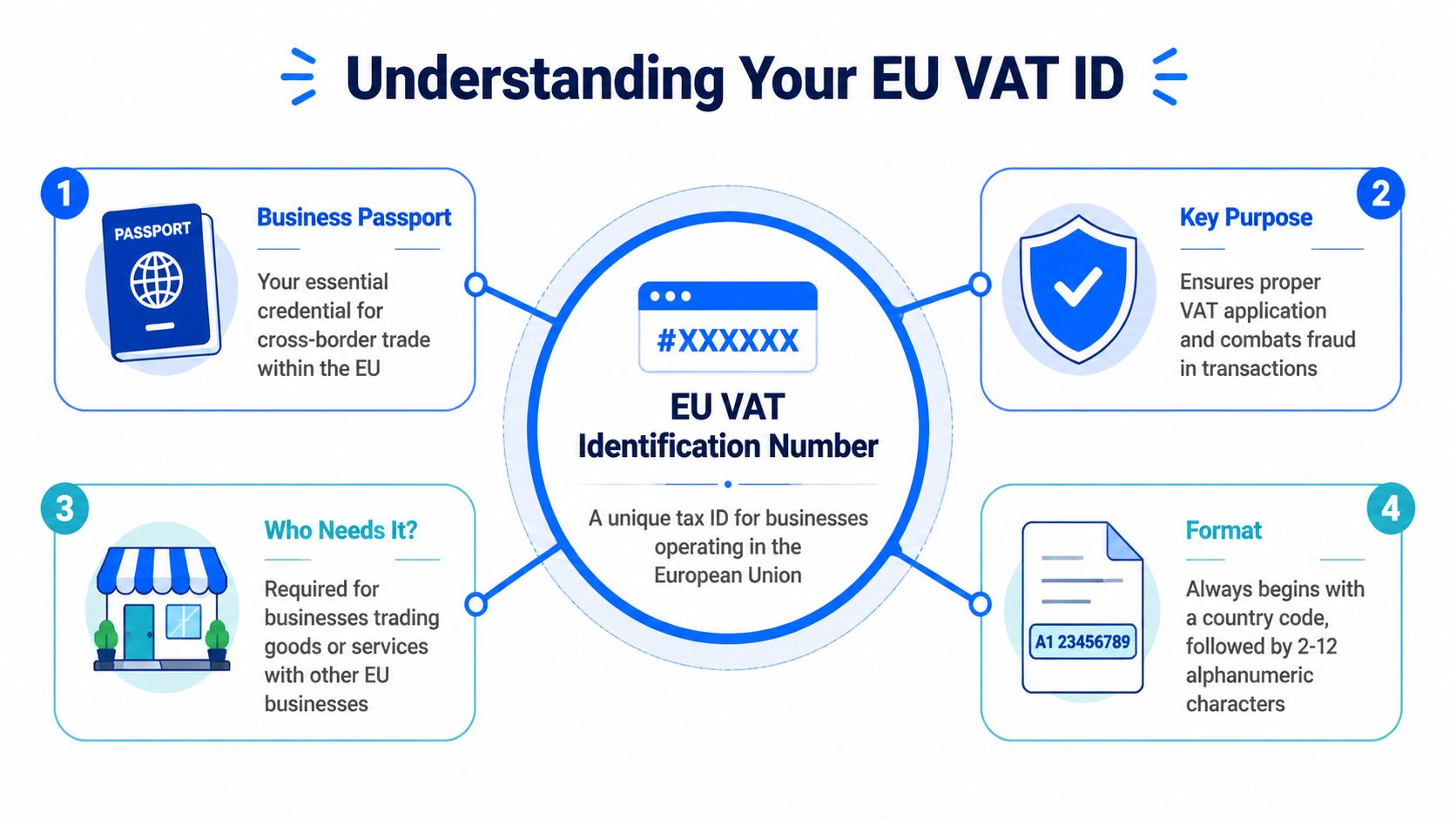
According to the VAT identification number background summary, the EU VAT identification number is a unique identifier assigned to businesses registered for VAT across the 27 EU member states, and the system traces back to the Sixth VAT Directive (77/388/EEC) adopted on May 17, 1977, later standardized by Directive 2006/112/EC. That same source notes that VAT IDs follow a common idea: a two-letter ISO country code prefix followed by 8 to 12 digits or characters, depending on the issuing country.
What it does in real life
A VAT ID does two jobs at once.
First, it helps tax authorities track the VAT status of the business involved in a transaction. Second, it gives trading partners a way to identify each other properly on invoices and validate whether the intended VAT treatment makes sense.
That’s why the number appears in places like:
Cross-border B2B invoices
Supplier onboarding forms
Marketplace tax settings
Accounting exports and ERP records
Validation checks before zero-rating
What it is not
Here, many businesses trip.
A VAT ID is not automatically the same as your company registration number. It’s also not just any domestic tax reference your business has. Those numbers can be related, but they serve different purposes. A company registry proves the legal existence of the company. A VAT ID proves VAT registration status for the relevant tax framework.
A good analogy is a passport and a driver’s licence. Both identify you. But they don’t do the same job, and you can’t swap one for the other when the border officer asks.
Why the format matters so much
The structure of the number isn’t cosmetic. The prefix identifies the country, and the rest follows that country’s own logic. Some countries use digits only. Others include letters, control characters, or fixed opening characters.
That matters because systems don’t just “read” VAT numbers. They try to parse them, classify them, validate them, and pass them into invoice or filing workflows.
Practical rule: If your software treats every VAT number as a plain string of digits, you should expect errors on cross-border documents.
Why bookkeepers care more than owners expect
For a business owner, the VAT ID can feel like a setup detail. For a bookkeeper, it affects the whole chain. Extraction, coding, validation, export, and audit support all depend on that identifier being accurate.
When the VAT ID is correct, the invoice can move cleanly through the workflow. When it’s wrong, the damage usually shows up later. A failed validation, a rejected export, a VAT adjustment, or an awkward email to the client asking for a corrected invoice.
How do you get a VAT number in the EU?
Register with the tax authority in the EU country where your business is required to account for VAT. There is no single universal EU VAT number: each member state issues its own number, although OSS schemes can simplify some cross-border reporting.
Confirm whether domestic turnover, stock location or cross-border sales trigger registration.
Prepare company registration, tax, identity, address and trading evidence requested by the country.
Use VIES to validate a number for cross-border EU trade after it is issued.
What documents are needed for EU VAT registration?
Requirements differ by country, but businesses commonly provide the registration form, incorporation documents, company-register extract, existing tax or VAT certificate, proof of planned trade and power of attorney for any fiscal representative.
Some countries require documents in the local language or certified copies.
Non-established businesses may need a local fiscal representative.
Registration timing and thresholds depend on the country and transaction type.
Decoding Country-Specific VAT Number Formats
Here’s where the eu vat identification number stops being conceptually simple and starts becoming operationally awkward.
Every EU VAT number begins with a country code, but what comes after that varies by country. That variation is exactly why accountants see extraction errors, import errors, and validation failures on otherwise normal invoices.
The Avalara guide to EU VAT number formats notes that these country-specific formats are critical for invoice automation compliance and that unformatted VAT parsing fails 28% of the time on cross-border B2B invoices.
The pattern is shared, but the details are not
A quick glance at common examples shows the problem.
Some countries are straightforward. Germany uses a country prefix plus digits. Others are less forgiving. Austria includes a fixed letter after the prefix. France uses a control key. Spain allows letters in positions that can confuse OCR and rule-based imports.
That means a one-size-fits-all validation rule is weak from the start.
Common EU VAT Number Formats 2026
Country | Country Code | Format | Example |
|---|---|---|---|
Austria | AT | U + 8 digits | ATU12345678 |
Belgium | BE | 0 + 9 digits | BE0123456789 |
France | FR | 2 control characters + 9 digits | FRXX999999999 |
Germany | DE | 9 digits | DE999999999 |
Spain | ES | 9 characters, may include letters at start or end | ESX12345678 |
What this means for automation
If you’re entering VAT IDs manually, format knowledge helps you spot obvious mistakes. If you’re automating invoice capture, it becomes even more important.
A parser might read:
the leading 0 in a Belgian number as disposable
the U in an Austrian number as noise
a Spanish trailing letter as a typo
a French control segment as separate from the main number
Once that happens, the number looks “almost right” to a human but fails downstream. That’s the dangerous kind of error because it survives long enough to create rework.
A simple way to sanity-check a number
Before validation, ask three basic questions:
Does the prefix match the country on the invoice?
Does the structure match that country’s known format?
Does the number appear complete, including letters and leading zeroes?
If your team handles Irish invoices often, Snyp’s 2026 Irish VAT resource is a useful companion because Ireland tends to be one of the places where businesses discover that VAT handling and invoice interpretation get messy faster than expected.
Country-specific format checking is not “nice to have” admin. It’s the first filter that stops bad data from entering the books.
For bookkeepers, this is one of the biggest workflow lessons. Don’t wait for the validation stage to catch what the format stage should have rejected.
When and Why a VAT Number Is Absolutely Required
Some VAT details are administrative. This one isn’t.
In many cross-border situations, the eu vat identification number is the piece that supports the VAT treatment you want to apply. If it’s missing, invalid, or used carelessly, the transaction may need to be treated in a completely different way.
The European Commission VAT identification numbers page states that since the One Stop Shop launched on July 1, 2021, over 500,000 businesses had registered by mid-2025, and the scheme simplifies reporting for sales above the €10,000 pan-EU threshold. The same source notes that, under Regulation (EU) 2019/2152, VAT IDs are mandatory on Intrastat declarations for intra-EU goods movements, helping monitor over €700 billion in annual trade.
Cross-border B2B invoices
This is the scenario commonly encountered first.
When one EU business sells to another across borders, the VAT result often depends on both parties being correctly identified as taxable businesses. The VAT number is part of that proof. It’s usually shown on the invoice and checked during compliance review.
Without that, the supplier may not be able to apply the intended treatment confidently. Even when the commercial deal is correct, poor VAT ID handling can turn a clean B2B sale into a tax problem.
Ecommerce and OSS
If you sell across borders to EU consumers, the issue changes shape but becomes just as important.
The OSS system exists to reduce the old problem of multiple registrations for sellers operating in several EU markets. Once your sales pattern takes you beyond the pan-EU threshold, VAT administration becomes more centralized through OSS, but your business still needs proper identifiers and disciplined invoice data.
That’s especially relevant for sellers using marketplaces, multiple storefronts, and several payment or fulfillment platforms. If you work with Amazon’s EU programs, Seller Central Pan-European insights can help you understand how operational expansion can quickly create tax and reporting complexity.
Intrastat and goods movements
For businesses moving goods across EU borders, VAT IDs don’t just belong on invoices. They also matter for reporting.
That catches wholesalers, manufacturers, distributors, and ecommerce operators who transfer stock between countries. In those cases, the VAT number isn’t a back-office detail. It’s part of the formal reporting trail attached to the movement.
Why getting it wrong costs more than people expect
The most expensive VAT mistakes aren’t always dramatic. Often they start with a bad assumption.
A team assumes a customer’s VAT number is valid because it “looks right.” A supplier uses an old VAT number copied from an outdated profile. An ecommerce business expands into new countries and keeps using the same invoice setup everywhere.
The result can be:
Incorrect VAT treatment on sales or purchases
Manual corrections across invoices already issued
Problems during filing or audit review
Cash flow pressure when VAT must be paid unexpectedly
Extra work for accountants cleaning up records after the fact
The practical test
Ask yourself whether the VAT number changes the tax treatment of the transaction. If the answer is yes, it is not optional admin.
That includes many common situations:
Selling goods to an EU business in another member state
Providing services to an EU business customer
Moving stock between EU countries
Using OSS for distance sales above the threshold
Preparing formal cross-border reporting
Businesses often focus on rates first. In practice, the identifier often matters earlier. Before you decide what VAT to charge, you need to know who the customer is in VAT terms.
If your invoice treatment depends on B2B cross-border status, treat VAT number collection and checking as part of the sale, not as after-the-fact bookkeeping.
How to Validate Any EU VAT Number in Seconds
A VAT number written on an invoice is not the same as a VAT number you can rely on.
Validation is the step that turns a claimed identifier into a checked one. In EU practice, the main tool for that is VIES, the VAT Information Exchange System. It connects validation requests to the relevant member state database.
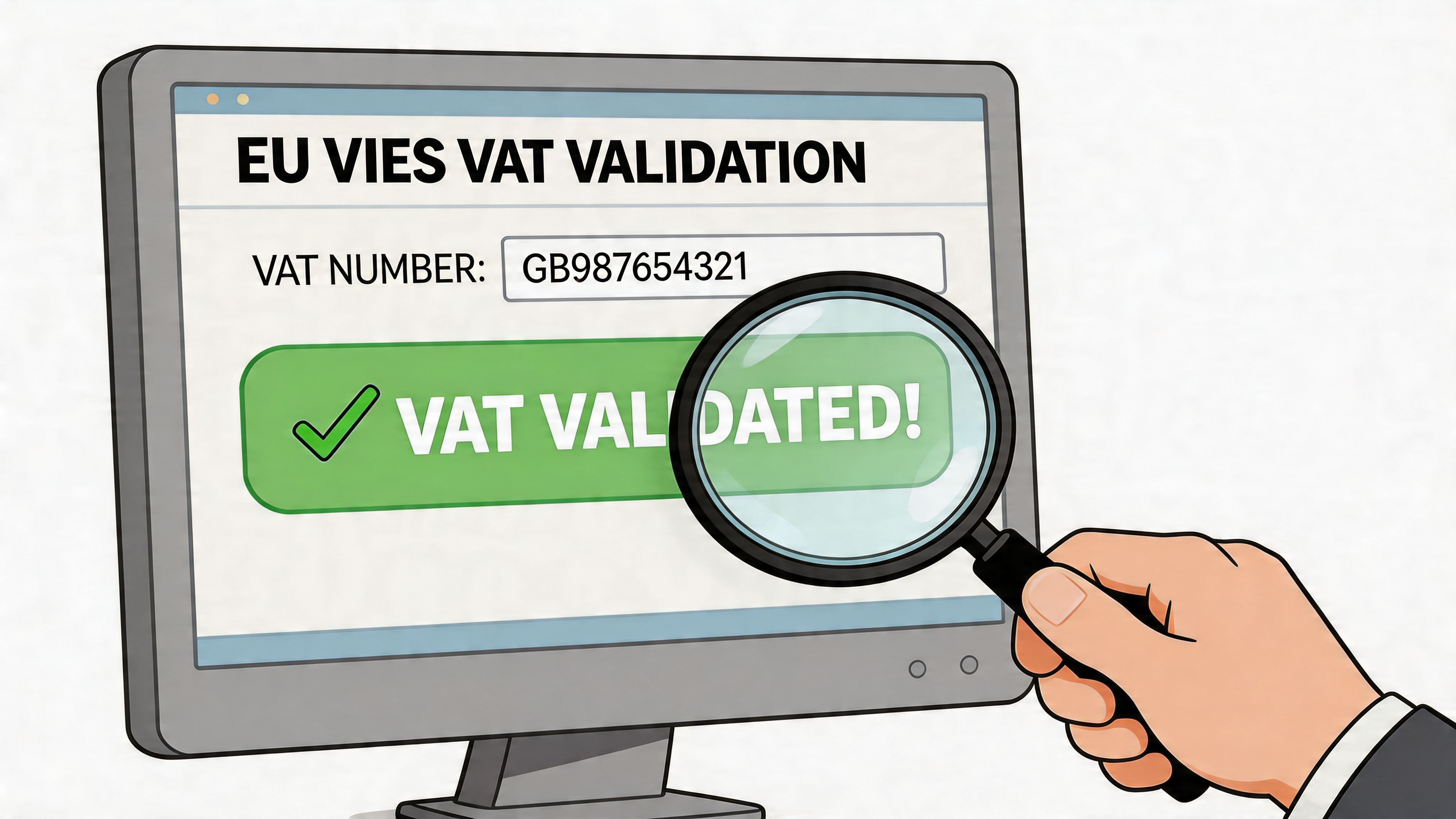
The FreightAmigo article on understanding EU VAT numbers states that successful VIES validation returns a name and address match, that historical uptime has been 95%, and that 2024 to 2025 outages hit 12% because of national system overloads. The same source says a failed validation on an intra-EU B2B invoice can trigger reverse-charge denial, forcing a 21% standard VAT payment and fines ranging from €5K to €50K per quarter for repeat errors. It also notes that VIES false negatives can spike 8% during peaks.
The basic manual workflow
For a single VAT number, the process is simple.
Select the member state that issued the number.
Enter the VAT number without guessing or “correcting” it.
Run the validation request.
Read the result carefully, including whether the service is available.
If the result is valid, keep evidence of the check. If the result is invalid, stop and review the source document before you issue or finalize the invoice treatment.
What the result really means
A “valid” result means the issuing authority recognizes the number in the VIES-connected system.
An “invalid” result can mean the number is wrong, incomplete, inactive for intra-EU use, or entered with the wrong country selection. It can also mean the source data on the invoice is stale.
A “service unavailable” result is different again. It doesn’t prove the number is invalid. It means the system could not complete the check at that moment.
Don’t treat a technical outage as tax evidence. Treat it as an incomplete check and document what you did next.
Good habits that save trouble later
For manual checks, a few habits make a big difference:
Keep a record: Save a screenshot or other evidence of the validation attempt.
Check the country first: Many failed validations start with the wrong prefix or wrong member state selection.
Retry during outages: A system issue is not the same as a failed registration.
Ask for confirmation early: If the number fails, contact the customer or supplier before month-end closing.
A short walkthrough helps if you want to see the process visually.
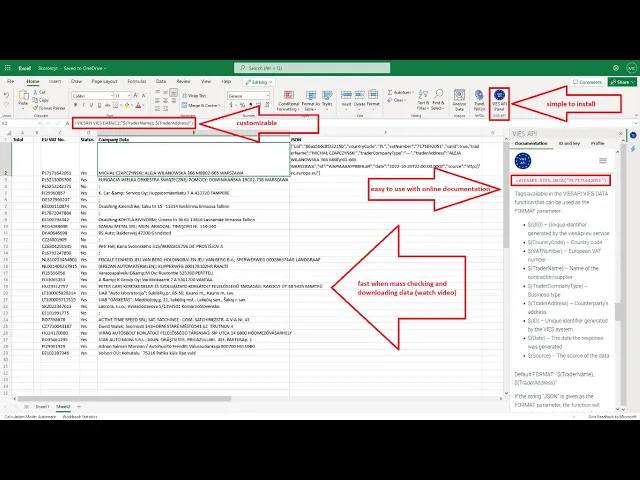
Where manual checking breaks down
Manual validation works for occasional checks. It becomes weak when you’re handling high invoice volume, multiple entities, or lots of portal-fetched documents.
That’s when teams start needing structured controls such as:
Format checks before validation
Batch validation
Exception queues for failed or unavailable checks
Saved evidence linked to the invoice record
If you validate one number at a time, the process is manageable. If you validate dozens or hundreds during a close cycle, you need the workflow to do more than display a green tick.
A Practical Guide to Obtaining Your VAT Number
Most businesses don’t apply for a VAT number just because they like paperwork. They do it because their trading pattern leaves them little choice, or because registering gives them a practical advantage.
The key is to start with the reason. Once you know why you need a VAT number, the registration path becomes much easier to understand.
Common situations that trigger registration
One reason is domestic VAT registration in your home country. Another is cross-border activity that pushes you into wider EU compliance. Some businesses also choose to register voluntarily because they need cleaner VAT handling on purchases and sales.
Typical triggers include:
Your business activity reaches the point where VAT registration is required domestically
Your cross-border consumer sales exceed the €10,000 pan-EU threshold linked to OSS
You need proper VAT registration status for intra-EU business transactions
You want to reclaim VAT on eligible business purchases
Your expansion into another market creates a local obligation
What the application process usually involves
While each country has its own portal and paperwork style, the process usually asks for the same core information.
Expect to provide details such as:
What you usually need | Why it matters |
|---|---|
Business identity details | To match the application to the legal entity |
Trading activity description | To show what the business does |
Address and contact information | For registration and official notices |
Start date of taxable activity | To determine when registration applies |
Cross-border activity details | To assess EU VAT obligations |
The business decision matters before the form does
Owners often jump straight to “Where is the online form?” A better first step is asking, “What is the actual reason I’m registering?”
That question matters because the route can differ depending on whether you are:
selling domestically
selling cross-border to consumers
trading B2B across EU borders
storing stock in another country
registering for OSS
If Spain is part of your expansion plan, a practical local guide like register for VAT in Spain from renn can help you understand the administrative side before you start collecting documents.
A sensible order of operations
For business owners, I usually suggest this order:
Map your sales and purchase flows. Don’t register based on vague assumptions.
Identify where the VAT obligation arises. Home country, OSS, or another member state.
Gather entity and trading documents early. Delays often come from missing admin, not tax complexity.
Check how invoices will be issued after registration. The number only helps if your systems use it correctly.
Tell your accountant or bookkeeper before go-live. VAT registration without workflow changes creates avoidable errors.
One final caution
Registration is the beginning of the compliance job, not the end of it.
Once you have the VAT number, it needs to appear consistently in the right places, be validated when counterparties rely on it, and flow correctly through invoicing and accounting records. Many businesses think the hard part is getting the number. In practice, the harder part is using it properly every day.
Automating VAT Compliance for Accountants with Booksmate
Manual VAT handling usually fails in a very ordinary way. Not because the team doesn’t understand the rules, but because they’re chasing invoices across email inboxes, portals, marketplace accounts, and shared folders.
That’s where automation changes the job. Instead of asking staff to download every invoice, read every VAT number, compare every prefix, and then retype data into accounting software, the workflow can be structured so the document arrives, the data is extracted, and exceptions are flagged before export.
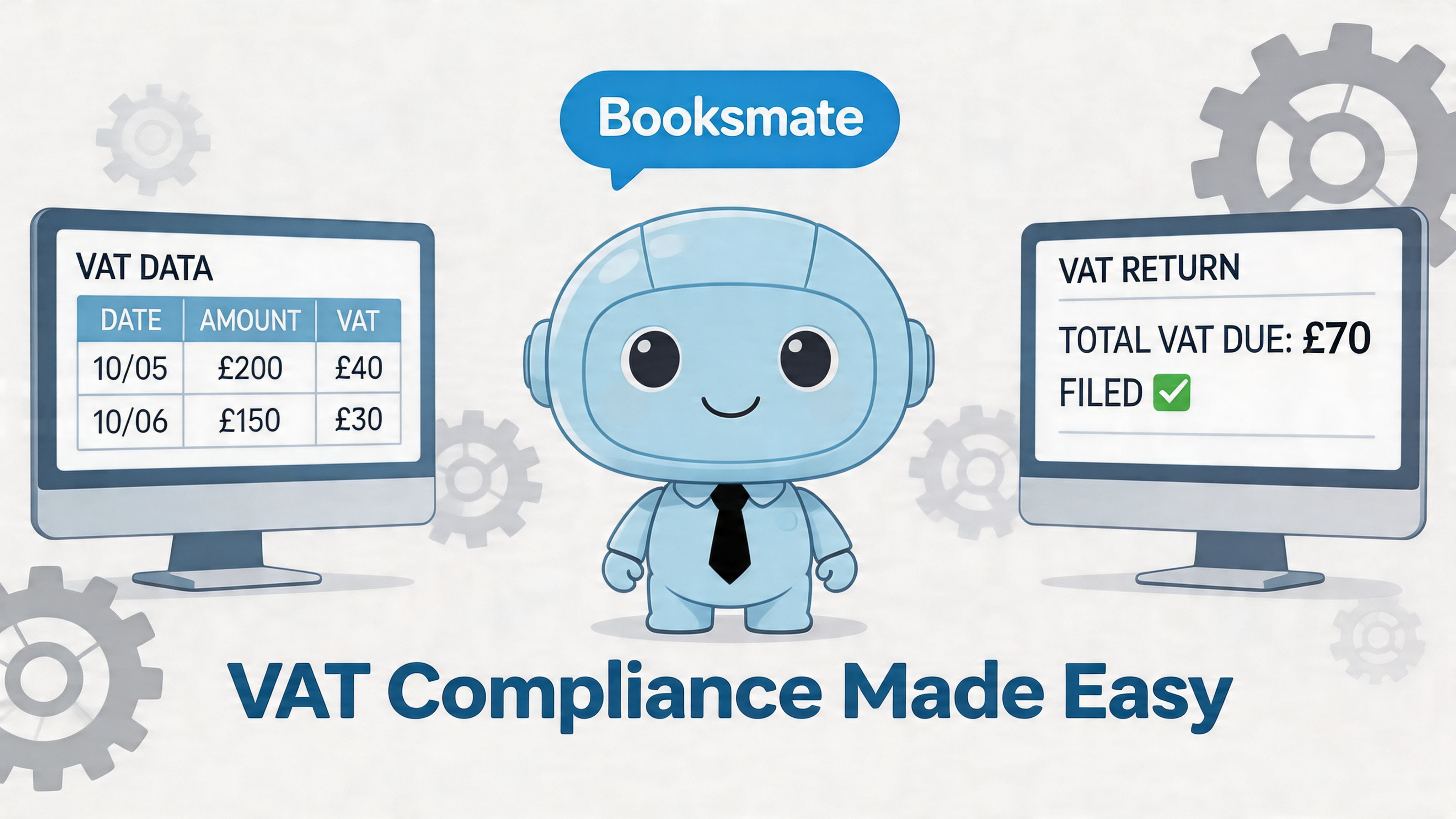
What a practical workflow looks like
A well-designed process usually follows this sequence:
Step | What happens | Why it matters |
|---|---|---|
Invoice collection | Documents are fetched from portals and inboxes | The team stops relying on manual downloading |
Data extraction | Key fields, including VAT numbers, are captured | Reduces retyping and copying errors |
Format checking | Country-specific structure is reviewed | Catches obvious mistakes early |
Validation | Numbers are checked through the proper validation workflow | Supports compliant VAT treatment |
Export | Cleaned data moves to accounting software | Prevents correction work later |
This matters most for firms handling invoices from platforms like Amazon, Stripe, Google, Microsoft, and PayPal, where document formats vary and VAT number quality can be inconsistent.
Why automation helps with the hardest part
The hardest part is not fetching the invoice. It’s deciding whether the extracted VAT number is complete, plausible, and safe to rely on.
A smart workflow can identify the country prefix, preserve leading characters, and apply logic that reflects the country-specific formats discussed earlier. That means the system doesn’t treat an Austrian VAT number and a Belgian VAT number as interchangeable strings.
What accountants should want from the dashboard
For day-to-day bookkeeping, the most useful output is not “all numbers extracted.” It’s a shortlist of exceptions that need human attention.
That includes invoices where:
No VAT number was found
The format doesn’t match the issuing country
Validation couldn’t be completed
The supplier and VAT country appear inconsistent
The invoice is about to be exported with unresolved VAT risk
The best automation doesn’t remove judgment. It moves judgment to the small set of invoices that deserve it.
Where this saves time in real firms
The time saving is cumulative.
A bookkeeper doesn’t need to log into multiple portals just to collect source documents. An accountant doesn’t need to review every invoice line by line looking for one malformed identifier. A finance manager gets cleaner exports into the accounting stack rather than discovering issues during filing.
That’s the practical bridge between VAT knowledge and implementation. Knowing the rules is one thing. Building a process that respects them at scale is what keeps month-end under control.
Frequently Asked Questions About EU VAT Numbers
Even when the core rules are clear, a few edge cases keep coming up in practice. The toughest ones usually involve invalid numbers, Brexit complications, and invoices that arrive with incomplete information.
The PolishTax discussion of intra-community delivery without a valid VAT EU number notes that if a buyer lacks a valid VAT EU number, the seller must charge local VAT instead of zero-rating the supply, with penalties that can reach 20% of turnover. The same source says post-Brexit UK sellers face 12% rejection rates in 2025 VIES statistics and mentions fallback workflows such as provisional zero-rating with 90-day proof deadlines.
FAQ
Question | Answer |
|---|---|
Is a VAT ID the same as a company registration number? | No. They may be related in some countries, but they do different jobs. A company number identifies the legal entity. A VAT ID identifies VAT registration status. |
What if my customer gives me a VAT number that fails validation? | Pause before treating the sale as a zero-rated intra-EU B2B supply. Ask for confirmation or a corrected number and review whether local VAT should be charged. |
What if VIES is unavailable? | Treat it as an incomplete check, not automatic failure. Record the attempt, retry, and keep supporting evidence of your follow-up. |
Can I rely on a VAT number copied from an old invoice? | Not safely. Numbers can be entered incorrectly, become inactive for intra-EU purposes, or belong to a different entity than expected. |
Do UK numbers still create confusion? | Yes. Post-Brexit handling is one of the areas where teams often need extra care, especially when old customer records still contain assumptions from pre-Brexit workflows. |
What should a bookkeeper do when an invoice arrives without a usable VAT number? | Flag it early, before export or filing. It’s much easier to request a corrected invoice during processing than to fix VAT treatment after the accounts are posted. |
A good rule is to treat VAT number problems as workflow issues, not just tax issues. The faster they surface, the cheaper they are to fix.
If your team spends too much time downloading invoices, checking VAT details by hand, and cleaning up bad exports later, Booksmate can help streamline the process. It pulls invoices from portals and inboxes, extracts key data with AI, organizes documents in one dashboard, and gets them ready for export so your accountants can focus on exceptions instead of repetitive admin.
For a practical records review, use this VAT audit documentation checklist to prepare supporting evidence.
For larger volumes, explore processing VAT invoices automatically to reduce manual work.