

Most advice on how to keep track of business expenses starts too late. It starts with categories, tax deductions, or reconciliation. Those matter, but they aren't the first problem most businesses face anymore.
The first problem is getting the documents. If invoices live across Amazon, Stripe, Google, Microsoft, PayPal, SaaS billing pages, and scattered inboxes, your books are already incomplete before anyone assigns a category. A clean expense system starts upstream, at document capture, then moves through organization, reconciliation, and reporting.
Table of Contents
Laying the Foundation for Expense Tracking
Treat expense tracking like a system
Set the basic rules before spending starts
Solving the Document Collection Puzzle
Why most expense systems break before bookkeeping starts
What a workable collection flow looks like
Organizing Data for Clarity and Compliance
Build categories that help both accounting and taxes
A simple chart of accounts structure
The Crucial Reconciliation and Reporting Loop
Reconciliation is quality control
What to review every month
Automating Workflows and Integrating Systems
Connect collection classification and export
What to automate first
Measuring Success and Avoiding Common Pitfalls
Metrics that show whether the system works
Mistakes that quietly break expense tracking
Laying the Foundation for Expense Tracking
Treat expense tracking like a system
If you want a method that survives growth, staff changes, and tax season, treat expense tracking like a system, not a habit. A habit depends on memory and discipline. A system depends on rules, structure, and a repeatable workflow.
Establishing a clear expense policy serves as your blueprint, while setting up dedicated bank accounts and credit cards forms the essential foundation. If these core components are weak, your entire financial tracking system will become unstable later.
A technically sound workflow starts with separate business and personal finances, then recording each transaction with date, vendor, amount, category, and purpose, attaching receipts, and reconciling on a fixed cadence. Practitioner guidance recommends daily or weekly logging plus monthly reconciliation, and for smaller firms with fewer than about 30 transactions per month, a structured spreadsheet can be enough before software becomes the better option for scale and audit readiness, as outlined by Del Real Tax on tracking business expenses.
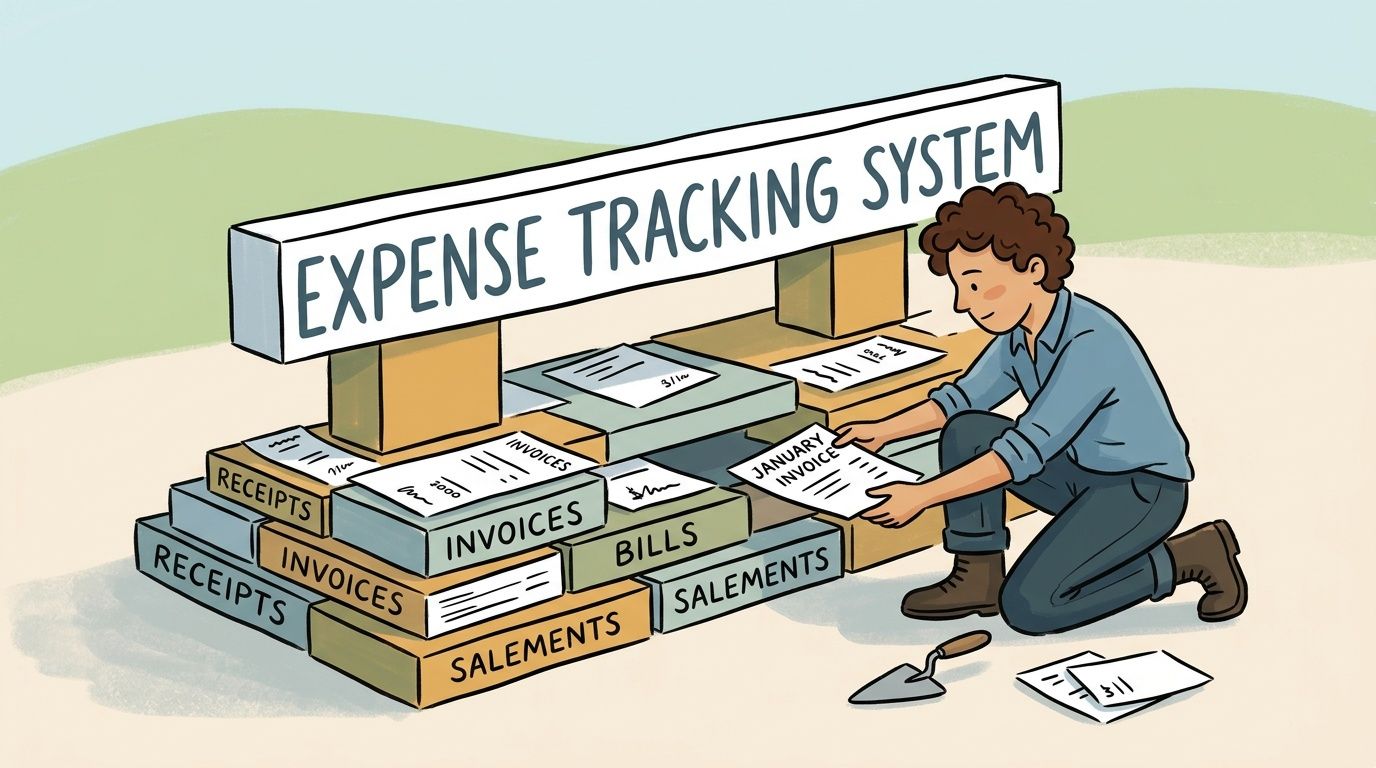
Practical rule: If a transaction can't be traced to the right account, the right document, and the right business purpose, it isn't fully tracked.
Set the basic rules before spending starts
Even a solo operator needs a simple expense policy. It doesn't need legal language. It needs clarity.
Your policy should answer these questions:
What counts as a business expense: Define ordinary recurring spending such as software, contractor payments, office supplies, travel tied to work, and platform fees.
Who can spend: In a one-person business, that's easy. In a team, decide who can buy directly, who needs approval, and what should go through procurement.
What documentation is required: At minimum, keep the receipt or invoice plus the date, vendor, amount, and why the purchase was for the business.
Where records live: Pick one storage location and stick to it. Don't split records between inboxes, phones, desktops, and chat threads.
What doesn't work is a vague rule like "save receipts when you can." That creates cleanup work at month-end, and cleanup work is where details disappear.
If you're still deciding between a spreadsheet-first approach and a dedicated tool, this guide to a small business expense tracker from ReceiptGen is a useful reference for comparing practical options.
Solving the Document Collection Puzzle
Most articles on how to keep track of business expenses assume you already have the receipt. That's the blind spot.
For many businesses, the hardest part isn't coding a charge to software, advertising, or office supplies. It's collecting the invoice from the portal where the vendor hid it. The work happens before bookkeeping. Someone has to log into the vendor account, find billing history, download the file, rename it, store it, then match it to the card charge.
Why most expense systems break before bookkeeping starts
That problem gets worse as spending shifts to digital vendors. A major underserved angle is not categorization but collecting receipts and invoices in the first place when spending happens across dozens of vendor portals and inboxes. Guidance summarized by Brex on tracking business expenses notes that most guides rarely address the operational bottleneck of manual portal downloading for SaaS, marketplaces, ad platforms, and payment tools.
Manual collection fails in predictable ways:
Invoices stay in portals: The charge appears on the card, but the source document never reaches accounting.
Inboxes become filing systems: Finance teams search old emails instead of working from a central record.
Paper and digital records get mixed: Some receipts are scanned, some are photographed, some are lost.
Month-end turns into a chase: Someone has to ask employees or clients to resend what should have been captured at the start.
That isn't just annoying. It weakens the audit trail and slows every downstream step.
The cleanest general ledger in the world won't help if the source documents never make it into the system.
What a workable collection flow looks like
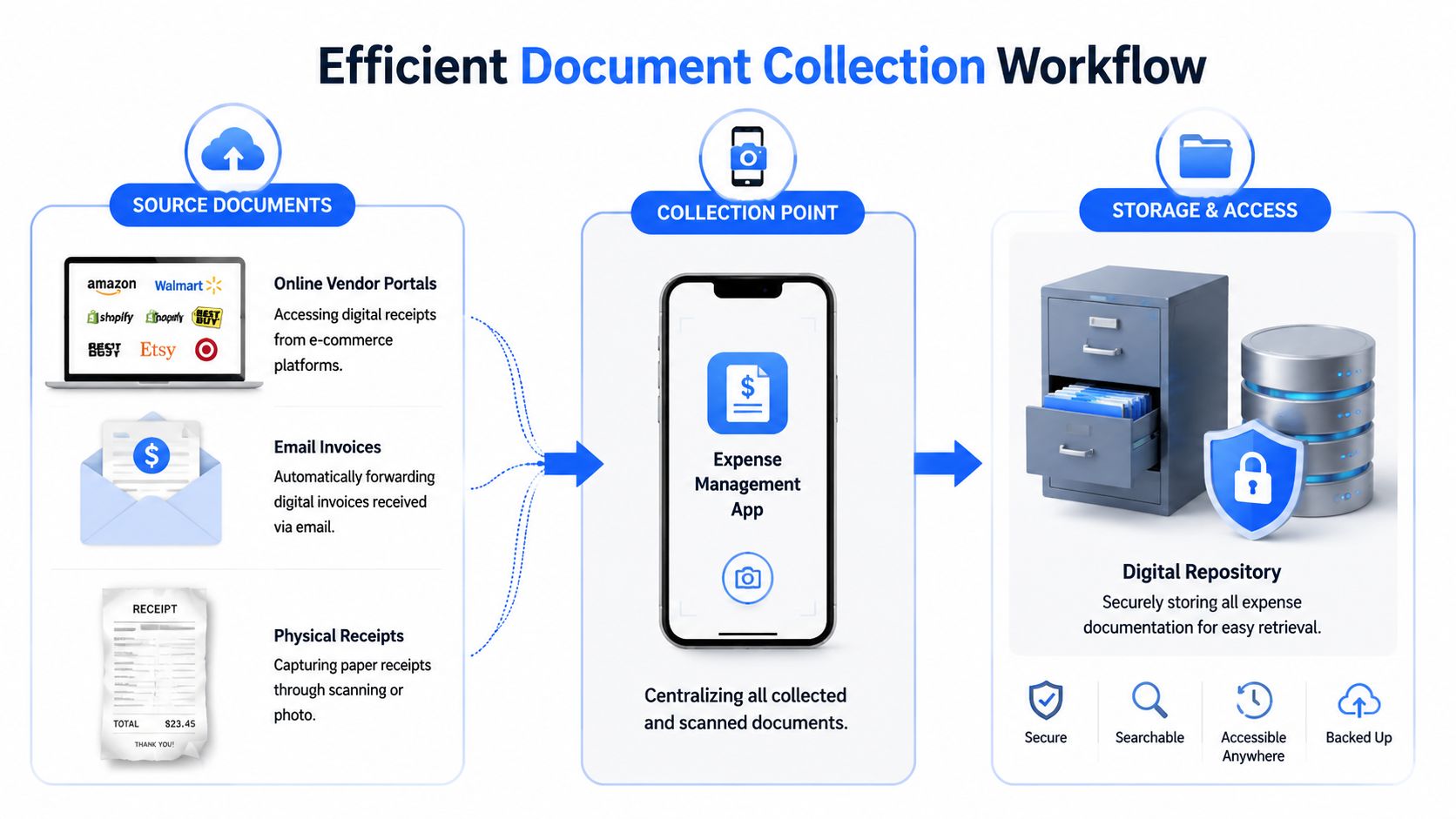
A modern collection process should pull documents from three places into one repository:
Vendor portals such as ecommerce accounts, ad platforms, payment providers, and software billing pages.
Email inboxes where vendors send invoices, receipts, and payment confirmations.
Physical receipts that employees scan or photograph on the day of purchase.
Once those sources feed a single intake point, categorization becomes easier because the supporting evidence arrives with the transaction context.
A practical setup often includes these controls:
Collection point | What to standardize | What usually goes wrong |
|---|---|---|
Vendor portals | Download schedule or automated fetch | Missed invoices from recurring vendors |
Email invoices | Shared finance inbox or monitored mailbox | Documents trapped in personal inboxes |
Physical receipts | Same-day scan rule | Faded paper and lost context |
Central storage | Uniform naming and indexing | Files spread across folders and devices |
If you're still wrestling with receipt sprawl, this article on choosing a receipt organizer app is a useful next read because it focuses on getting documents under control before the books go messy.
The key trade-off is simple. Manual download processes can work for a very small vendor list. They break once the business runs on many subscriptions, marketplaces, and payment tools. At that point, the bottleneck isn't accounting knowledge. It's document acquisition discipline.
Organizing Data for Clarity and Compliance
Once documents arrive reliably, the next job is turning raw files into usable accounting data. At this stage, many teams either overbuild or stay too loose.
You don't need a complicated chart of accounts. You need one that's consistent, easy to review, and detailed enough to explain what the business spends money on.
Build categories that help both accounting and taxes
A foundational reason to track business expenses is that tax systems generally tax profit, not gross revenue. For self-employed U.S. filers, the IRS Schedule C requires reporting business income, business spending, and net profit or loss. In practice, every correctly recorded deductible expense can reduce taxable income, which is why keeping receipts, vendor details, dates, amounts, and business purpose matters, as explained in Stride Health's guide to tracking business expenses.
That last field, business purpose, is where weak records often fall apart. "Software subscription" is a category. "Project management tool for client delivery team" is business purpose. One tells you what was bought. The other explains why the business paid for it.
Record enough detail so that someone outside your company could understand the purchase without asking you a follow-up question.
Broad categories are useful for reporting. Granular subcategories are useful for control. The right level depends on whether the extra detail changes decisions.
Use broader labels when:
Spending is low-volume: You don't need five separate office supply accounts.
Tax treatment is similar: Grouping similar operating costs keeps reports readable.
Managers won't act on more detail: Extra categories create clutter if nobody reviews them.
Use more detail when:
A category drives budget decisions: Marketing often deserves separate lines for paid ads, software, freelancers, and events.
Vendors are numerous and recurring: Subscription-heavy businesses need visibility into software sprawl.
Project reporting matters: Client work, departments, or cost centers may require finer tracking.
For teams that still use spreadsheets before moving into a fuller system, this Excel expense tracker template guide can help standardize fields and categories.
A simple chart of accounts structure
Here is a practical starting point for a small or mid-sized business.
Standard Chart of Accounts Expense Categories
Category | Description | Examples |
|---|---|---|
Cost of Goods Sold | Direct costs tied to delivering products or services | Materials, subcontracted production, direct labor tied to delivery |
Payroll and Contractors | Payments to staff and external contributors | Salaries, freelance design, bookkeeping support |
Software and Subscriptions | Recurring digital tools used to run the business | Project tools, email platforms, design software |
Marketing and Advertising | Spending to generate demand | Paid ads, sponsorships, creative services |
Travel and Meals | Work-related travel and business meals | Airfare, hotels, client meals with documented purpose |
Office and Operations | General running costs | Supplies, postage, coworking fees, internet |
Professional Services | Specialized outside support | Legal, tax prep, consulting |
Banking and Processing Fees | Charges tied to financial operations | Merchant fees, wire fees, card processing charges |
What doesn't work is vague catch-all coding such as "miscellaneous" for repeated spending. If an expense shows up regularly, it deserves a home. Uncategorized costs are not a category. They're a signal that your structure needs work.
The Crucial Reconciliation and Reporting Loop
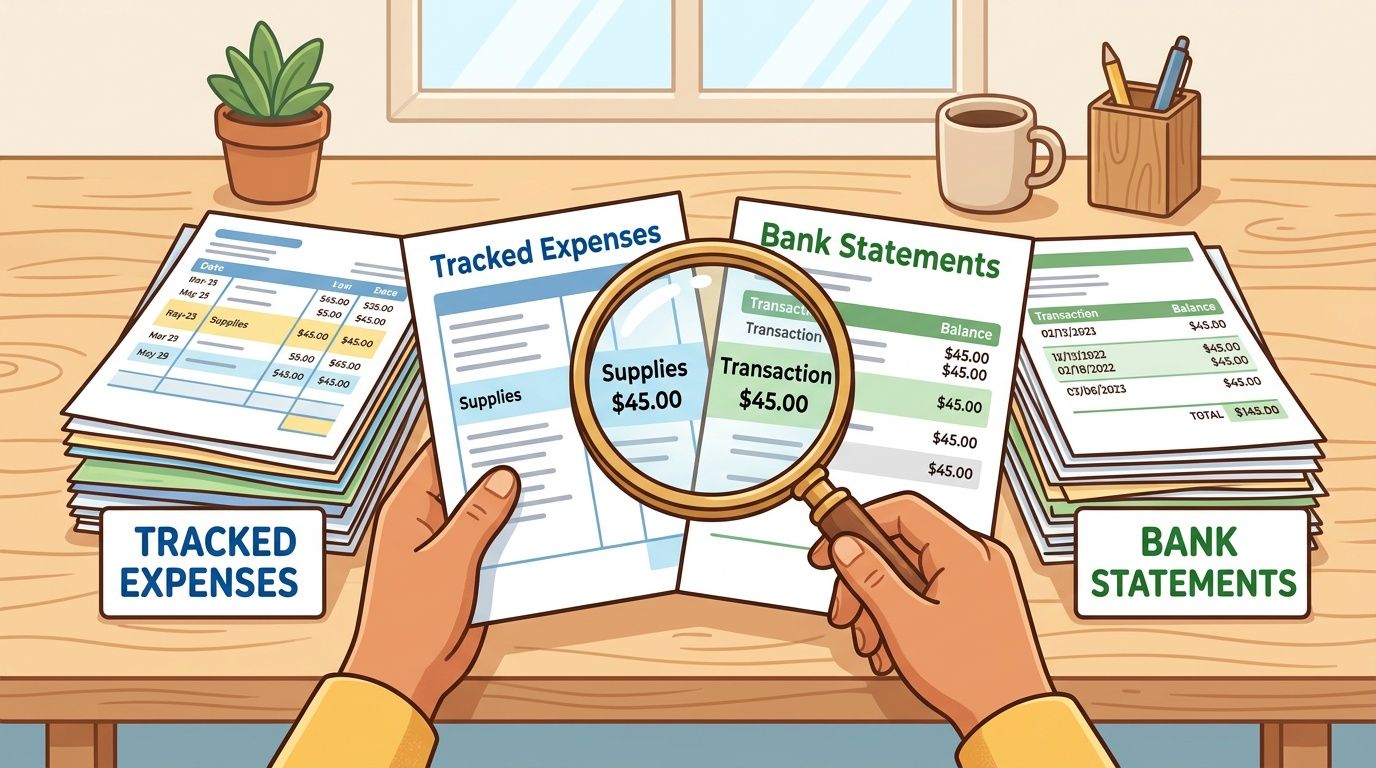
Reconciliation is where expense tracking becomes accounting. Until then, you have a list. After reconciliation, you have a record you can trust.
Reconciliation is quality control
The main operational pitfall in expense tracking is lateness. When expenses are entered days or weeks later, they're more likely to be misclassified or missing receipts. Guidance summarized by Productive on project expense tracking emphasizes real-time capture and regular weekly or monthly reviews to catch issues before period close.
I've seen the same pattern repeatedly. The transaction itself is rarely the mystery. The missing piece is context. A card charge to a vendor is easy to import. Knowing whether it belongs to software, marketing, or reimbursable client spend gets harder once time passes.
That is why reconciliation should be treated as a formal close task, not a casual review of bank feeds.
A solid monthly review asks four blunt questions:
Did every bank and card transaction make it into the ledger?
Does each transaction have support attached or otherwise documented?
Was it coded to the right category and period?
Do any duplicates, reversals, or unusual charges need follow-up?
Controller check: If you wait until tax season to reconcile, you're not tracking expenses. You're reconstructing them.
What to review every month
A useful monthly reconciliation checklist looks like this:
Pull statements for every business bank account and credit card.
Match imported transactions against your expense log or accounting system.
Flag unmatched items immediately. They are usually missing documents, timing issues, or posting errors.
Review duplicates caused by manual entries plus bank feed imports.
Check large or unusual vendors for miscoding or unauthorized spend.
Confirm recurring subscriptions still belong on the books.
Lock the period once corrections are complete.
After that, reporting becomes simple. Two reports matter first:
Profit and Loss statement: This shows whether spending levels make sense relative to revenue and operating needs.
Spending by category report: This shows where cash is going and whether patterns are changing.
If you want a quick visual walkthrough of reconciliation basics, this video is a useful refresher before you build your month-end checklist:

Good reporting depends on verified data. If the books aren't reconciled, category reports turn into opinion. Once reconciled, they become management tools.
Automating Workflows and Integrating Systems
Modern expense control isn't one feature. It's a chain.
The strongest setups connect document collection, data extraction, coding, approval, export, and reconciliation into one operating flow. When those parts stay disconnected, staff re-enter the same information multiple times and errors creep in at every handoff.
Connect collection classification and export
Expense tracking has evolved from a manual bookkeeping task into a data-driven control process. Guidance summarized by TMetric's business expense tracker glossary describes a progression from manual trackers to automated tools, integrated accounting systems, and enterprise platforms. The value of automation is control. Businesses can detect spending patterns, spot budget overruns, identify unauthorized expenses, monitor subscription creep, and compare project costs against revenue.

A practical automated stack often works like this:
Collection layer: Documents enter from inboxes, vendor portals, and scans.
Processing layer: The system extracts date, vendor, amount, and other fields, then routes items for review.
Approval layer: A bookkeeper, accountant, or manager confirms coding and exceptions.
Accounting layer: Approved records export into QuickBooks, Xero, or another ledger system.
Reporting layer: Reconciled data feeds P&L and spend analysis.
A document-focused tool fits differently from a standard expense app. Booksmate, for example, connects to vendor portals and email inboxes to fetch invoices and receipts, extracts key invoice data, organizes the files in a dashboard, and prepares them for export to accounting software. That solves the upstream collection problem that card-feed tools don't fully address. For a broader look at this kind of workflow design, this guide to automation in accounting covers where automation removes manual work.
What to automate first
Don't automate everything at once. Start where people repeat the same mechanical task.
The best first targets are usually:
Workflow | Automate it when | Keep it manual when |
|---|---|---|
Portal invoice fetching | Vendors are numerous and recurring | Vendor count is very small |
Inbox document capture | Invoices hit multiple mailboxes | One shared mailbox already works cleanly |
Field extraction | Staff retype vendor, date, and amount | Volume is low and review time is trivial |
Export to accounting | Data is entered twice in separate systems | Books are maintained in a simple spreadsheet |
What doesn't work is adding isolated tools without deciding who owns the review step. Automation should remove handling, not remove accountability. Someone still needs to review exceptions, maintain categories, and confirm that exported data lands correctly.
Measuring Success and Avoiding Common Pitfalls
A good expense system should get boring. Documents arrive on time, coding stays consistent, reconciliation closes cleanly, and nobody has to hunt through inboxes at month-end.
If that isn't happening, the problem usually isn't effort. It's that the process lacks measurable standards.
Metrics that show whether the system works
Track a short list of operating metrics every month:
Time to close books monthly: If close drags, look upstream at missing documents and unresolved transactions.
Share of expenses with attached support: Missing files point to collection gaps.
Number of uncategorized transactions: This shows whether your chart of accounts is usable in practice.
Open exceptions at month-end: Items waiting on receipts, approvals, or coding decisions should be visible.
Repeat vendor cleanup items: If the same vendors always cause problems, the collection process is weak.
You don't need complicated dashboards. A simple internal scorecard is enough if someone reviews it and acts on it.
A reliable expense process doesn't depend on heroic cleanup work at the end of the month.
Mistakes that quietly break expense tracking
These are the failure points I see most often:
Commingling funds: Personal and business spending in the same account creates avoidable cleanup and weakens the audit trail.
Vague descriptions: Notes like "meeting" or "supplies" don't explain business purpose.
Receipt pileups: Delayed capture strips context from otherwise valid expenses.
Overuse of miscellaneous categories: Repeated use usually means the chart of accounts is poorly designed.
Irregular reconciliation: Errors sit untouched until they become harder to unwind.
No owner for document collection: Everyone assumes someone else downloaded the invoice.
If you fix those six issues, the rest of the system gets easier. Expense tracking stops being a recurring scramble and becomes part of normal financial control.
If your team spends too much time chasing invoices across portals and inboxes, Booksmate is worth a look. It focuses on the document collection side of expense tracking by fetching invoices and receipts from online portals and email, extracting the key data, organizing the files, and preparing them for export into your accounting workflow.