German E-Invoicing in 2027: A Monthly Bookkeeping Guide to XRechnung and ZUGFeRD
How to keep your monthly invoice pack for the Steuerberater complete as German suppliers move to XRechnung and ZUGFeRD in 2027 and 2028. Dates, file checks, storage and a checklist.

The goal of monthly bookkeeping is simple. One folder for your Steuerberater, with every supplier invoice for the month in its original form, and nothing missing.
German e-invoicing makes that folder easier to get wrong. More supplier invoices will arrive as data files, and a lot of invoice tooling was built with only PDFs in mind. If a data file gets lost on the way, the folder looks complete. It is not.
This guide covers what changes, what to keep and how to hand it over. It is for owner-operators and small finance teams in Germany, and it is based on BMF and GoBD guidance as of October 2026. It is general information, not tax advice. Your Steuerberater has the final word on your own case.
What goes into the monthly bookkeeping pack from 2027
Your Steuerberater needs the files that legally count as the invoice. A screenshot or a typed summary does not count.
Each month, include:
- Every e-invoice exactly as it arrived. For XRechnung that means the
.xmlfile. For ZUGFeRD it means the whole PDF, because the data is stored inside it. - Normal PDFs and scanned paper from suppliers who may still send them. In 2027 that includes many smaller German suppliers. Foreign vendors, receipts up to €250 and train tickets stay on PDF or paper even after that.
- Portal invoices. Anything you downloaded from a supplier website belongs in the pack, not only what came by email.
- A short note on pairs. If a supplier sent an XML file plus a PDF copy, say so. That way nobody archives the copy on its own.
- Validation reports, if you ran any. The BMF recommends keeping them. You are not required to have them.
Never send these instead of the original file:
- Text pulled out by OCR or AI, with no source file attached
- A PDF you printed from an XRechnung
- One merged "March.pdf" built from many invoices (merging usually throws the embedded data away)
The same rule applies if you hand over through DATEV or Sevdesk. The export should carry the original file, not a rebuilt one.
2025, 2027, 2028: who has to do what
| Date | You, as the buyer | Your German suppliers |
|---|---|---|
| 1 Jan 2025 | Must be able to receive e-invoices. A normal email address works. | Paper still allowed. PDF allowed if you agree. |
| 1 Jan 2027 | Nothing new. | Turnover in 2026 over €800,000? Then e-invoices are required for domestic B2B. Below that line, one more year of paper or PDF. |
| 1 Jan 2028 | Nothing new. | Close to every domestic B2B invoice must be an e-invoice. |
The BMF sets this out in its FAQ on the E-Rechnung (questions 11 and 12, Stand März 2026). The legal transition rules sit in § 27 Abs. 38 UStG.
In practice, 2027 will be a mixed year. You cannot see which suppliers are above the €800,000 line, so plan for XML files, ZUGFeRD PDFs and ordinary PDFs side by side.
Some large suppliers are moving early. Deutsche Telekom says it is moving its business customers to e-invoices during 2026, switching step by step to ZUGFeRD, and will send those customers nothing but e-invoices from 1 January 2027 (Telekom Geschäftskunden). Other large German suppliers are likely to take a similar route.
If you prefer to watch, Sevdesk has a German video that walks through the 2025, 2027 and 2028 dates.
Watch on YouTube: E-Rechnung Pflicht: Was gilt für dich ab 2025, 2027 und 2028? (sevdesk, German)
Two file types, one rule
The legal test for an e-invoice (E-Rechnung) is structure. The data has to match the European standard EN 16931, so software can read the amounts without guessing. A PDF without that data is a "sonstige Rechnung", which means "other invoice". It can still be valid for tax. It simply does not meet the e-invoice test.
XRechnung
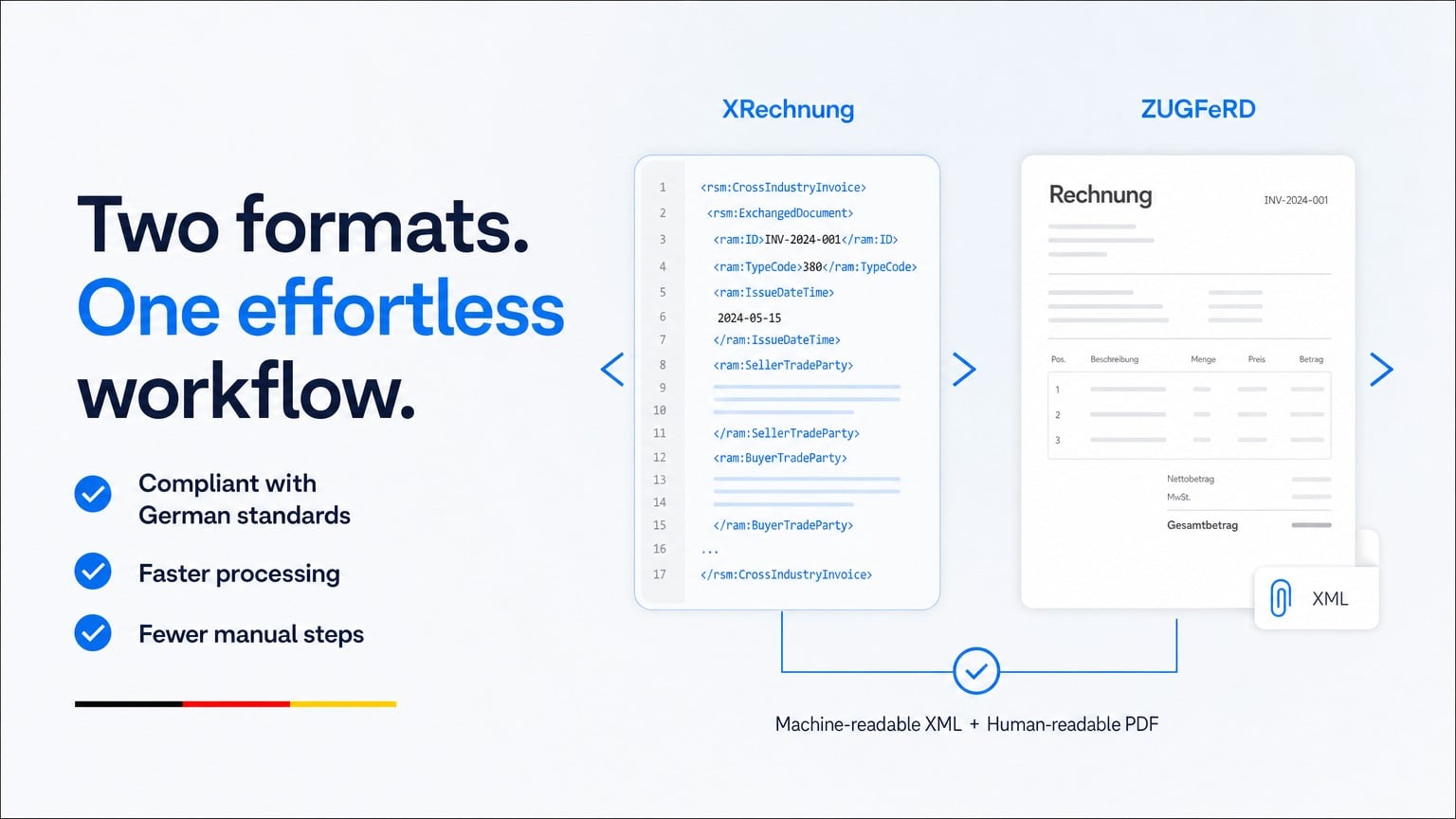
This one is a data file in XML. Open it in a text editor and you see tags, not a page. To read it like an invoice, you need a viewer or accounting software. In email it shows up as a file ending in .xml. Some suppliers add a PDF copy to the same message.
KoSIT, the body that maintains XRechnung, says it is one allowed format for B2B, not a required one. A Leitweg-ID is only needed for invoices to public bodies, not for B2B (KoSIT XRechnung FAQ).
ZUGFeRD and Factur-X
This one is a hybrid. You open it like any PDF, but technically it is a PDF/A-3 with an XML file stored inside. Factur-X is the French name for the same format.
The rule for both
The structured data is what counts. The BMF calls the XML part of a hybrid "leading". If the visible PDF says one thing and the XML says another, VAT follows the XML. Big gaps between the two can lead the tax office to see the PDF as a separate, second invoice.
Which ZUGFeRD profiles count
ZUGFeRD comes in levels of detail called profiles. From version 2.0.1, four of them are accepted as e-invoices:
- BASIC
- EN 16931 (also called COMFORT)
- EXTENDED
- XRECHNUNG
Two profiles hold too little data to qualify: MINIMUM and BASIC WL. A file using either of them is treated like a normal invoice and is useful as a booking aid only. See the BMF FAQ (question 7) and the FeRD ZUGFeRD FAQ.
Checking an attachment in 30 seconds
You do not need special software to sort your inbox.
- The file ends in
.xml, or you get a zip with XML in it. Treat it as an XRechnung and keep it. - You get XML and PDF together. Keep the XML. Think of the PDF as a convenience print.
- You only get a PDF. Open the attachments panel in your PDF reader (the paperclip icon). If you find
factur-x.xml,xrechnung.xmlorzugferd-invoice.xmllisted there, you have a ZUGFeRD file. - You only get a link. Log in to the portal and look for an XRechnung or ZUGFeRD download before you grab the regular PDF.
Want to know the ZUGFeRD profile? Open the embedded XML and look at the profile ID in the first lines. If you see minimum or basicwl in it, the file is not an e-invoice. From 2027, if that supplier is in scope, ask for a version in BASIC or higher.
Free viewer from the tax office. The ELSTER E-Rechnungsviewer turns an XRechnung or ZUGFeRD file into a readable invoice in your browser. The BMF points to it in its FAQ. Open one supplier file there now, so XML attachments stop looking scary.
Keeping e-invoices for 8 years
The rules come from § 14b UStG and the GoBD, which the BMF updated for e-invoices on 14 July 2025. In plain words:
- Store the structured part as you received it. It must stay unchanged and machine-readable.
- Keep it for 8 years.
- For ZUGFeRD, the XML on its own meets VAT law. You only need the PDF layer too if it holds extra tax-relevant details, such as a booking note. Most small businesses just keep the complete file, which covers both cases.
- You are free to make a human-readable version of an XRechnung. It does not replace the XML.
You will see software sold as "GoBD-compliant". The GoBD do not certify anything, so that label is the vendor's own claim. What you can control is one question for every tool in your chain: is the file that comes out the same file that went in?
Sources: BMF FAQ (question 13) and the GoBD update dated 14 July 2025.
Your checklist, by deadline
This month
- Set up an invoice inbox, or confirm the one you have. An address like
rechnung@yourcompany.dethat forwards into your bookkeeping folder is enough for most small firms. It is a good habit, not a legal must. - Open one XRechnung in the ELSTER viewer so you know what you are looking at.
- Take a recent PDF from a big supplier and check its attachments panel.
- Ask your Steuerberater how they want the originals: DATEV, Sevdesk, a shared folder or an upload email.
- Write down every supplier portal you still log into by hand during monthly bookkeeping.
Before 1 January 2027
- Send a test
.xmlfile through every step you use: mail rules, upload forms, download scripts, exports. Anything that filters for PDF will drop it. - Drop habits that rebuild invoices: merging for print, compressing, stamping, or swapping the file for an OCR copy.
- Name one person who follows up when a supplier file does not open or fails a check.
- Expect telecom, energy, transport and other large German suppliers to change format around this date.
Before 1 January 2028
- Plan for nearly all domestic B2B invoices to be e-invoices.
- Keep a separate path for foreign suppliers and exempt invoices. They will still be PDFs.
- Review your archive. Is the structured original stored, and will you still find it in 8 years?
Supplier portals get a second download button
The BMF accepts download from a customer portal as a valid way to deliver an invoice (FAQ question 8). Expect more portals to add an XRechnung or ZUGFeRD button as their owners hit the deadlines.
So the monthly bookkeeping round of logins does not go away. You just click a different button.
- When both versions exist, take the e-invoice.
- Do not rename or convert it.
- A script or browser extension that only saves PDFs will skip XML-only downloads, and it will not tell you.
Edge cases your Steuerberater may raise
Validation
Before you claim input VAT, you need to be satisfied that an invoice is correct. A technical validator can do that check for you, and the BMF accepts relying on a suitable one. Keep the report it produces. Whether or not you validate has no effect on whether the invoice was legally received.
The BMF-Schreiben dated 15 October 2025 sorts problems into two groups. A format problem means the file fails the e-invoice test entirely, so you book it like any other invoice. Once the supplier is in scope from 2027, go back and request a fixed version. If the format is fine but a business rule fails, look at which field is affected. Only fields that VAT law requires matter for your input VAT, so a missing buyer reference on its own is not a reason to lose it.
Invoices that stay PDF or paper
Suppliers do not have to send e-invoices for amounts up to €250 gross, for Fahrausweise (travel tickets), for many VAT-exempt services, or to private consumers. Kleinunternehmer do not have to issue them either. Suppliers abroad are outside the German rules. In 2028 you will still get PDFs for things like a US software plan or a €12 taxi ride.
One catch for Kleinunternehmer: they still have to be able to receive e-invoices (BMF FAQ questions 4 and 12).
Peppol
Germany does not force a network on you. Email works for B2B, and you can ignore Peppol unless you bill public bodies, which is where it is mostly used. If you sell across EU borders, note that from 1 July 2030 the EU's ViDA (VAT in the Digital Age) rules extend structured invoicing to B2B sales between member states. For now, the German rules above are the ones that touch your monthly bookkeeping.
Where Booksmate fits
Booksmate handles the collection for your monthly bookkeeping. It gathers supplier invoices from your email and from 500+ supplier websites into one place*, so you can hand your Steuerberater a complete pack without the login marathon.
Once the pack is ready, DATEV and Sevdesk export are live today.
What we are building, and will ship before 1 January 2027:
- Storage. Files will stay exactly as received. Where there is XML, that is the version Booksmate will treat as the invoice.
- Handover. DATEV and Sevdesk exports will carry the e-invoice as the supplier sent it.
- Checks. Booksmate will warn you when a ZUGFeRD file uses MINIMUM or BASIC WL, so you can go back to the supplier in time.
- Reading. You will see XRechnung files as a normal invoice in the app. Totals, VAT and invoice numbers will come straight from the XML, not from a scan of the PDF.
- Collecting. Plain
.xmlattachments and emails with XML plus a PDF copy will be picked up. On portals that offer both, Booksmate will fetch the e-invoice version.
If chasing invoices across inboxes and portals is what eats up your monthly bookkeeping, try Booksmate free for 14 days. The e-invoice support will arrive in the same workflow.
Questions people ask
A supplier still sends me a normal PDF in 2027. Is that allowed?
Often, yes. Suppliers whose 2026 turnover was €800,000 or less may keep using paper or PDF until the end of 2027. Larger suppliers may not. Since you cannot check their turnover, it is fair to ask a big supplier directly. From 2028 almost all German B2B suppliers must switch.
Is a ZUGFeRD file with the MINIMUM profile good enough?
No. MINIMUM and BASIC WL do not count as e-invoices under German VAT rules. If the supplier has to send an e-invoice, ask for BASIC, EN 16931 or a higher profile.
My Steuerberater works from PDFs. Can I only send the PDF version of an XRechnung?
Send a PDF as an extra if it helps them read it. The XML still has to go with it, and the XML is what you archive. A PDF made from the XML is a copy, nothing more.
The totals in the PDF and the XML do not match. Which one do I book?
Book from the XML, and contact the supplier. A large gap is a risk, because the PDF could be seen as a second invoice.
Is there anything to install or register before e-invoices can reach me?
No. Any normal email address can receive them in Germany, and Peppol is optional. What you do need is a way to open XML files, and the ELSTER viewer does that for free.
I am a Kleinunternehmer. Does any of this apply to me?
Partly. You are exempt from sending e-invoices, but since 1 January 2025 you must be able to receive them.
Does Booksmate already handle XRechnung and ZUGFeRD?
Not fully yet. Right now Booksmate pulls in your invoices from inboxes and supplier websites, then sends them to DATEV or Sevdesk. We are adding XRechnung and ZUGFeRD support and plan to have it live before 1 January 2027. That covers collection, a readable view, data from the XML, profile checks and original-file exports.
Sources
- BMF FAQ: Verpflichtende E-Rechnung (German, Stand März 2026)
- BMF-Schreiben, 15 October 2025: Einführung der obligatorischen E-Rechnung (German)
- GoBD, 2. Änderung vom 14. Juli 2025 (German)
- FeRD ZUGFeRD FAQ (German)
- KoSIT XRechnung FAQ (German)
- ELSTER E-Rechnungsviewer
- Telekom Geschäftskunden: E-Rechnung (German)
Written in October 2026 from the BMF guidance published at that time. Use it as orientation and talk to your Steuerberater about your own situation.
* When Booksmate logs in to supplier websites, your credentials stay on your computer.