A Finance Leader's Guide to Make or Buy Decision Making
Master make or buy decision making with this practical guide. Learn to analyze costs, risks, and strategic benefits to drive smarter business choices.

As a finance leader, you're constantly standing at a crossroads. The signposts point in two directions: build a solution in-house or buy one off the shelf. This isn't just a technical or budget question; it's a strategic choice that will ripple through your finances and operations for years to come.
Getting this right starts with understanding the full picture.
The Strategic Crossroads of Making vs. Buying
Let's ground this in a real-world scenario I see all the time. Your team needs to pull invoices from a dozen different supplier portals. Do you task your internal dev team with building a custom tool for this? Or do you sign up for an automated service that does it for you?
One path promises total control and a perfect fit for your workflows, but it comes at the cost of your team's precious time and resources. The other offers instant relief and efficiency but ties your fortunes to a vendor. This is the classic make or buy decision making dilemma.
This is far more than just a line item on a budget. It's a fork in the road that determines your team’s focus, your company’s agility, and your true operational costs down the line. To avoid the hidden expenses and opportunity costs that trip so many people up, you need a structured way to think it through.
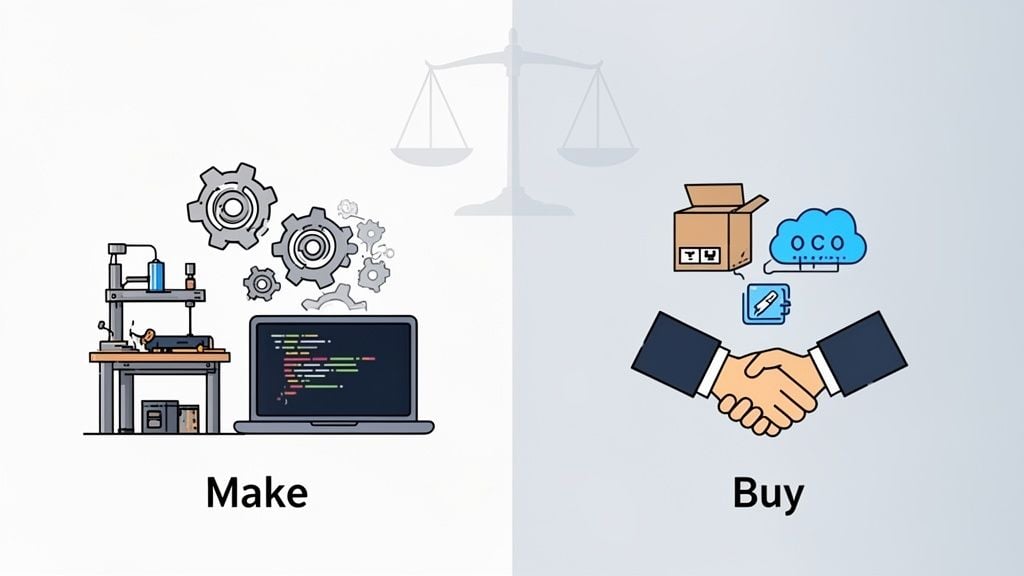
A High-Level Comparison
Before we dive into a full-blown analysis, let's start with an at-a-glance look at what separates these two paths. So many teams get this wrong because they treat it as a simple cost calculation instead of what it really is: a strategy question.
The right choice ultimately reflects what your company values most—time, ownership, or control.
For instance, building a solution gives you a custom asset that evolves with you, but the upfront investment is steep. Buying gets you started faster with less risk, but it means ongoing fees and dependency on someone else's roadmap. If you're navigating a larger procurement process, a comprehensive ERP Buyers Guide can be an invaluable resource for understanding the vendor landscape.
The most effective organizations balance both: they buy where ownership adds little strategic value and build where learning, control, and differentiation compound.
This is especially true for finance teams. Think about it: every hour your skilled analysts spend manually downloading invoices is a hidden cost. Is that task a core competency that gives you a competitive edge? Or is it a repetitive, low-value chore that’s perfect for outsourcing?
Quick Guide to Make vs Buy Factors
To help you start framing your decision, here’s a quick summary of the key trade-offs between building and buying.
Factor
Make (Build In-House)
Buy (Purchase from Vendor)
Initial Cost
High initial capital expenditure for development, talent, and infrastructure.
Low initial cost, typically a predictable subscription or license fee.
Speed to Market
Slower; requires significant time for development, testing, and deployment.
Faster; the solution is often ready to use almost immediately.
Customization
Complete control; can be tailored perfectly to your specific workflows and needs.
Limited to what the vendor offers; may require adjusting your processes.
Maintenance
Ongoing internal responsibility for updates, bug fixes, and security patches.
Handled by the vendor, including all updates and technical support.
Strategic Focus
Diverts internal resources (engineering, IT) from core business objectives.
Frees up internal teams to concentrate on value-driving initiatives.
Risk
High risk of project delays, budget overruns, and potential failure.
Lower risk, but introduces vendor lock-in and dependency on their stability.
This table gives you a great starting point, but the real magic happens when you apply these factors to your specific situation. The next steps will show you exactly how to do that.
Calculating the True Total Cost of Ownership
Okay, let's get real about the numbers. Before you can even begin to weigh building versus buying, you have to be brutally honest about the problem you're trying to solve. A fuzzy objective like "we need to get our invoices faster" is a recipe for a failed project.
You have to go deeper. Are you just trying to snag a few PDFs from major vendors? Or are you looking for a system that can pull detailed line-item data and plug it directly into your ERP? Nailing down these specifics is the bedrock of a smart make or buy decision. The first move is always to separate your absolute must-haves from the nice-to-haves.
Distinguishing Needs from Wants
It’s easy to get carried away and build a giant wishlist instead of a focused list of requirements. I've seen it happen countless times. To keep things grounded, sit down with your finance team and start sorting features into two buckets.
- Must-Haves: These are the deal-breakers. If the solution doesn't do these things, it’s useless. Think: "It must connect to Amazon Seller Central" or "it must export a CSV that our accounting software can read without manual edits."
- Nice-to-Haves: These are features that would be great but aren't essential for launch. Maybe that's a slick mobile app for capturing receipts on the go or some cool customizable dashboard widgets.
This one exercise works wonders. It helps you avoid scope creep if you decide to build, and it stops you from overpaying for a bunch of features you'll never use if you decide to buy.
Unpacking the Hidden Costs
Once you have your requirements locked in, it's time to talk Total Cost of Ownership (TCO). The biggest mistake I see teams make is just comparing an internal development estimate to a software subscription fee. That’s not even close to the full picture.
The true cost of building something yourself is a long-term commitment that goes way beyond the initial coding. It's a slow burn on your resources that many people conveniently forget to factor in.
A critical error in make-or-buy analysis is underestimating the ongoing resource drain of a custom-built solution. The opportunity cost of pulling your best engineers off core, revenue-generating projects to maintain an internal tool can silently cripple innovation.
Just look at the famous case of Boeing's 787 Dreamliner. The company outsourced up to 70% of its components to get to market faster. While the goal was saving money, unexpected supply chain nightmares and integration problems led to cost overruns that topped an eye-watering $30 billion. It's a massive lesson that even a 'buy' decision requires a deep understanding of every possible cost and risk, as this analysis on make-or-buy decision making details.
The Real Cost of Building In-House
So when you're adding up the costs for the 'make' option, you have to be honest about all the expenses. Don't just look at the initial build.
- Developer & IT Salaries: This isn't just their base pay. You need to factor in the fully-loaded cost for the team building it and maintaining it.
- Ongoing Maintenance: Software needs constant care. Think bug fixes, security patches, and updates every time a connected system or API changes.
- Infrastructure Costs: Where will this live? You've got server hosting, databases, and other operational costs to consider.
- Specialized Training: Does your team need to learn a new programming language or framework? That's time and money.
- Security Audits: If it's your code, it's your responsibility. You'll need regular penetration testing to protect sensitive financial data.
The Full Picture for Buying a Solution
The 'buy' option isn't just the sticker price, either. A proper TCO analysis means looking at the entire financial commitment. This includes the value of getting immediate access to comprehensive financial data from a specialized tool, which can often offset other expenses.
Your 'buy' TCO calculation should absolutely include:
- Subscription or Licensing Fees: This is the obvious one, but watch out for tiered pricing and be sure to ask about future price increases.
- Implementation & Onboarding: Are there one-time setup fees? What will it cost you (in time or money) to get your data migrated?
- Training & Adoption: Your team needs to learn the new tool. That's a real productivity cost that you can't ignore.
- Integration Costs: Does it connect out-of-the-box with your current stack? Or will you need to pay for custom connectors or use your own developers to bridge the gaps?
Only when you’ve laid out these complete TCO models side-by-side can you have an honest conversation about which path truly makes the most financial sense.
Now that you have a solid handle on the costs, it’s time to look beyond the numbers. The best make or buy decisions aren't just about what's cheapest. They’re about what’s smartest for the business. This is where we get into the strategic side of things—quantifying the benefits and risks that don’t show up on a spreadsheet.
A decision based purely on cost is a rookie mistake. Sure, buying a ready-made solution might seem more expensive at first glance, but what if it gets you to market six months faster than your competitors? That head start could be priceless. For a finance team drowning in manual work, buying a specialized tool like Booksmate to automate invoice fetching means you instantly tap into someone else’s expertise. Your team is freed up overnight to focus on analysis, not data entry.
On the other hand, building your own tool is a gamble. It promises a perfect fit but comes with a ton of risk. What if the project stalls, the budget balloons, or the final product is already outdated by the time it’s finished? You need a way to weigh these pros and cons without letting gut feelings or office politics take over.
From Gut Feel to Data
This is where a weighted scoring matrix becomes your best friend. It’s a simple but incredibly effective tool for turning subjective opinions into objective data. It forces everyone to agree on what "good" looks like before you even start comparing the options.
First, you’ll list out your key decision criteria. Then, you assign a "weight" to each one, usually on a scale of 1 to 5, to show how important it is. A 5 means it’s a non-negotiable, while a 1 is more of a nice-to-have.
For that invoice automation project we've been talking about, your criteria might look something like this:
- Total Cost of Ownership (TCO): The all-in cost over 3-5 years.
- Speed to Value: How fast will we see a return on this investment?
- Feature Alignment: Does it do exactly what we need it to do?
- Scalability: Can it grow with us as we process more invoices?
- Data Security: How safe is our sensitive financial data?
Getting this down on paper forces a crucial conversation and aligns the team around a shared definition of success.
Building Your Decision Matrix
With your criteria and weights locked in, the next step is to score both the 'make' and 'buy' options against each item. I recommend using a scale of 1 to 10, where 1 is a terrible fit and 10 is a perfect match.
You then calculate the weighted score for each line by multiplying the Weight (1-5) by the Score (1-10). This gives you a final number that reflects not just how well an option performs, but how much that performance matters to your business.
A decision matrix isn't about finding a perfect solution. It's about making the trade-offs clear. It forces an honest discussion about whether you value speed over cost, or customization over security.
To even start this process, you need solid cost data. The diagram below shows the basic flow for getting those numbers in order. You define what you need, calculate the costs for both paths, and then compare them.
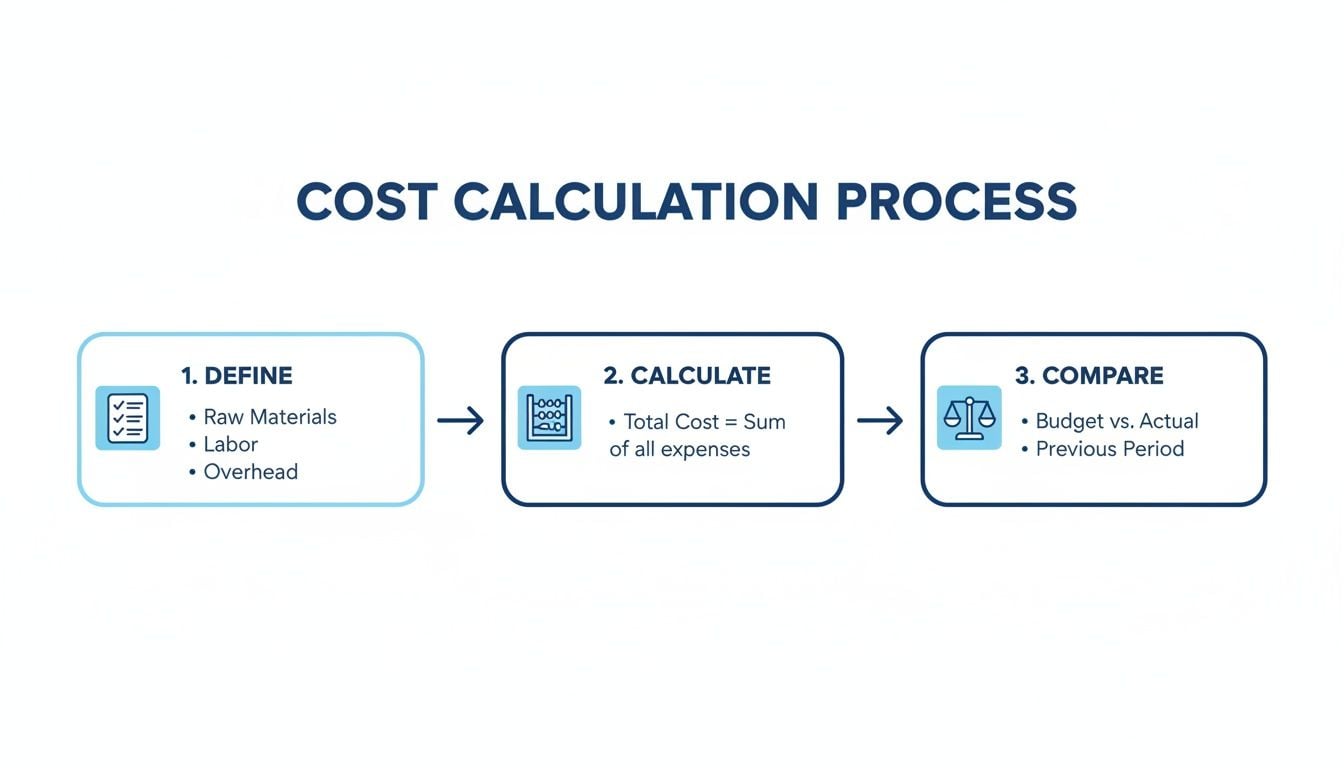
Think of this as the essential prep work. Getting these financial inputs right ensures your scoring matrix is built on a foundation of facts, not assumptions.
To give you a better idea of how this looks in practice, here’s a sample scoring matrix for our invoice automation example.
Sample Decision Scoring Matrix for Invoice Automation
Decision Criteria
Weight (1-5)
Make Score (1-10)
Buy Score (1-10)
Make Weighted Score
Buy Weighted Score
Total Cost of Ownership
4
7
5
28
20
Speed to Value
3
9
15
45
Feature Alignment
35
Scalability
6
8
18
24
Data Security
Total Score
141
169
As you can see, even though the 'make' option scored higher on cost and feature alignment, the 'buy' option won out because of its massive advantage in speed, scalability, and security—the factors we decided were most critical.
Analyzing the Final Scores
Once all the scores are in, just add them up. The option with the higher total is your winner, backed by a clear, data-driven process. The real power of this method is its transparency. If your decision is challenged, you don't have to rely on persuasion. You can simply walk stakeholders through the matrix and show them the logic.
This is how you build a defensible recommendation that leadership can get behind. It demonstrates that you’ve done your homework and approached the make or buy decision with rigor, considering all the angles—both financial and strategic.
Executing Your Decision and Planning for the Future

You’ve run the numbers, your decision matrix has given you a clear winner, and you’ve made the call. The hard part’s over, right? Not so fast. The best decision in the world can fall flat if the execution is clumsy. Now comes the real work: turning that choice into a success story.
Naturally, what comes next depends entirely on whether you landed on 'make' or 'buy'. Each path has its own map and its own set of challenges. You’ll need a specific game plan for whichever one you choose.
If You Chose to Buy a Solution
When you decide to buy, you’re not just picking a tool off a shelf; you’re starting a partnership. And the success of that partnership hinges on picking the right vendor and managing the relationship well from day one.
It’s easy to get wowed by a flashy demo or a laundry list of features you'll never touch. I’ve learned the hard way that the things that really matter down the road are reliability and support. A tool that’s down when you need it most or a support team that takes days to get back to you is a massive liability, no matter how great the price.
As you vet your vendors, dig deep into these areas:
- Customer Support: How fast do they respond? Do they offer the kind of support your team actually needs, whether that’s by phone, email, or a dedicated chat? Don't just take their word for it—ask for references and talk to their current customers about their real-world experience.
- Contract Terms: Get your eyes on the fine print. Pay close attention to the service-level agreement (SLA) for uptime guarantees and penalties. You’ll also want to look for clear language on data ownership, security, and any caps on future price increases.
- Onboarding and Training: A smooth start is everything. Find out if the vendor provides hands-on training or if your team will be left to fend for themselves with a few help articles.
A vendor's long-term reliability and the quality of their support team are far more valuable than a flashy feature set. Your goal is to find a partner who is invested in your success, not just a supplier selling a product.
If You Decided to Make It In-House
Going the 'build' route is tempting because you get total control. But that control comes with a hefty dose of responsibility, and success depends on rock-solid project governance and never losing sight of the original business problem.
First things first: establish a clear governance structure. This isn't about creating red tape; it's about defining accountability. Who owns this project? Who gets the final say on features? And how will you measure and report on progress?
With that in place, you need to break the project into small, realistic chunks. I’ve seen too many in-house projects fail because the plan was to build a massive, perfect solution all at once. A better approach is to aim for smaller, iterative releases.
This lets you:
- Deliver Value Sooner: Get a simple but functional version into your finance team’s hands as quickly as possible.
- Create Feedback Loops: Early versions are perfect for gathering real-world feedback, which helps you adjust priorities and ensure the final product actually solves the right problems.
- Manage Scope Creep: With regular check-ins and releases, you can put a stop to those "nice-to-have" features that threaten to derail the project's timeline and budget.
Setting a Cadence for Review
Finally, it’s crucial to remember that a make or buy decision isn't set in stone. The business world changes, new technology emerges, and what made sense for your company in 2026 might be the wrong call by 2028.
You have to build in regular checkpoints to re-evaluate your decision. I'd suggest doing this at least once a year. During that review, you should be asking tough questions:
- Is this solution still meeting our most important business needs?
- How does the real-world TCO compare to our initial projections?
- Are there new alternatives on the market that are significantly better, cheaper, or more secure?
This review process keeps your strategy agile. It ensures your choice continues to deliver real value and prevents you from getting locked into a solution—whether you built it or bought it—that no longer serves your team.
Real-World Lessons in Making the Right Call
Frameworks and spreadsheets are essential, but the real wisdom in make-or-buy decision making comes from seeing how these choices play out in the real world. Big strategic pivots have defined entire industries, and by looking at those stories, we can pull out lessons that apply directly to the choices your finance team faces every day.
Take manufacturing, where this analysis has been a competitive battleground for decades. A little over ten years ago, a massive shift happened. As manufacturing wages in China started climbing by as much as 20% a year, companies that had relied on it for production had to go back to the drawing board.
Suddenly, the calculus of "making" in-house versus "buying" from a specialized supplier looked completely different. I recall one global manufacturer that, during this re-evaluation, realized it needed 20% more capacity than it had planned for. That single insight made the massive capital investment required for building a new facility look incredibly risky, tipping the scales decisively toward outsourcing. You can get a deeper sense of how these economic shifts influence sourcing strategies and why they matter.
Finding the "Hidden Factory" in Your Finance Team
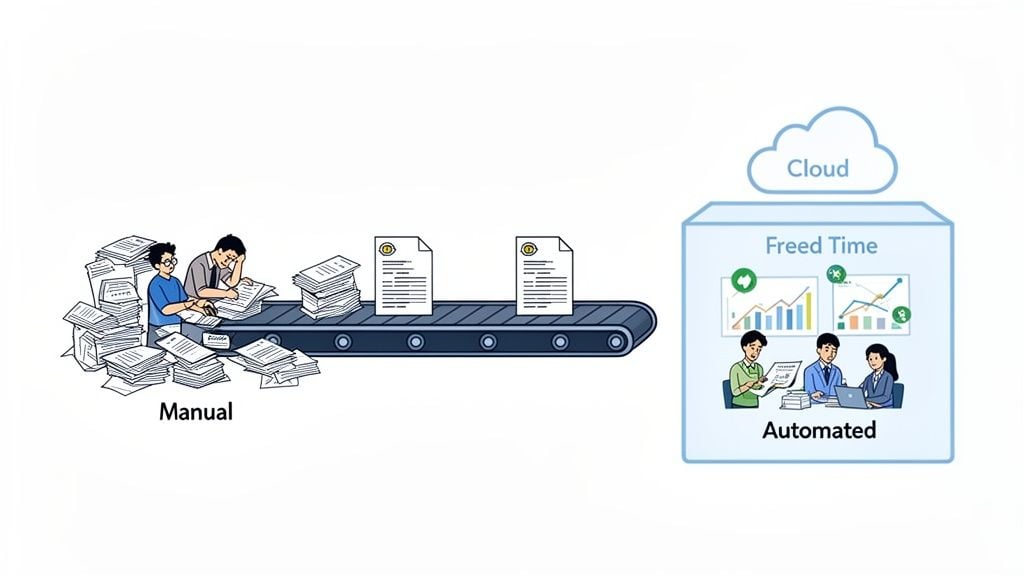
It might not feel like it, but the jump from a global factory floor to your finance department is shorter than you think. The core logic is exactly the same. All those manual, repetitive tasks your team performs are a kind of "hidden factory"—and it has very real production costs.
Think about the hours your sharpest analysts spend every single month just logging into dozens of supplier portals to download invoices. That time is a direct cost, and worse, it’s a valuable resource being pulled away from work that actually moves the needle.
Just as a car manufacturer outsources tire production to focus on engineering and design, a modern finance team can outsource data collection to focus on strategic analysis and business partnership.
This is where the "buy" decision becomes a strategic lever. By investing in a specialized solution, you're not just buying a piece of software. You're outsourcing a low-value, repetitive function to free up your team for the work they were actually hired to do.
Give Your Team Their Time Back
When you bring in a tool like Booksmate to automate something like invoice fetching, you aren't just making a process more efficient. You’re fundamentally upgrading what your team is capable of accomplishing.
Here’s what that looks like in practice:
- From Data Janitor to Data Analyst: Instead of getting bogged down in digital paperwork, your team can finally dig into spending trends, find real cost-saving opportunities, and build financial models that guide the business.
- From Reactive to Proactive: With data flowing in automatically, they can flag budget variances before they spiral out of control, not weeks after the quarter has already closed.
- From Burnout to Breakthroughs: Taking the soul-crushing, tedious work off their plate is a massive morale booster. It lets your best people tackle complex challenges and feel like they’re making a tangible impact.
This shift transforms the finance department from a simple cost center into a strategic engine for the company. At its heart, a smart make-or-buy decision is about clearly seeing which tasks are just noise and which ones truly define your value.
How Strategic Sourcing Shapes Modern Finance Teams
The whole "make or buy" conversation used to be confined to the factory floor. But what was once a decision about manufacturing widgets has become a powerful strategic tool for the modern back office, especially for finance teams. The game has changed, and it’s no longer just about parts and labor—it's about controlling costs and managing risk in a volatile world.
Just look at how major players are navigating today's uncertain landscape. General Motors is pouring a massive $7 billion into building its own EV batteries. This isn't just about bringing production in-house; it’s a calculated move to own their core technology, lock down their supply chain, and slash costs. Their goal is to cut battery expenses by an incredible 60% per kWh by 2025. It’s a perfect example of using a 'make' decision to build a powerful, long-term competitive edge. You can see a broader view of how technology and cost are influencing these decisions for multinational firms across industries.
Applying Industrial Logic to Finance Operations
So, how does this manufacturing logic apply to your finance team? Simple. Every manual process—like a team member downloading invoices one by one—is your own little internal assembly line. Right now, you're choosing to 'make' processed documents, and you're paying for it with expensive, hidden labor costs. The alternative is to 'buy' a specialized, automated system that offers a clear and immediate return.
This isn't about convenience. It’s about strategically reallocating your most valuable resources. Every hour a sharp analyst spends on mind-numbing data entry is an hour they aren't spending on high-value financial strategy. That's a huge opportunity cost, and it's quietly chipping away at your company’s bottom line.
When companies apply this make-or-buy thinking beyond manufacturing to functions like IT and finance, they can boost their Return on Assets (ROA) by a significant 5-10%. This is a direct result of making sure your most skilled people are focused only on what truly moves the needle.
Improving Your Return on Assets
At the end of the day, bringing a rigorous make-or-buy framework to your finance operations is one of the most direct ways to improve your company’s financial health. When you decide to 'buy' a specialized solution like Booksmate to handle repetitive, non-core tasks, you’re not just getting new software. You're making a conscious choice to optimize your team's true potential.
This decision frees your financial experts to concentrate on the work that actually creates value:
- Strategic forecasting that guides smarter business decisions.
- Deep-dive variance analysis that pinpoints hidden cost-saving opportunities.
- Cash flow optimization that strengthens the company's financial foundation.
By offloading the manual grind, you transform your finance team from a cost center into a strategic partner, directly contributing to a healthier bottom line and a much stronger return on assets.
Common Questions I Hear About Make-or-Buy Decisions
Even with the most thorough framework, you’re bound to have some lingering questions. It’s only natural. After guiding dozens of finance teams through this exact process, a few key questions always surface. Let's tackle them head-on.
How Often Should We Revisit This Decision?
Making a choice isn't the end of the road. A make-or-buy decision is a living thing, not a "set it and forget it" task. Markets shift, new tech appears, and your own company’s needs will absolutely change. Because of this, you should plan to formally review your decision at least once a year.
This doesn't mean you need to run a full-scale analysis from scratch every 12 months. Think of it as a quick health check. You're simply asking:
- Is our current solution still doing the job we hired it to do?
- Has the total cost of ownership (TCO) strayed far from what we originally projected?
- Are there any new vendors or technologies out there that are just too compelling to ignore?
This annual check-in prevents you from getting stuck with a solution—whether you built it or bought it—that’s quietly holding your team back.
The biggest mistake I see teams make is underestimating the hidden costs. When you build, it’s the endless maintenance and the cost of pulling your developers off other projects. When you buy, it’s the nightmare of terrible customer support or clunky integrations. You have to dig deeper than the sticker price.
When Does It Actually Make Sense to Build?
Even when buying looks like the faster, cheaper option on paper, there are times when building is the only smart long-term play. It really boils down to one thing: competitive advantage. You build when the capability you need is a unique part of what makes your business special.
You should seriously consider building if the solution:
- Handles proprietary data or a workflow that is your company's "secret sauce."
- Needs such deep and specific integration with your existing tech stack that any off-the-shelf tool would feel bolted on and inefficient.
- Is destined to become a core intellectual property asset that adds real, tangible value to your company's balance sheet.
In these situations, the strategic value of owning and controlling the technology completely overshadows the short-term win of buying. It stops being an expense and becomes an investment in your company's future.