Cash Discount Example: Full Guide for 2026
Explore a clear cash discount example like 2/10 net 30. Understand invoice vs. POS discounts, see journal entries, and learn implementation in 2026.

A common cash discount example is 2/10, net 30. It means a customer gets 2% off if a $1,000 invoice is paid within 10 days instead of the full 30 days, so they save $20 and pay $980.
If you're looking at those terms on an invoice and also seeing “cash discount” signs at stores, it's easy to assume they mean the same thing. They don't. One usually belongs to business-to-business invoicing, and the other usually belongs to point-of-sale retail pricing.
Table of Contents
- Introduction
- The Two Worlds of Cash DiscountsA side-by-side comparison
- B2B Cash Discount Example 2/10 Net 30How to read the terms
- The math behind the example
- Why buyers should pay attention
- Accounting for Invoice Discounts Journal EntriesGross method
- Net method
- A practical recording checklist
- Implementing Your Own Discount PolicyChoose the right policy for your sales model
- Make the policy usable in real life
- Decide whether the policy is worth the trade-offs
- How Booksmate Automates Discount DetectionWhere manual teams miss discounts
- What automation changes
- Questions teams still ask
Most new business owners first run into this topic in a very ordinary way. An invoice lands in the inbox with 2/10, net 30 printed near the bottom, and someone in the office asks, “Should we take this?” Then later that week, the same owner sees a local shop offering a lower price for cash and hears that called a cash discount too.
That naming overlap causes real confusion. In accounting, a cash discount often means an early-payment incentive tied to invoice timing. In merchant services, the same phrase may refer to a cash price at checkout that helps offset card-processing costs. Investopedia's explanation of cash discount terminology highlights this mismatch and why many business owners mix the two up.
The practical problem is that these two situations don't work the same way. They don't happen at the same moment, they don't serve the same purpose, and they aren't recorded the same way in the books. If you treat a B2B invoice discount like a retail checkout discount, your accounting gets messy fast.
What matters most is knowing which world you're in before you touch the math or the journal entry.
The Two Worlds of Cash Discounts
The phrase cash discount sounds simple, but it points to two different business situations. If you mix them together, the accounting gets messy fast.
One happens in B2B trade. A seller sends an invoice, sets payment terms, and offers a small discount if the buyer pays early. The classic example is 2/10, net 30.
The other shows up in B2C or retail. A customer stands at a register, chooses how to pay, and sees one price for cash and another for card. That is a pricing and checkout policy decision, not an accounts receivable decision.
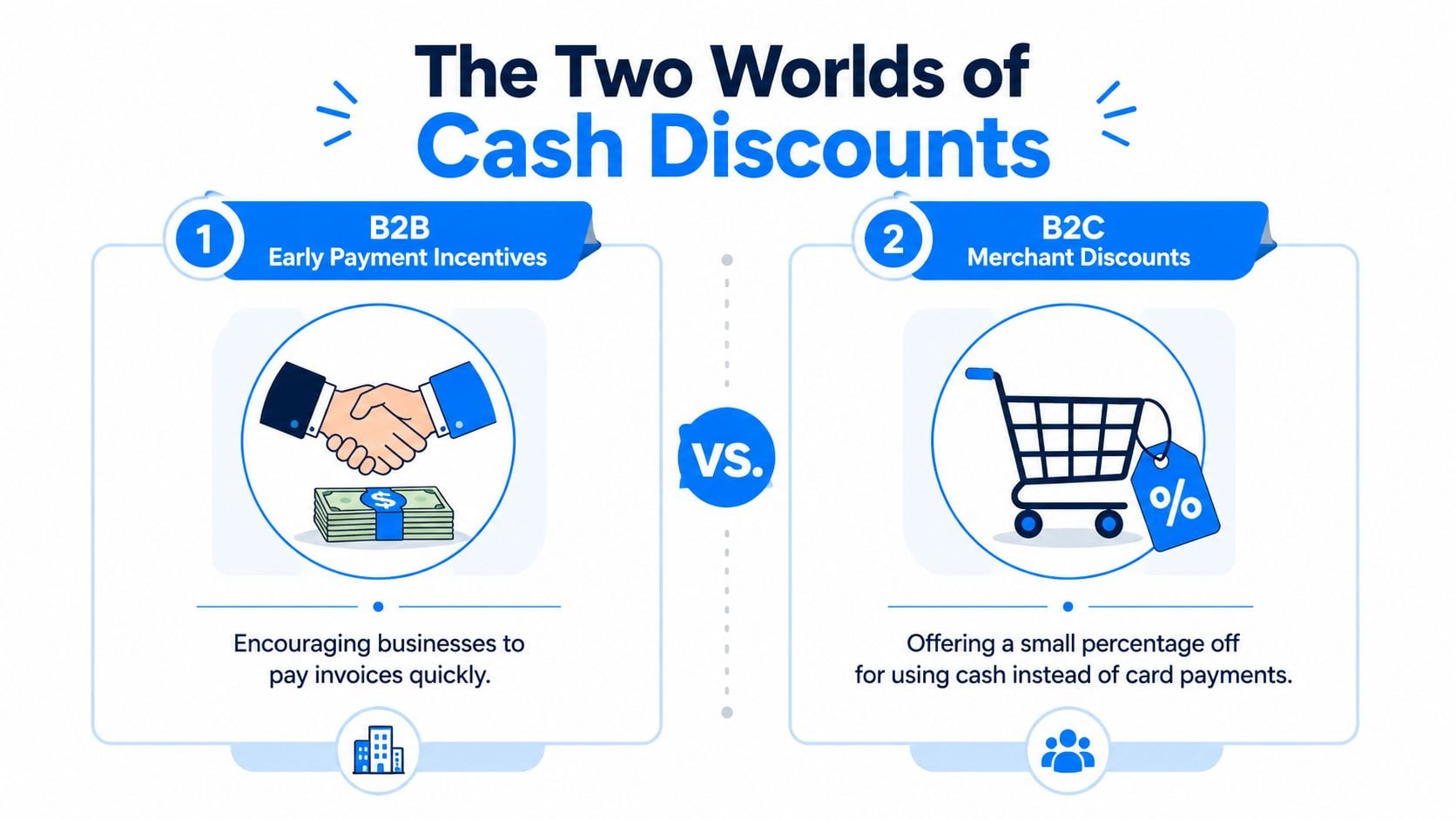
A simple way to sort them is to ask one question first. Is there an invoice with a due date, or is there a customer paying at checkout?
If there is an invoice and payment terms, you are usually dealing with an early-payment discount. If the price changes at the register based on cash versus card, you are dealing with cash pricing, dual pricing, or a POS cash discount program.
Here's the side-by-side view.
Area
B2B early-payment discount
B2C POS cash discount program
Who uses it
Sellers and buyers on invoice terms
Merchants and retail customers
When it happens
After invoicing, before due date
At checkout
Main purpose
Improve cash flow and speed collections
Offset card-related costs
Common wording
2/10, net 30
Cash price, dual price, cash discount
Accounting focus
Accounts receivable and discount treatment
Sales pricing and POS setup
A side-by-side comparison
Consider a wholesaler that sells inventory to a retailer on 30-day terms. The wholesaler offers a discount if payment arrives within 10 days. That decision affects receivables, cash flow, and how the discount is recorded in the books.
Now consider a café that posts one menu price for card payments and a lower price for cash. The owner is dealing with checkout setup, customer communication, and how prices appear in the POS.
Same phrase. Different mechanics.
That difference matters because a bookkeeper handles each one in a different place. B2B discounts usually show up in invoices, customer statements, and collections activity. B2C cash pricing shows up in registers, receipts, signage, and payment processor settings.
For a new business owner, a useful analogy is this: B2B cash discounts work like a reward for faster settlement of a bill. B2C cash discounts work like a pricing choice at the point of sale. The first is tied to time. The second is tied to payment method.
For practical review, check three things:
- Timing: A discount for paying before the due date belongs in the invoice and receivables process.
- Setting: A discount offered at the register belongs in pricing and POS operations.
- Records: B2B discounts affect journal entries for sales or purchases. B2C cash pricing affects how the sale is rung up and reported.
That distinction clears up most confusion before you ever start calculating the discount.
B2B Cash Discount Example 2/10 Net 30
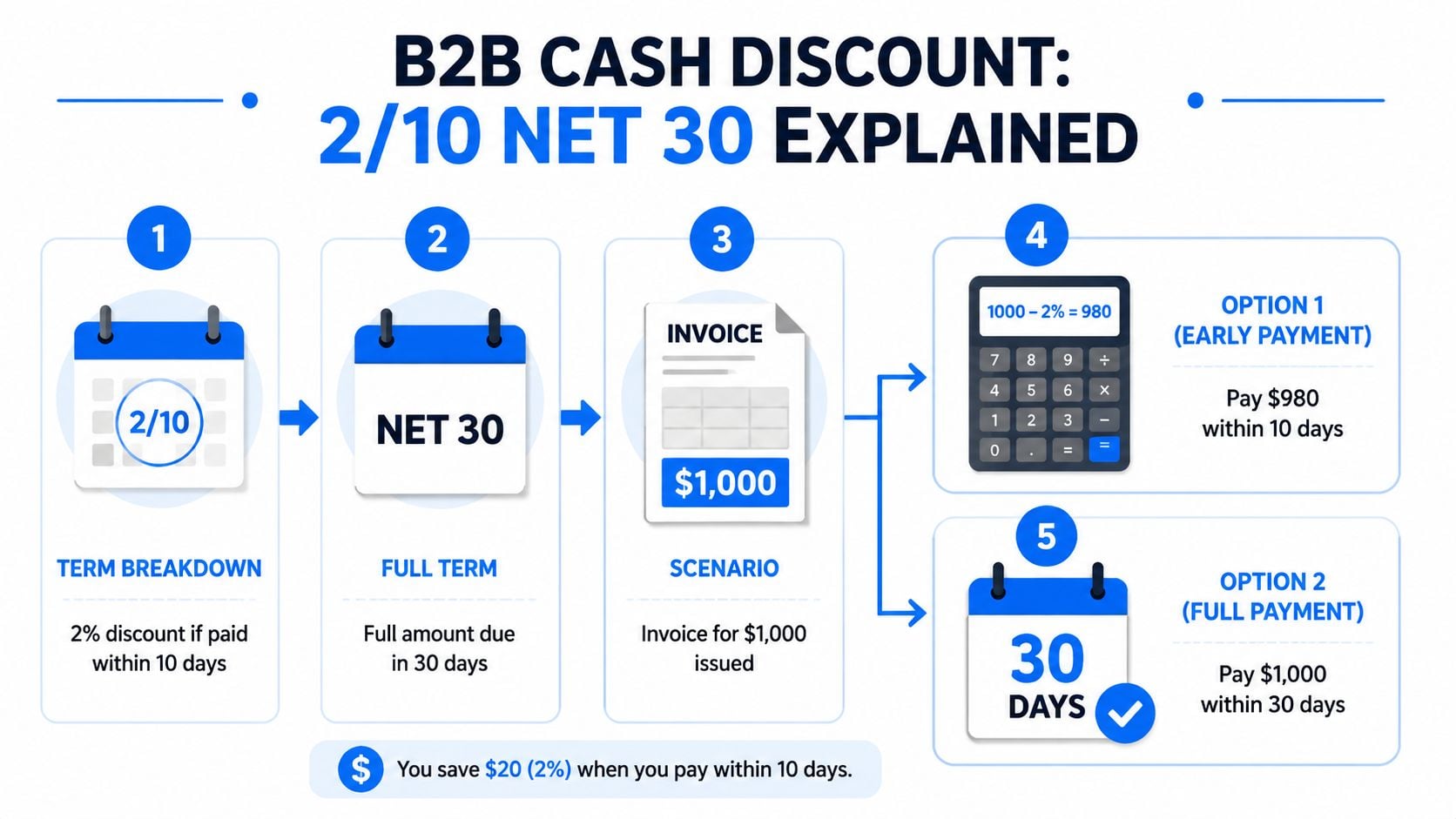
For most accountants and bookkeepers, the standard cash discount example starts with one short line on the invoice: 2/10, net 30.
How to read the terms
Break it into parts.
- 2 means the discount rate is 2%.
- 10 means the buyer must pay within 10 days to get that discount.
- Net 30 means the full invoice amount is due within 30 days if the buyer doesn't pay early.
That format is common in invoice practice, and educational accounting guides use the same structure when teaching cash discounts and the formula cash discount = purchase price × discount rate in this cash discount definition and example guide.
A visual makes the terms easier to see in sequence.
Use the standard example:
- Invoice amount: $1,000
- Discount rate: 2%
- Discount window: 10 days
- Final due date: 30 days
The discount is:
$1,000 × 2% = $20
If the buyer pays within the discount period, the payment becomes:
$1,000 - $20 = $980
That's the cleanest cash discount example because it shows the idea without extra variables. The buyer saves $20, and the seller gets paid sooner.
Practical rule: Don't overcomplicate the first calculation. Start with invoice amount × discount rate. Then subtract the discount from the invoice total.
A short video may help if you want to hear the terms explained aloud.
A lot of owners look at a 2% discount and shrug. That's a mistake.
When a buyer skips a discount like 2/10, net 30, they're effectively choosing to keep the seller's money for an extra 20 days and give up the discount. A finance-oriented explanation of this common example shows that the annualized cost of giving up that discount is roughly 36.7%. The same source uses the $1,000 invoice example and notes the buyer saves $20 by paying early in this explanation of cash discount advantages.
That's why experienced finance teams don't treat early-payment discounts as minor clerical details. They treat them as a cash management choice.
From the seller's side, the discount can speed collections. From the buyer's side, taking the discount may be cheaper than delaying payment. That's especially true when the buyer has available cash and no better short-term use for it.
Accounting for Invoice Discounts Journal Entries
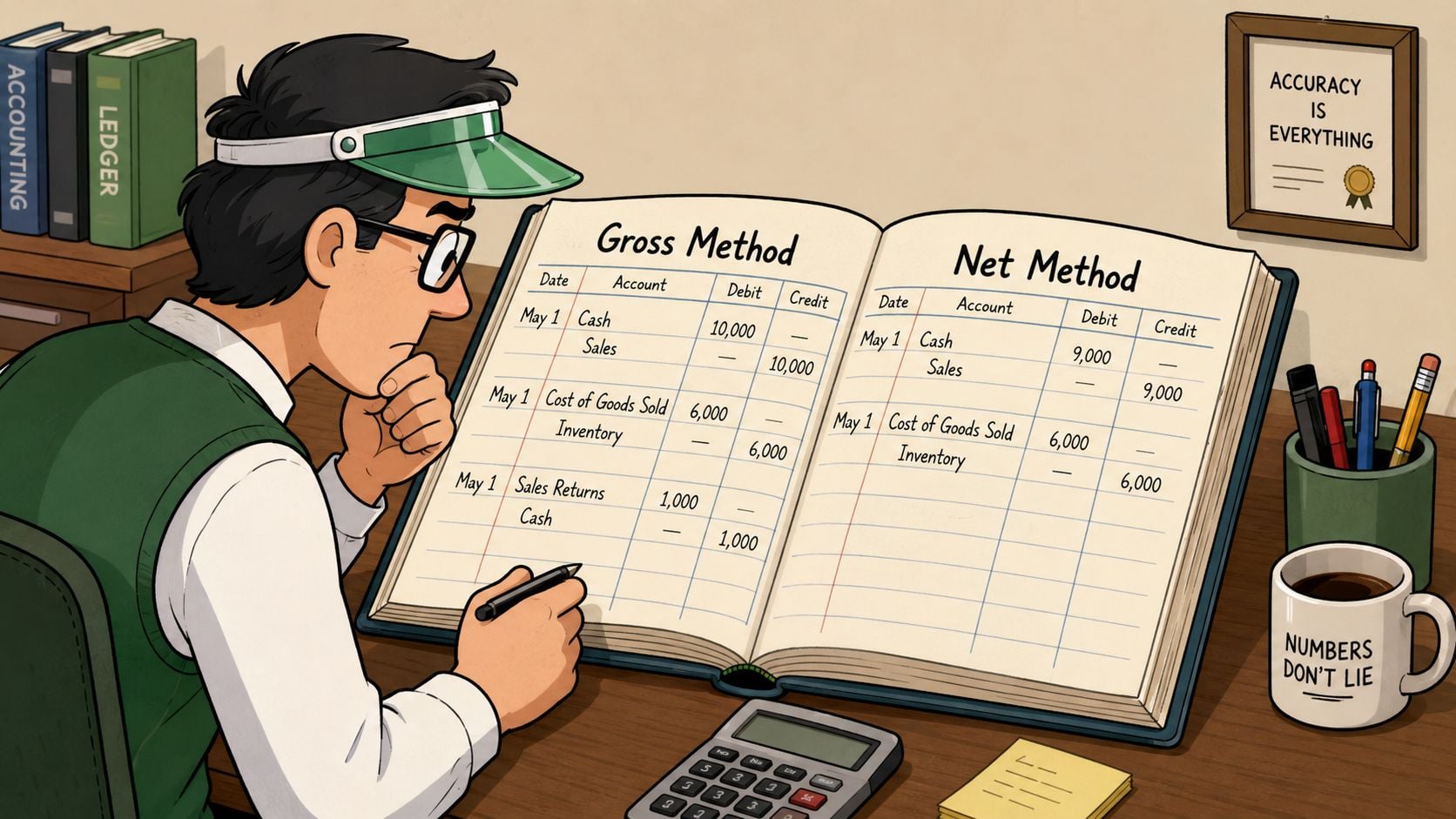
Once the invoice terms are clear, the next question is how to record them. Either the gross method or the net method is commonly used.
If you want a refresher on debits and credits before applying these entries, this guide to double-entry bookkeeping is a useful foundation.
Gross method
Under the gross method, you record the full invoice amount when the sale happens. If the customer pays early, you record the discount when payment arrives.
For the seller, the entries look like this:
At saleDebit Accounts Receivable $1,000Credit Sales $1,000
If customer pays within discount periodDebit Cash $980Debit Sales Discounts $20Credit Accounts Receivable $1,000
If customer pays after discount periodDebit Cash $1,000Credit Accounts Receivable $1,000
For the buyer, using purchase-side language:
At purchaseDebit Inventory or Expense $1,000Credit Accounts Payable $1,000
If buyer pays within discount periodDebit Accounts Payable $1,000Credit Cash $980Credit Purchase Discounts or related account $20
If buyer pays after discount periodDebit Accounts Payable $1,000Credit Cash $1,000
The gross method is popular because it's easy to follow. The books start with the invoice as issued, then adjust only if the discount is taken.
Under the net method, you assume the discount will be taken. That means you record the receivable or payable at the discounted amount from the start.
For the seller:
At saleDebit Accounts Receivable $980Credit Sales $980
If customer pays within discount periodDebit Cash $980Credit Accounts Receivable $980
If customer misses discount periodDebit Cash $1,000Credit Accounts Receivable $980Credit Sales Discounts Forfeited $20
For the buyer:
At purchaseDebit Inventory or Expense $980Credit Accounts Payable $980
If buyer pays within discount periodDebit Accounts Payable $980Credit Cash $980
If buyer misses discount periodDebit Accounts Payable $980Debit Discount Lost or related account $20Credit Cash $1,000
The net method gives a cleaner view when customers usually pay early. The trade-off is that missed discounts require an extra entry and closer follow-up.
Bookkeepers usually get tripped up in the same places.
- Watch the invoice date: The discount period is tied to timing, so date errors can change whether the discount applies.
- Separate discount accounts clearly: Don't bury discounts inside sales or expense lines if your chart of accounts tracks them separately.
- Match the company policy: If the business uses the gross method, stay consistent. Switching methods casually creates reporting noise.
- Check ERP and invoice settings: Some systems calculate discount windows automatically, but only if the terms are entered correctly.
If the invoice says one thing and the vendor email says another, stop and confirm before posting payment. Timing disputes often start with informal communication.
Implementing Your Own Discount Policy
A good discount policy should answer one simple question before anyone has to ask it: what exactly happens, for whom, and when?
That matters because "cash discount" can describe two very different setups. In B2B, it usually means an early-payment term on an invoice, such as 2/10 net 30. In B2C, it usually means a cash price at the register and a higher card price. If those two ideas get blended together, staff give mixed answers, customers get confused, and the books get messy.
Choose the right policy for your sales model
Start with how you sell.
A wholesaler sending invoices to business customers needs a policy built around terms, dates, approvals, and collections. A retailer or service business taking payment at checkout needs a policy built around posted prices, POS settings, receipts, and front-desk explanations. A company that does both should treat them as two separate lanes, much like keeping a payroll account separate from an operating account. Both involve cash, but they do different jobs.
- For B2B invoicing: Define the discount terms clearly, decide who can approve exceptions, and make sure accounting knows how to record them.
- For B2C checkout: Set up pricing displays, receipt wording, and card-versus-cash handling so the customer sees a clear price structure.
- For mixed businesses: Use different written procedures for invoice discounts and point-of-sale cash pricing. One label should not cover both.
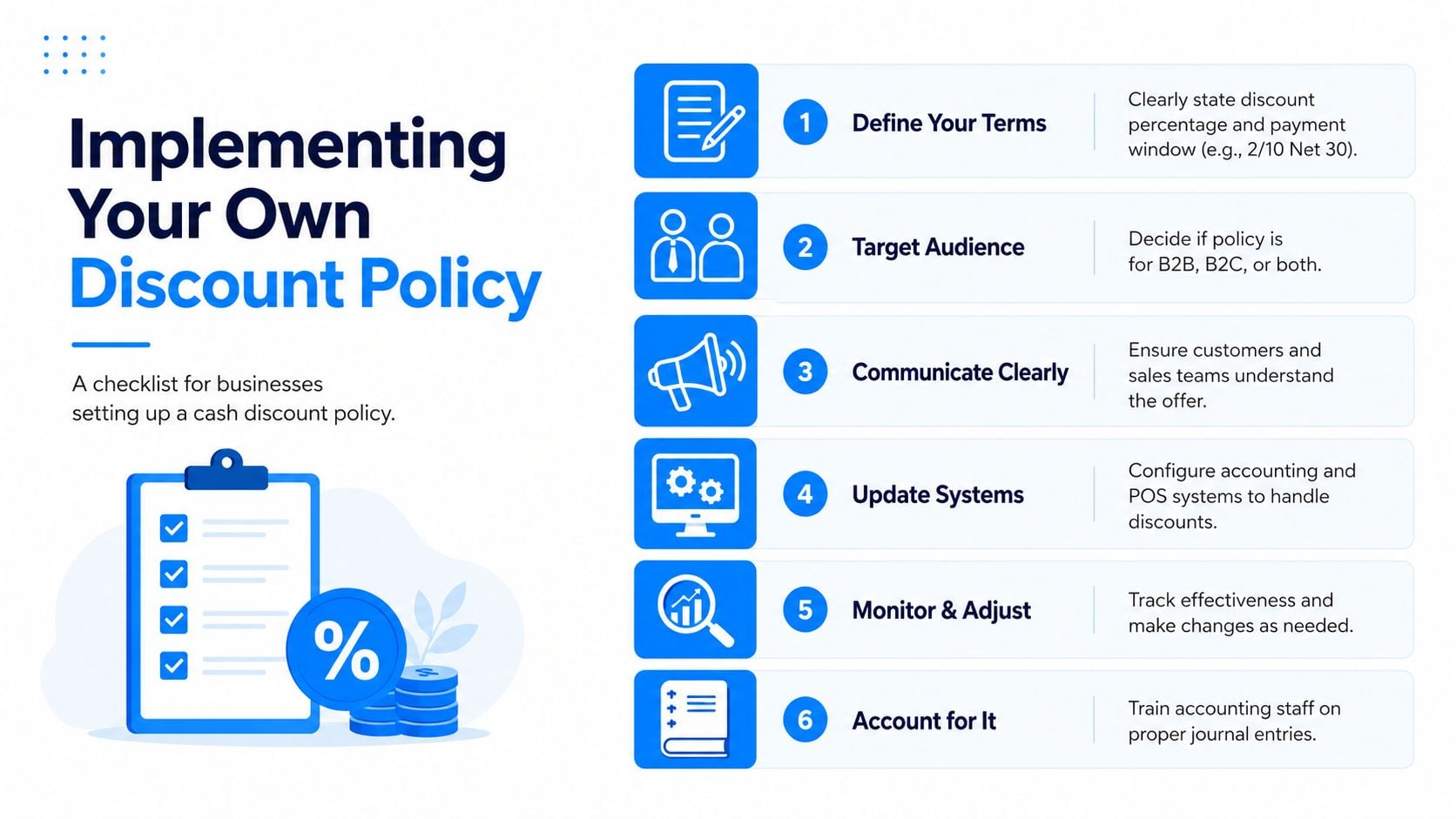
This checklist is a useful visual reference.
A policy is ineffective if it is not documented and shared.
Write the terms in the same places people work: invoices, POS settings, staff procedures, quote templates, and customer scripts. If you offer B2B early-payment discounts, your accounts receivable team should know the exact wording, the discount window, and how to handle short payments. If you use B2C cash pricing, the person at the counter needs language that is clear and calm, especially when a customer asks why the card total is different.
It also helps to connect the policy to day-to-day communication. Good processes around vendor relationship management best practices reduce confusion about due dates, credits, and payment expectations.
A workable setup usually includes:
- Plain wording: Use terms staff and customers can read quickly.
- System alignment: Confirm the invoicing platform or POS applies the policy exactly as written.
- Staff practice: Train the people who answer billing questions, not just the people who post entries.
- Exception rules: Decide in advance who can override terms, extend a deadline, or honor a discount late.
Every discount policy has a cost. The question is whether the benefit is larger than the friction it creates.
For B2B, the benefit may be faster collections and fewer overdue receivables. For B2C, the benefit may be lower card-processing cost recovery. But the operational test is different in each case. A B2B discount works only if invoices go out promptly, customers understand the terms, and your team follows up on time. A B2C cash pricing program works only if signage is clear, the register is configured correctly, and staff can explain the pricing without sounding defensive.
Customer reaction matters too.
Some buyers see an early-payment discount as routine trade credit. Some retail customers see cash pricing as a straightforward posted-price structure. Others may feel they are being charged extra for using a card. That is why wording, receipts, and staff explanations need as much attention as the math.
If you're reviewing discount policy as part of a broader liquidity plan, this guide to practical cash flow management for businesses is a useful companion resource.
How Booksmate Automates Discount Detection
Manual invoice handling creates a simple problem. Teams miss terms they would have acted on if they had seen them in time.
A bookkeeper downloads invoices from vendor portals, scans email attachments, and posts them one by one. During that routine, discount language can slip past. The terms may be buried in a footer, shown as shorthand, or arrive in a batch with dozens of unrelated bills.
Where manual teams miss discounts
Most misses don't come from misunderstanding accounting. They come from workflow.
- Invoices arrive in different places: Some come through portals, others through inboxes.
- Terms are easy to overlook: A small note on page two can matter more than the total on page one.
- Approval delays eat the discount window: By the time someone reviews the invoice, the early-payment option may already be gone.
That's why document collection matters as much as journal-entry knowledge. If the invoice never gets surfaced quickly, the accounting treatment becomes irrelevant.
Booksmate is built around that collection problem. It connects to online portals and email inboxes, gathers invoices and receipts, and organizes them so finance teams aren't chasing documents manually.
Its workflow becomes especially useful when invoice terms need attention. Once documents are collected, AI-based extraction can pull key details from the invoice and place them in a central dashboard. That gives a team a better shot at spotting early-payment language before the window closes. If you want to see the document capture side in more detail, Booksmate shows how it can extract invoices and receipts.
Even with automation, some edge cases still need human judgment.
A few common ones:
- Partial payments: If a customer or buyer pays only part of the invoice, the discount terms may not apply the way staff expects.
- Tax handling: The tax treatment of discounts can vary by jurisdiction and setup, so confirm with your accountant before standardizing entries.
- International vendors: Terminology and invoice customs differ across countries, so don't assume every “discount” note works like U.S. invoice terms.
The software helps surface the document and its terms. The finance team still decides how to apply policy, timing, and accounting treatment correctly.
If your team spends too much time hunting down invoices and too little time acting on them, Booksmate can help. It automates invoice and receipt collection, organizes documents in one place, and gives bookkeepers a faster way to catch terms like early-payment discounts before they're missed.